Every hurricane season the same question lands on my desk: should I install a whole home propane generator or a solar plus battery system? It is one of the most common questions we field at Florida Solar Design Group, and it is also one of the most poorly handled questions in the broader backup power industry. Generator salespeople tell you solar cannot handle a real outage. Solar salespeople tell you generators are obsolete. Both pitches are wrong in different ways, and the honest answer depends on a stack of factors most homeowners never get walked through.
This is the comprehensive guide I wish every homeowner in Lee, Charlotte, and Collier Counties would read before writing a check for either system. You will find a live calculator that lets you plug in actual specs for your situation, a side by side comparison of roughly thirty factors, a 15 year cumulative cost analysis with an interactive chart, and detailed commentary on every major consideration a real installer would bring up if you were sitting across a kitchen table from one of our designers. The goal is not to push you toward one answer. The goal is to give you the information density to make the right decision for your home, your site, your ownership horizon, and your tolerance for long outages.
Why This Decision Matters More in Southwest Florida
The generator versus solar plus battery decision plays out differently in Southwest Florida than it does anywhere else in the country. Three factors push the stakes higher than most homeowners realize. First, we live in a hurricane corridor. A direct or near miss storm can knock power out for days or weeks in some neighborhoods, not just hours. Ian did exactly that in 2022. Second, our climate makes losing air conditioning a medical concern, not a comfort issue. An elderly homeowner or someone with respiratory problems cannot safely ride out a multi day outage in August without cooling. Third, SW Florida gets more lightning strikes per square mile than almost anywhere in the United States, which means even non-hurricane outages happen regularly. Most FPL and LCEC customers lose power several times a year for reasons unrelated to tropical weather.
Any backup power decision you make needs to handle all three scenarios. A system that is great for quick thunderstorm outages but cannot run a full week during hurricane recovery is only a partial solution. A system that runs forever but sits idle the other 99 percent of the year leaves a lot of value on the table. That is why comparing just the upfront sticker price misses most of the picture.
The Two Systems in One Paragraph Each
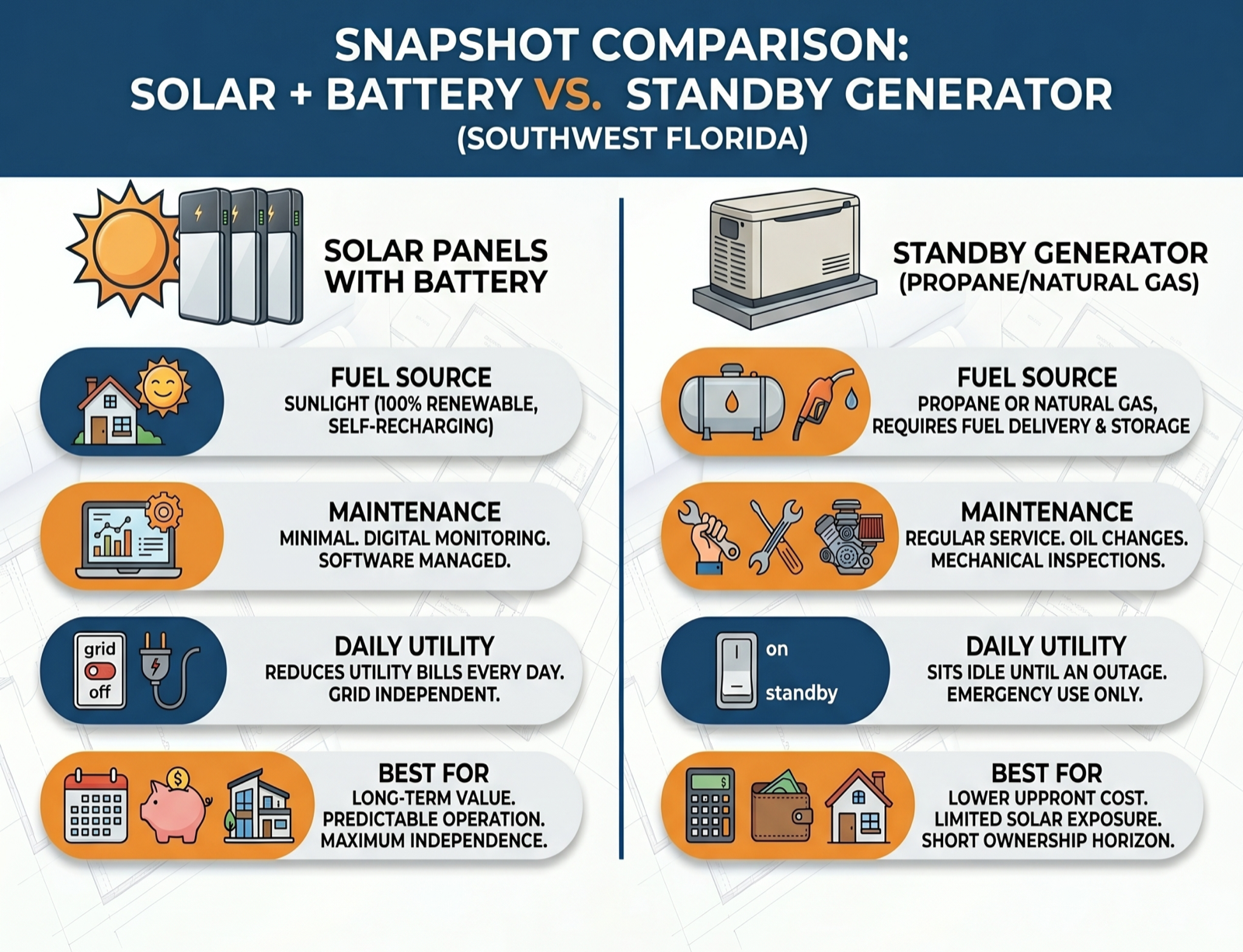
A whole home propane or natural gas standby generator is an internal combustion engine that starts automatically when the grid drops and powers your home through an automatic transfer switch. It runs on propane from an onsite tank or natural gas from the utility, and it consumes fuel any time it is operating. For a typical 200 amp Southwest Florida home, you are looking at a 22 to 26 kW air cooled generator, a service rated automatic transfer switch, a concrete pad, and either a 1,000 gallon buried propane tank or a natural gas connection. The system sits idle until the grid fails, at which point it takes over within 10 to 30 seconds and runs continuously until the grid returns or the fuel supply is interrupted.
A solar plus battery backup system uses rooftop solar panels to generate electricity during the day, stores excess energy in lithium iron phosphate batteries, and uses a hybrid inverter to deliver power to the home continuously, whether the grid is up or down. When the grid fails, the system transfers to island mode in under 50 milliseconds (imperceptible to most appliances), then runs the whole home from the battery at night and from fresh solar production during the day. In Southwest Florida sun, a properly sized system runs indefinitely during outages as long as the weather allows reasonable production. It also offsets your electric bill every single month the grid is up.
How to Use the Calculator
Move the sliders on each side to match the system you are actually pricing. The comparison table, the 15 year cost chart, and the cumulative cost table below all update as you adjust inputs. I preloaded a common sample configuration for a 200 amp service home: a 24 kilowatt whole home propane generator with a buried 1,000 gallon tank on the generator side, and a single EG4 FlexBOSS21 system with one GridBOSS load management unit, three 16 kWh batteries, and 25 panels at 460 watts on the solar side. Both are systems we commonly install. The defaults represent real market pricing for Lee, Charlotte, and Collier County installations. Adjust to match the quote in front of you.
Whole Home Generator
Solar Plus Battery Backup
Starting configuration: 1 EG4 FlexBOSS21 inverter, 1 GridBOSS load management unit, 3 batteries at 16 kWh each, and 25 solar panels at 460 watts. This is our standard recommendation for a 200 amp home.
What These Systems Actually Cost to Install in Southwest Florida
The sticker price on either system is not a simple number. A 24 kW whole home propane generator installed in Fort Myers typically lands between $15,000 and $18,000 for the generator alone, plus about $12,000 for a buried 1,000 gallon tank if you do not already have one, plus $1,500 to $2,500 in additional concrete, wiring runs, and trenching depending on your site. A buried 500 gallon tank drops that tank cost to $6,000 to $8,500. A 2,000 gallon buried tank runs closer to $18,000 to $20,000. Total out the door for a complete generator installation with a new 1,000 gallon tank usually falls between $28,000 and $32,000. Existing propane customers with an adequate tank can install just the generator for $16,000 to $18,000. Customers with natural gas service skip the tank entirely and typically spend $16,000 to $18,000 for the generator alone plus the gas line connection.
A solar plus battery system for the same 200 amp home is typically $45,000 to $55,000 installed, all in. That includes the solar array, the hybrid inverter, the battery bank, the load management equipment, all permitting and interconnection fees, panel and inverter warranties, and Florida sales tax exemption on the equipment. The price scales up with panel count, battery count, and system complexity. A very small backup-focused solar system might come in under $40,000. A larger system with extended backup capability and a full roof of panels can push past $70,000.
Full Side by Side Comparison
The table below covers roughly thirty factors that matter when choosing between a whole home generator and a solar plus battery system. It updates as you move the sliders in the calculator. Neither column is the winner on every line. Each system has clear strengths and real tradeoffs.
| Factor | Whole Home Generator | Solar Plus Battery |
|---|---|---|
| Total Upfront Cost | $28,000 installed | $50,000 installed |
| Continuous Output | 24 kW (100 amps at 240 V) | 21 kW continuous from battery, plus solar production during daylight |
| Surge Capability | Approximately 36 kW for a few seconds (1.5x continuous) | 42 kW for 30 seconds (2x continuous) |
| Motor Starting (AC compressor, well pump) | Good. Engine torque handles inrush current. | Excellent. Hybrid inverters deliver inrush current instantly. |
| Usable Energy Storage | 800 gallons usable propane (roughly 8,000 kWh electrical equivalent) | 48 kWh usable battery, recharged daily from solar |
| Daily Electricity Production | None. Generator is a backup device, not a production device. | Approximately 48 kWh per day average in SW Florida |
| Runtime Without Fuel Delivery or Sun | About 14 days on a full 1,000 gallon tank at realistic Florida outage load | Indefinite with any sunlight. About 1.5 nights on stored battery alone if zero solar input. |
| Startup Time After Outage | 10 to 30 seconds. Transfer is perceptible. | Under 50 milliseconds. Transfer is seamless to most loads. |
| Annual Maintenance Required | Yes. Oil, filters, valve checks, battery, coolant. Standard for any engine. | None. No moving parts. Rainfall handles panel cleaning in SW Florida. |
| Annual Maintenance Cost | $700 per year | $0 per year |
| Annual Fuel or Energy Cost | Approximately $150 per year (exercise plus typical outage usage) | $0. Sunlight is free. |
| Monthly Electric Bill Impact | No change. Generator is not designed to offset grid consumption. | Offsets roughly $170 to $210 per month in average SW Florida utility cost |
| Expected Lifespan | Engine 10 to 15 years. Tank 25 years or more. | Panels 25 to 30 years. Batteries 10 to 15 years. Inverter 10 to 15 years. |
| Typical Warranty | 5 year limited standard (10 year optional) | 25 year panel output, 10 to 15 year battery, 10 year inverter |
| Noise Level During Operation | 60 to 70 dBA at 23 feet (lawnmower range) | Silent. No audible operation. |
| Onsite Emissions | Yes. CO, NOx, and CO2 at the home during operation. | None. |
| Fuel or Energy Source | Propane delivered by truck | Sunlight. Free, silent, arrives daily. |
| Refueling Reliability During Hurricane | Propane trucks can be delayed after widespread storms. Priority often goes to hospitals and shelters first. | Sun usually returns within a day or two after a hurricane passes. No truck required. |
| Permitting Timeline in SW Florida | 2 to 4 weeks typical. Gas and electrical trades. | 2 to 6 weeks depending on utility interconnection queue |
| HOA Compatibility | Varies. Noise, vibration, and tank visibility can draw complaints. | Florida Statute 163.04 preempts most HOA restrictions on solar. Limited grounds for denial. |
| Hurricane Survivability | Enclosures rated to 150 mph. Tanks must be properly anchored or buried. | Panels rated to 140 to 160 mph. Inverters mounted on protected wall. |
| Property Value Impact | Varies by buyer. Some prefer having one, some view the tank as a negative. | Positive in nearly every appraisal study. Buyers pay a premium for paid off solar. |
| Space Footprint | Approximately 20 sq ft for the generator. Buried tanks require yard access for placement and setback. | Mostly rooftop. Garage wall space for the inverter and batteries. |
| Aesthetic Visibility | Generator visible as a gray enclosure. Buried tank has only a low profile dome visible. | Panels visible from certain angles. All electronics inside garage or mechanical room. |
| Smart Home and Monitoring | Basic cellular monitoring via manufacturer app | Full production, consumption, and battery state of charge monitoring with load level data and automation |
| EV Charging Capability | Only when generator is running on fuel | Solar charges EVs during the day at essentially zero marginal cost |
| Scalability After Install | Limited. The engine is sized once. | Batteries and panels can be added later within the inverter and interconnection envelope. |
| Safety Considerations | Carbon monoxide if improperly vented. Fuel handling. Hot exhaust. Standard precautions apply. | Standard electrical risks. No fuel. No combustion onsite. |
| Florida Sales Tax Exempt | No. Standard sales tax applies. | Yes. Solar equipment is exempt from Florida sales tax. |
| Florida Property Tax on Added Value | Any added assessed value is taxable. | Florida statute exempts added solar value from property tax assessment. |
15 Year Cumulative Cost Comparison
The chart below shows cumulative cost for both options over 15 years starting from day one. The generator line includes the upfront investment plus annual maintenance and fuel. The solar line starts at the upfront investment and declines each year as the bill offset recovers the investment. Where the lines cross is the break even point. Based on the sample configuration, that crossover sits just past year 7.
15 Year Cumulative Cost Table
The same data in table form, with the initial investment at the top and the 15 year total at the bottom. The generator column tracks cash out the door over time, including maintenance creep and scheduled service events in years 5, 8, 10, 12, and 15. The solar column tracks net position, which is the upfront cost minus the cumulative bill offset. Solar Advantage is the generator cumulative minus the solar net position. Negative numbers mean the generator is still ahead. Positive numbers mean solar has pulled ahead.
| Year | Generator Annual | Generator Cumulative | Solar/Battery Net Cumulative | Solar Advantage |
|---|---|---|---|---|
| Initial (Upfront) | $28,000 | $28,000 | $50,000 | -$22,000 |
| Year 1 | $850 | $28,850 | $47,900 | -$19,050 |
| Year 2 | $850 | $29,700 | $45,800 | -$16,100 |
| Year 3 | $850 | $30,550 | $43,700 | -$13,150 |
| Year 4 | $850 | $31,400 | $41,600 | -$10,200 |
| Year 5 | $1,150 (5 yr service) | $32,550 | $39,500 | -$6,950 |
| Year 6 | $850 | $33,400 | $37,400 | -$4,000 |
| Year 7 | $950 | $34,350 | $35,300 | -$950 |
| Year 8 (break even) | $1,300 (major service) | $35,650 | $33,200 | +$2,450 |
| Year 9 | $950 | $36,600 | $31,100 | +$5,500 |
| Year 10 | $1,250 (10 yr service) | $37,850 | $29,000 | +$8,850 |
| Year 11 | $1,000 | $38,850 | $26,900 | +$11,950 |
| Year 12 | $1,400 (service) | $40,250 | $24,800 | +$15,450 |
| Year 13 | $1,100 | $41,350 | $22,700 | +$18,650 |
| Year 14 | $1,100 | $42,450 | $20,600 | +$21,850 |
| Year 15 | $1,450 (service) | $43,900 | $18,500 | +$25,400 |
| 15 Year Total Cost of Ownership | $15,900 operating | $43,900 | $18,500 | +$25,400 |
Note: The 15 year projection applies 3 percent annual inflation to generator maintenance, fuel, and service events, 3.5 percent annual electric rate escalation on the solar bill offset, and 0.5 percent annual panel production degradation, all adjustable above. Service event bumps in years 5, 8, 10, 12, and 15 reflect typical scheduled intervention (battery replacement, hoses, coolant, engine service). Actual fuel cost during a named storm can be several times the assumed annual average. After year 15 the generator typically needs a major rebuild or replacement. The solar plus battery system continues producing for another 10 to 15 years with only a possible battery or inverter replacement at some point in that window.
What the Numbers Actually Tell You
The upfront cost favors the generator by roughly $22,000 in the sample configuration. That is real money. The offsetting factor is that the solar system reduces your electric bill by about $170 to $210 every month starting at commissioning, and those savings grow each year as utility rates escalate faster than panels degrade. By year four the gap is cut in half. By year seven the lines cross. By year fifteen the delta is roughly $37,000 in favor of solar under the 3 percent generator inflation, 3.5 percent electric rate escalation, and 0.5 percent panel degradation baked into the default assumptions, and the solar system continues producing for another decade with minor intervention.
If you are staying in the home for five years or less and you only care about upfront cost, the generator is the easier check to write. For ownership horizons beyond seven years, solar plus battery typically comes out ahead on a total cost of ownership basis under realistic inflation assumptions. That is the honest read of the sample numbers. Your specific situation may shift the break even point earlier or later, which is what the sliders are for.
Sizing a Generator for a 200 Amp Home in Southwest Florida
Most 200 amp SW Florida homes end up with a 22 to 26 kW air cooled standby generator. Smaller units (14 to 20 kW) require load shedding to handle dual AC systems, pool pumps, electric water heaters, and well pumps. Load shedding means the generator cannot run everything simultaneously, so the automatic transfer switch stages loads on and off as capacity allows. For homes with two AC systems, a pool, and an electric water heater, a 22 kW unit is the minimum I would specify. For homes with three zones, multiple pool systems, or an electric range plus dryer, 24 or 26 kW is more appropriate.
Liquid cooled generators in the 30 to 48 kW range exist and are sometimes specified, but they are aimed at very large homes or small estates. They cost nearly double an air cooled unit installed, and the incremental benefit over a properly sized 26 kW air cooled unit is modest for a typical 200 amp service. For the homes we see in Lee, Charlotte, and Collier Counties, a 24 kW air cooled unit is the most common sweet spot.
Sizing a Solar Plus Battery System for a 200 Amp Home
The sizing logic on the solar side is different. You are not sizing to run every load simultaneously in the way a generator has to. The hybrid inverter handles continuous output, the battery handles energy storage, and the panels handle daily replenishment. A single EG4 FlexBOSS21 delivers 21 kW of continuous output, which covers the vast majority of 200 amp homes because you are never actually drawing 48 kW continuously even when the main breaker could theoretically allow it. Arrays larger than 19 kW DC require a second inverter to stay within the solar to inverter AC ratio that the equipment expects.
Battery sizing is the critical variable. Three 16 kWh batteries (48 kWh total) is our baseline recommendation because it comfortably covers one full night of whole home usage including AC, with capacity to spare for the morning ramp before solar production picks up. Homes with very heavy loads or extended cloudy weather concerns benefit from four or more batteries. Panel sizing targets full bill offset, which in SW Florida usually means 10 to 14 kW DC for a typical 2,500 to 3,500 sq ft home. Our sample configuration of 25 panels at 460 watts produces about 11.5 kW DC, which aligns well with a home consuming roughly 14,000 to 16,000 kWh per year.
Propane vs Natural Gas for Whole Home Generators
If natural gas is available at your home, it changes the generator math significantly. Natural gas generators connect to your existing utility gas supply and eliminate the need for a propane tank entirely. They also draw fuel from what is effectively an infinite supply (the gas utility) rather than a finite tank that can run out. In parts of SW Florida where natural gas is available (mostly older neighborhoods in Fort Myers, Cape Coral, and some newer master planned communities), natural gas is almost always the better choice over propane for generator fuel. Installed cost drops because there is no tank to bury, and annual fuel cost drops because natural gas is typically cheaper per BTU than delivered propane.
The catch is that most SW Florida neighborhoods do not have natural gas service. Developments built after the late 1990s typically rely entirely on propane or electric for any combustion needs. If you are on propane, you own the tank and its fuel. If you are on natural gas, you depend on the utility being operational during an outage, which is usually a safe bet but not absolute. During Hurricane Ian, natural gas service held up in most areas even when electric was down for weeks, which is a point in favor of natural gas if you have access to it. If you are unsure whether your address has natural gas service, your utility can confirm quickly.
Propane Tank Sizing, Placement, and Buried vs Above Ground
Tank selection is where many generator quotes get thin. A 500 gallon tank gives a 24 kW generator about 6 to 8 days of runtime at realistic Florida outage load. A 1,000 gallon tank gives 12 to 16 days. A 1,500 gallon tank gives 18 to 24 days. A 2,000 gallon tank gives 26 to 32 days. Those numbers assume a mix of AC runtime, refrigeration, lighting, and pool equipment at moderate duty cycle. Run the generator harder and you burn through faster. Our standard recommendation for a 22 to 26 kW generator is a buried 1,000 gallon tank, which delivers two weeks of autonomy without needing resupply.
Buried tanks are the right answer in Southwest Florida for nearly every homeowner installing a new tank. They survive hurricanes better than above ground tanks, they look far better aesthetically (only a low dome is visible), they handle the summer heat better (below ground temperature is more stable), and they are almost always preferred by HOAs. A buried 1,000 gallon tank installed in SW Florida typically runs around $12,000 including excavation, anchoring, gas line run, and inspection. A 500 gallon buried tank is $6,000 to $8,500. A 2,000 gallon buried tank can run $18,000 or more. Above ground tanks are cheaper upfront but rarely permitted in deed restricted communities, and they carry higher hurricane risk from wind and flying debris.
Surge Capability and Starting Motor Loads
Your AC compressor does not draw its rated running amps at startup. It draws 5 to 7 times its rated running current for a fraction of a second when the compressor kicks on. A 4 ton air handler can pull 80 to 120 amps of locked rotor current at startup. A 24 kW generator can handle it, barely, if everything else is quiet. Two ACs starting within a few seconds of each other is a different problem, and that is before the well pump or pool pump fires.
A hybrid inverter like the EG4 FlexBOSS21 handles inrush slightly differently. The batteries deliver current instantly with no mechanical ramp up, which means the system can hold voltage through the compressor start with less sag than most generators. In practice either system is adequate for a typical 200 amp home, but soft starters are a worthwhile add for both. Soft starters cut inrush current by 60 to 70 percent and allow you to size either system more economically while reducing wear on compressors.
Generator Noise, Setbacks, and Enclosure Options
Generator noise is a real consideration, especially in dense neighborhoods. A 24 kW air cooled standby generator operating at rated load produces about 65 to 70 dBA at 23 feet. That is roughly equivalent to a lawnmower running continuously. Manufacturers publish quieter figures but those are often measured at lighter load or different distances. For a home with close neighbors, expect noise to be noticeable any time the unit runs, including during weekly self test cycles.
Setbacks vary by jurisdiction in Southwest Florida but generally require a minimum distance from property lines, operable windows, and combustible structures. Lee County, Charlotte County, and Collier County each have slightly different rules but most follow NFPA 37 and the Florida Building Code for gaseous fuel standby generators. Acoustic enclosure upgrades can drop noise by 5 to 10 dBA for an additional cost. Placement matters: putting the generator on the opposite side of the house from the neighbor’s bedroom makes a bigger difference than spending money on enclosure upgrades. A solar plus battery system produces zero noise under any operating condition.
Daily Solar Production You Can Expect in SW Florida
Southwest Florida averages about 5.2 to 5.6 peak sun hours per day over a full year. Summer is slightly less due to afternoon cloud cover, winter is slightly more due to lower humidity and sun angle. A properly oriented 11.5 kW DC solar array in Fort Myers produces roughly 15,000 to 17,000 kWh per year, or an average of about 41 to 47 kWh per day. That covers the average SW Florida home’s annual consumption of 12,000 to 16,000 kWh with room to spare for battery charging and minor grid export.
Daily production varies significantly. A bright December day produces more than a stormy August afternoon. Battery sizing is what smooths this out. The combination of 48 kWh of usable battery plus 11.5 kW DC of panels means the system can sustain a full day of home operation on less than ideal weather, then recharge on the next sunny day. The only failure mode is multiple consecutive full cloudy days with no meaningful production, which is rare in SW Florida outside of active tropical weather.
Battery Backup Duration: The Honest Math
A common question during sales conversations is “how long will the batteries last in an outage.” The honest answer depends on how much the sun is cooperating. With full sun and a 48 kWh battery bank, the system effectively runs indefinitely because production during the day exceeds consumption, refilling the battery for the next night. With partial sun (typical post-hurricane conditions), the system can still run most loads but may need to shed non-critical circuits during extended cloudy stretches. With zero sun (dense overcast for multiple consecutive days), 48 kWh of battery runs a typical SW Florida home for approximately 1.5 days before depletion.
That is why battery sizing is the key variable for outage resilience. Adding a fourth battery extends zero-sun runtime to roughly 2 days. Six batteries push it to 3 days. Eight batteries is around 4 days of zero-sun runtime. The cost per added battery is $7,250 installed, which is why most homeowners settle at three or four batteries rather than over-sizing for rare worst case scenarios.
Maintenance Requirements and Real Costs
A standby generator is a combustion engine, and engines need maintenance. Annual service in SW Florida through a factory authorized provider runs $500 to $900 and covers oil, filter, spark plug, valve adjustment, coolant check, and battery test. Homeowners who service their own unit can do it for $200 to $350 in parts, assuming comfort with small engine work. Expect the starting battery to fail every 3 to 4 years at roughly $150 each replacement. Coolant flush and hose replacement on cooled units is typically a year 8 to 10 event. The fuel solenoid is a common intermittent failure point on older propane units. None of this is unreasonable for a piece of equipment that sits outdoors in Florida heat and humidity for a decade, but it is not zero.
A solar plus battery system has essentially no scheduled maintenance. Panels self clean in Florida rain. Hybrid inverters run sealed with no user serviceable parts. Batteries have an internal BMS that monitors every cell. Monitoring software flags any anomaly before it becomes a problem. Over 16 years of installing these systems in Southwest Florida, I have never scheduled a customer for annual solar system maintenance. Panel microcracks or inverter faults do occur rarely, but they are warranty events, not maintenance events.
Reliability and the Failure Modes Nobody Talks About
The generator failure scenario that worries me most is the silent exercise failure. Most standby generators run a weekly self test cycle to verify they will start. The homeowner assumes all is well because they hear the generator fire up every Wednesday. What actually fails is the transfer switch, the starting battery under real load conditions, the fuel solenoid under extended runtime, or the voltage regulation during motor starting. None of these show up in a 10 minute self test. The first time you find out is during an actual outage. I have been called to troubleshoot multiple generators that passed their weekly self test for months but failed to carry the home when it mattered.
Solar plus battery systems have different failure modes. Cell failures in batteries are rare but do happen (warranty events). Inverter failures typically present as monitoring alerts before anything goes dark. Panel microcracks are detected through production decline on the monitoring dashboard. The failure modes are digital and visible, not hidden in a system that only runs under load. I would rather have a clear monitoring alert than find out during an emergency that a component is not working.
Fuel Delivery Logistics During Extended Outages
This is worth planning for on the propane side. After Hurricane Ian, propane deliveries in parts of Lee County were delayed 4 to 10 days. Priority went to shelters, hospitals, and fuel depots first. Residential customers with a 250 gallon tank running a 22 kW generator at moderate load went about 3 days before needing fuel. Customers with 500 gallon tanks went 6 to 7 days. Customers with 1,000 gallon buried tanks mostly made it through Ian recovery without a delivery. Customers with 2,000 gallon tanks had zero refueling concerns.
The answer is not to avoid propane. The answer is to size the tank correctly and establish a priority fuel contract with your supplier before hurricane season. Most SW Florida propane suppliers offer automatic refill programs with priority status for standby generator customers. Sign up for one. Ask specifically about hurricane priority protocols. Natural gas customers have a different scenario: during Ian, underground gas service held up well across most of SW Florida. On the solar side, the fuel question does not exist because sunlight returns on its own within a day or two after a hurricane passes, and the batteries recharge from whatever production is available.
Hurricane Survivability: Wind Ratings and Water Intrusion
Whole home generator enclosures are rated to 150 mph sustained wind. Propane tanks (when properly anchored or buried) survive Category 3 or higher conditions reliably. Natural gas lines have underground protection. The automatic transfer switch and wiring are typically mounted against the home and protected from direct wind exposure. Overall, modern standby generator installations hold up well through hurricane conditions. The one risk worth noting is flooding. A generator on a pad at grade level can be compromised if water rises above the intake or electrical connection point. Elevation during installation is worth the extra cost in flood zones.
Solar systems face similar wind considerations. Modern rooftop panel attachments engineered to the Florida Building Code handle 140 to 160 mph wind uplift, which covers the design wind speeds across Lee, Charlotte, and Collier Counties. Hybrid inverters and battery cabinets are typically mounted in protected locations (garage wall, interior mechanical room) and are not directly exposed to wind or rain. In our experience through Ian, solar arrays installed to current code held up exceptionally well. Older installations using inferior racking hardware showed failures. Current code compliant systems did not.
Humidity, Salt Air, and the Florida Environment
Southwest Florida is rough on mechanical equipment. High humidity accelerates corrosion on any exposed metal. Salt air within 3 to 5 miles of the coast is harsher still. Standby generators use coated steel enclosures and galvanized hardware, but over a 10 to 15 year service life, corrosion on control panels, internal wiring connections, and fuel system components is a real consideration. Coastal installations may need to replace control boards or connectors during the generator’s lifetime as corrosion impacts reliability.
Solar equipment handles Florida’s environment well because the components are mostly solid state. Panels are sealed glass laminates with aluminum frames designed for coastal exposure. Racking uses marine grade stainless fasteners. Inverters and batteries are typically mounted indoors, eliminating environmental exposure almost entirely. The one weak point is rooftop connection boxes and conduit, which should use marine grade components in coastal installations. Done correctly, a solar system will outlast a generator in the same coastal environment by a significant margin.
Permitting and Inspection Timelines in Lee, Charlotte, and Collier Counties
Permitting moves at different speeds for each system. A generator permit in Lee County typically takes 2 to 4 weeks including inspection, assuming both gas and electrical trades are submitted correctly. Charlotte County and Collier County run similar timelines. The work itself is usually 1 to 2 days of installation. Total time from signed contract to operational generator is typically 6 to 10 weeks including equipment lead time.
Solar permitting is slightly longer due to the utility interconnection step. Building permit review runs 2 to 4 weeks. Utility interconnection approval through FPL or LCEC typically adds another 2 to 4 weeks, sometimes longer during high volume periods. Installation itself is 2 to 4 days on site. Permission to operate (PTO) from the utility is the final step. Total timeline from signed contract to operational solar plus battery system is typically 8 to 14 weeks. Not dramatically different from a generator, but longer due to the utility interconnection step that generators do not require.
HOA Rules and Florida Statute 163.04
Homeowners associations can restrict generator installations in ways they cannot restrict solar. Florida Statute 163.04 explicitly preempts HOA rules that effectively prohibit solar installations on owner occupied homes. HOAs can require reasonable aesthetic accommodations (panel placement, equipment screening) but cannot deny a solar system that meets code. That protection does not extend to generators. Many deed restricted communities in Lee, Charlotte, and Collier Counties have specific rules about generator noise, setback, enclosure, and tank screening. Some communities prohibit above ground tanks entirely. Some restrict generator size or require specific enclosure designs.
Before buying a generator, pull your HOA covenants and conditions document and read the sections on auxiliary equipment, fuel tanks, and noise. I have seen customers pay for permits and equipment only to be forced to modify or relocate installations at their own cost because they skipped this step. Solar customers are protected by state law. Generator customers are not.
Insurance Implications
Both systems can affect homeowners insurance, usually modestly. Some insurers offer a small discount for homes with standby generators because loss of power is a trigger for many claims (food spoilage, sump pump failure in flood events). Ask your agent specifically. Solar systems are typically included in dwelling coverage at no additional premium, though you should notify your insurer about the system value and confirm coverage limits are adequate. Solar systems in Florida that are fully owned (not leased) are generally covered under standard homeowners policies. Battery systems are also typically covered, though some insurers require disclosure and certification documents.
One insurance factor worth noting: a solar lease or PPA complicates coverage significantly because the equipment belongs to a third party. If you are considering solar, own the system outright, either cash or loan. Leased solar creates insurance, resale, and refinancing complications that outweigh any perceived monthly savings.
Resale Value and Appraisal Reality
Appraisal data consistently shows solar systems add value to a home at resale, though the exact premium varies. Studies from the Department of Energy and the Appraisal Institute generally find $3 to $4 of added value per watt of installed solar, or roughly $30,000 to $45,000 of appraisal value on an 11.5 kW system. Buyers in Florida increasingly expect solar on newer homes, and paid off solar is a documented selling feature in nearly every market study.
Generator resale value is more variable. Some buyers actively seek homes with whole home generators. Others view the propane tank as a negative (storage of combustible material, yard aesthetic, future fuel costs). Appraisers typically add $3,000 to $8,000 for an installed whole home generator, which is well below the replacement cost. The generator is a feature but not a strongly value adding feature in most SW Florida markets. Solar is both a feature and a documented value adder in nearly every comparable sales analysis.
Financing Both Options
Cash purchase is the simplest path for either system. Most of our SW Florida customers pay cash. Financing is available for both, and terms vary. Generator financing is typically done through manufacturer partnerships or home improvement loans with rates in the 7 to 12 percent range depending on credit. Solar loans are often better priced (6 to 9 percent typical) because the equipment carries dedicated lender relationships and the monthly electric bill savings can substantially offset the loan payment.
Whatever path you choose, avoid solar PPAs and solar leases unless you have a very specific reason. They strip away most of the financial benefit, complicate home resale, and create ongoing contract obligations that outlive your interest in the home. Owning the system outright, either cash or loan, is the only configuration that captures the full 15 year value curve shown in the calculator.
EV Charging, Smart Home, and Daily Utility
A generator runs only during outages. A solar plus battery system runs every day. That difference shows up in everyday utility that has nothing to do with backup power. Solar charges your EV during the day at essentially zero marginal cost. It powers your pool pump through the afternoon peak. It sends excess production back to the grid at mid-day and pulls it back at night under time of use structures. Modern hybrid inverters offer smart home integration, automated demand response, time-of-use arbitrage, and full production and consumption monitoring through mobile apps.
Generators offer basic cellular monitoring through the manufacturer app, which tells you operational status and runtime. They do not integrate meaningfully with smart home ecosystems because they are, fundamentally, backup appliances. The daily utility gap between the two systems is enormous and underrated in most sales conversations.
Warranty Realities for Both Sides
Generator warranties are typically 5 years standard with optional 10 year extensions. The standard warranty covers parts but often requires factory authorized labor at your expense for service calls. Extended warranties are usually worth purchasing for air cooled units, especially given the salt and humidity environment of SW Florida. Read the fine print on exclusions. Some warranties are voided by improper maintenance logs or unauthorized repairs.
Solar warranties run longer because the equipment has fewer failure modes. Panels carry 25 year power output warranties from reputable manufacturers, typically guaranteeing at least 85 percent of rated output at year 25. Battery warranties are typically 10 to 15 years depending on brand. Hybrid inverter warranties are typically 10 years standard with extensions available. These are warranties on equipment that has no moving parts and no maintenance requirements, which makes them far more predictable than engine warranties that depend on service history.
Environmental Considerations
A whole home generator produces onsite emissions whenever it operates: carbon monoxide, nitrogen oxides, and carbon dioxide. Propane and natural gas are cleaner burning than diesel or gasoline but still combustion processes. Over a typical 15 year service life with modest outage duty, emissions are modest but nonzero. For homeowners who care about this factor, it matters. For those who do not, it is simply context.
Solar plus battery systems have zero onsite emissions and produce electricity from sunlight. Over a 15 year service life, a typical residential solar system in SW Florida offsets roughly 180,000 to 240,000 pounds of CO2 equivalent compared to grid electricity from the Florida generation mix. Whether that matters to you is a personal value judgment. It is a factual difference between the two systems.
When a Whole Home Generator Is the Right Answer
A whole home generator is the better choice in several well defined scenarios. If your roof has poor solar exposure due to heavy tree canopy, north facing orientation, or deep lot shadow from neighboring structures, solar production is too limited to justify the investment. If your ownership horizon is short (under five years), the upfront price advantage of the generator is meaningful and the solar payback period will not fully materialize before you sell. If your monthly electric bill is under $75, the solar payback stretches beyond any reasonable investment horizon. If you already have a large propane tank for pool heat, cooking, or an existing standby need, the incremental cost of adding a generator to the existing fuel infrastructure is small.
If your primary goal is multi week outage coverage with unlimited runtime and you are willing to manage fuel delivery logistics, a large tank and properly sized generator deliver that capability better than any reasonably sized battery bank. And if you have natural gas service at your home, a natural gas generator effectively eliminates the fuel delivery concern entirely and becomes a very compelling value proposition at a lower total installed cost.
When Solar Plus Battery Is the Right Answer
Solar plus battery is the better choice for the majority of grid connected SW Florida homes. If you have reasonable solar exposure (not necessarily perfect), if you plan to stay in the home for seven years or more, if your electric bill is meaningful (typically $150 per month or higher), and if you want the backup system to provide daily value rather than sitting idle 99 percent of the year, solar plus battery comes out ahead on total cost of ownership while delivering every day benefits the generator cannot match.
For homes with heavy daily consumption (EVs, pools, multiple AC systems), the case gets even stronger because the daily bill offset scales with consumption. For homes with existing time of use rate structures (increasingly common with LCEC), solar plus battery can arbitrage energy costs in ways a generator cannot. For customers who value seamless outage response (sub 50 millisecond transfer, no perceptible transition), solar plus battery is the only option that delivers that.
A Note on Hybrid Setups
A small number of customers end up with both a generator and a solar plus battery system. This usually happens in one of two scenarios. Either the customer already has an existing generator they want to keep, or they already own a portable generator they are willing to deploy as a redundant emergency backup during extreme multi day weather events. In either of those cases, pairing solar plus battery with an existing generator produces a genuinely belt-and-suspenders backup strategy with minimal incremental cost, because you are not paying for a new generator install on top of the solar system. For off-grid homes, a generator is effectively standard equipment regardless of solar sizing because no solar plus battery system can be economically sized to handle every possible weather scenario when grid fallback is not available. On a grid connected home, a hybrid setup is a reasonable consideration when the generator already exists, but buying both from scratch is rarely the right answer from a cost standpoint. Most grid connected homeowners get the resilience they need from one system sized correctly.
Common Misconceptions We Hear Every Week
“Solar cannot run during an outage.” This is wrong. Grid tied solar without batteries cannot run during an outage because of anti-islanding code requirements. Solar with a hybrid inverter and battery bank absolutely runs during outages, because the system operates in island mode with the battery as the grid reference. Every system we install runs during outages automatically.
“Generators are cheaper.” Only in the first year. Over a 15 year horizon, the math shifts significantly as the generator accumulates maintenance, fuel, and service costs while the solar system offsets utility bills. Both systems have real total costs of ownership, and the generator is not the cheaper option on a 10 or 15 year view for most homes.
“Batteries do not last long enough in an outage.” It depends on sizing. 48 kWh of battery with active solar production runs indefinitely during SW Florida outages. 48 kWh of battery with zero sun lasts about 1.5 days. The answer is not “batteries are inadequate,” it is “size the battery bank to your outage expectations.” Larger battery banks handle longer zero-sun scenarios.
“Solar is too expensive.” It is expensive, but it is also an asset that pays itself back and continues producing value beyond payback. A generator is pure cost with no offsetting revenue stream. Comparing sticker prices without considering the ongoing value is the most common error in this decision.
“Generators are simple. Solar is complicated.” A generator is an engine with fuel, electrical, and transfer switch systems that require regular service. A solar plus battery system has no moving parts and is managed by software. Which one is simpler depends on how you define simple. If simple means mechanical familiarity, the generator feels simpler. If simple means low maintenance and predictable operation, solar plus battery is substantially simpler.
The Bottom Line
For a typical grid connected 200 amp home in Southwest Florida with reasonable solar exposure and a medium to long ownership horizon, solar plus battery is usually the stronger total cost of ownership answer over a 15 year window, and it delivers daily utility a generator cannot match. A whole home propane or natural gas generator wins on upfront cost and on multi week outage runtime if you are willing to manage fuel logistics, and it is the right answer for homes with poor solar exposure, short ownership horizons, or existing fuel infrastructure.
The right choice depends on your roof, your site, your utility, your outage expectations, and your ownership horizon. The calculator above gives you the math for your specific situation. The tables and commentary give you the context to interpret that math. What it does not give you is a real site assessment, which is where our designers come in.
If you want to dig into the battery side of this decision in more detail, our post on battery only backup systems walks through how to size the battery without committing to full solar. If you want to understand why modern systems back up the whole home rather than just a critical load panel, our post on whole home backup versus critical load panels covers that transition. For manufacturer specifications, the EG4 FlexBOSS21 spec sheet has the technical data on the inverter referenced throughout this guide.
Contact Florida Solar Design Group if you want a real design and a real quote for your home in Lee, Charlotte, or Collier County. We will walk through your specific site, your utility, your outage concerns, and your budget, and we will give you a straight recommendation on which system is the right fit.