

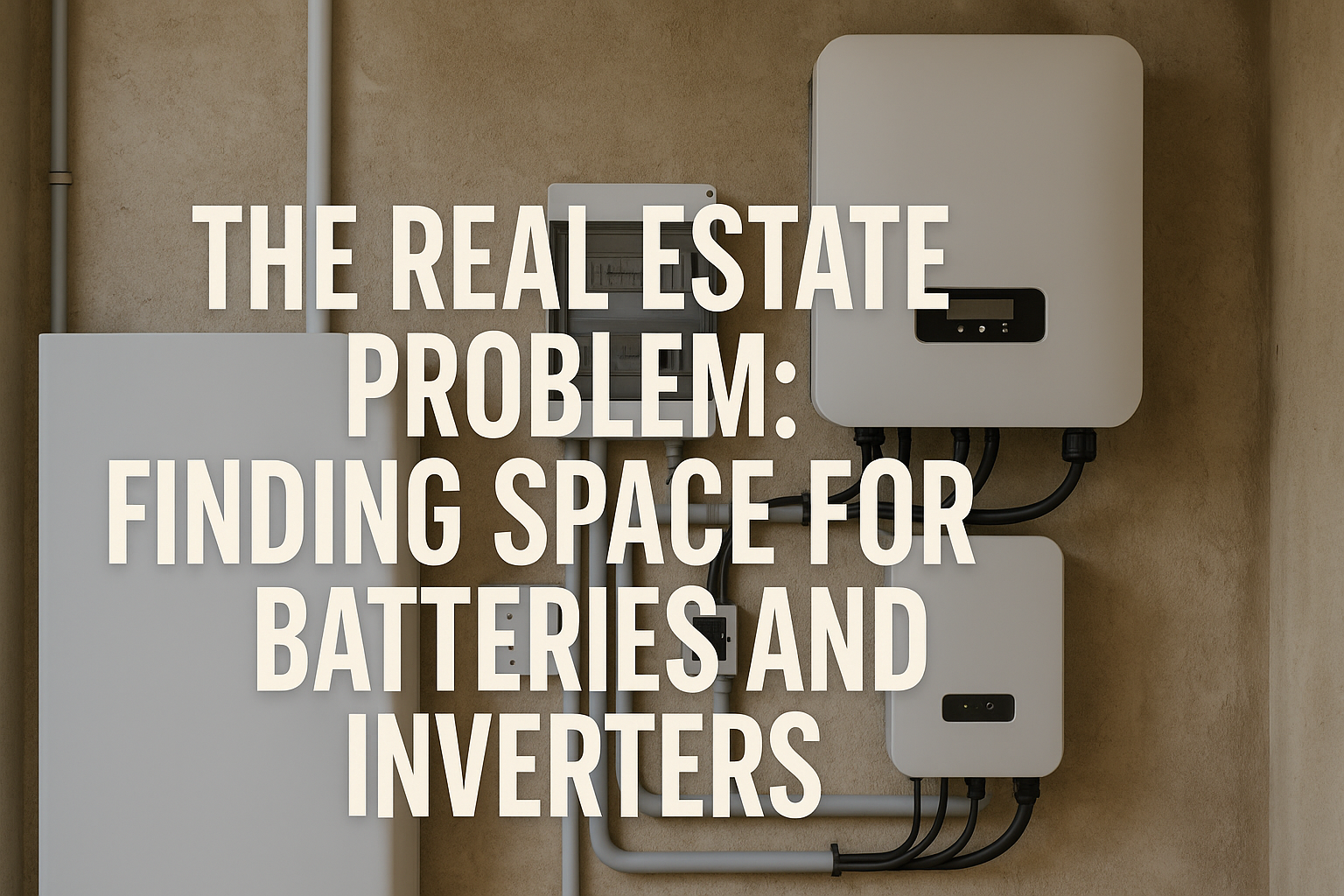
The Real Estate Problem: Finding Space for Batteries and Inverters
Ask any reputable solar installer what keeps them awake at night and you will hear about supply chains and permitting. The quiet killer is wall and floor space. Not acreage for panels. Actual real estate for batteries, inverters, disconnects, meters, and wireways. Even on new construction, solar is often an afterthought. By the time we arrive, every square inch is spoken for by drywall, cabinets, and the golf cart charger.
What Has To Fit In The First Place
- Battery system – Wall mounted or floor mounted. Needs ventilation clearance and service access. Many models prefer a clean, flat wall and a clear zone in front so a tech can actually work on it.
- Inverter or hybrid inverter – Usually near the main service to keep conduit runs short and tidy. It has air intake and exhaust on the sides that cannot be blocked.
- Cabling – depending on the system. proximity of key components is critical to reduce large cables that need to go long distances. This is both a cost and aesthetic issue.
- Backup or transfer equipment – Gateways, backup switches, or critical load panels. These are not optional if you want backup to run correctly and safely.
- AC and DC disconnects – Utility wants their shutoff points. We want ours where the tech can reach them. Everyone wants labels facing outward like a civilized human.
- Metering and comms – Production meters, CTs, Wi-Fi or Ethernet, sometimes cellular. All of it needs space and sane routing.
- Conduit and wire management – The difference between clean and clown show is usually 18 inches of wall space that we don’t get.
Why This Gets Messy On New Builds
Architects and builders plan rooms. Solar needs zones. If the equipment area is not reserved on the drawings, every trade will slowly invade it. The result is a perfect alcove for a broom and zero room for a battery. Then we get the call to make it invisible, silent, weatherproof, and code compliant next to a door swing and a hose reel. Sure. No problem.
The Simple Fix: Declare An Equipment Zone On Day One
If you are building or remodeling, set aside a dedicated, solar friendly rectangle and put it on the plans. Here is a spec that works on most homes and keeps everyone happy.
- Location: Same wall as the main service equipment or immediately adjacent. Garage or utility room is ideal. Outdoors is fine if it is a dry, shaded wall that is not a splash zone.
- Footprint: Reserve a clear wall section about 8 feet wide by 7 feet tall with a hard surface below. Bigger homes should give 15 feet by 7 feet. You will never regret extra space.
- Working clearance: Keep 3 feet of empty floor area in front of the equipment so a tech can service it without becoming a contortionist. It’s code required anyway.
- Penetrations: Stub conduit pathways from the attic or roof array area to the zone. Add a spare EMT or smurf tube to the main service. Put a pull string in each. Make sure the right type of conduit is used.
- Power and data: Provide a dedicated 120 V receptacle in the zone and a hardwired Ethernet drop if possible. Wi-Fi is fine until it is not.
- Protection: If the zone is in a garage near vehicle paths, install a bollard. Batteries do not enjoy meeting bumpers.
- Environmental: Avoid south facing exterior walls with full sun. Shade, overhangs, and light colored surfaces help equipment run cooler and last longer.
Good Layouts That Save Everyone Time
- Battery below, inverter above: Battery at a comfortable height or on its floor stand. Inverter directly above with short, clean conduit runs. Disconnects to the side at eye level.
- Side by side: Battery and inverter on the same horizontal line with 4 to 6 inches between for wiring and airflow. Gateways and meters stacked to the right near the service.
- Split interior and exterior: In tight garages, mount the inverter and disconnects outside on the other side of the wall. Keep the battery inside out of the heat. Short penetrations, clean look.
Common Space Killers We See Every Week
- The door swing trap: A door opens into the only clear wall and wipes out 4 feet of prime real estate. Move the door or rehang it to swing the other way.
- Low outlets and hose bibs everywhere: Random stuff peppered across the wall turns equipment placement into Tetris. Consolidate utility penetrations to the corners.
- Unplanned EV charging: The EVSE ends up on the same exact wall we needed. It is avoidable if we coordinate early.
- Nice cabinetry in a mechanical space: Cabinets look great until someone needs to service a breaker or a battery BMS. Keep cabinetry out of the zone.
- Fire code offsets: Certain distances from windows and doors are required for energy storage systems.
Retrofit Reality Check
On existing homes, we can usually make it work. It may involve longer conduit runs, exterior surface raceways, or patching drywall that should have been planned around. We are good at solving problems. Space is still physics. Give us a clean rectangle and we deliver a clean install. Give us a washer, a water heater, and a freezer all on the same wall, and you will get creative solutions with a side of compromise.
Builder and Architect Checklist
- Place a dedicated solar equipment zone on the drawings with dimensions and keep it clear throughout construction.
- Group service equipment, backup switch, meter, and inverter on one wall to shorten runs and simplify labeling.
- Provide spare conduit paths with pull strings. Future you will send you a thank you card.
- Confirm internet connectivity in the zone. Hard line preferred. Wi-Fi as backup.
- Protect the zone from vehicle traffic, direct sun, sprinklers, and storage creep.
- Consider heat alarms in garage spaces – they are code required for energy storage, and they need to be interconnected to the smoke alarm system.
Homeowner Guidance When Space Is Tight
- Pick the right hardware: Some batteries stack. Some hang. Some integrate the inverter. We can select a package that fits your actual wall, not an imaginary one.
- Think in modules: It is better to install one battery well with room for the second than to cram two into a bad location.
- Prioritize serviceability: You want a system that can be maintained without disassembling the garage. Clean access beats clever hiding every time.
Bottom Line
Panels love roofs. Batteries and inverters love a clean rectangle of wall and a clear floor in front. If you are building a house, reserve the space now. If you are retrofitting, we will find the best spot and make it look intentional. Space is the difference between a system that looks engineered and a system that looks like it happened to you.
Want It Done Right
We design for performance and for service. If you want a neat, code-compliant system that does not take over your garage, call us before you frame the walls. If the walls are already up, call us anyway. We will show you where the space is hiding.


