

Hoymiles just released the HiFlow Pro, the first plug-in solar microinverter in the United States certified to UL 3700. That is a real milestone, and I am glad it happened. What worries me is what happens next, which is a wave of people with battery backup systems and off-grid cabins deciding this is a cheap way to bolt on a few hundred extra watts of solar.
It is not. UL 3700 does not contemplate that use case anywhere. Not in the scope, not in the testing, not in the listing. And the potential failure modes are considerably worse than most people expect.
What UL 3700 Actually Covers
UL 3700 is the Outline of Investigation for Interactive Plug-In Photovoltaic Equipment and Systems. It was published in December 2025, and UL Solutions launched the certification program in January 2026. It is the first North American framework written specifically for balcony solar instead of borrowed from rooftop standards.
It does genuinely useful things. It requires the plug prongs to de-energize in under a second after disconnection, so you cannot get shocked by a live male plug in full sun. It requires anti-islanding. It requires ground fault protection independent of the receptacle GFCI. And it evaluates the whole assembly as one system: panel, microinverter, cord, plug, and receptacle configuration together.
The Hoymiles unit itself is a serious piece of hardware. Models from 360 watts, up to four operating in parallel for 1,200 watts total, NEMA Type 6 enclosure, output voltage collapsing below 34 volts within one second of disconnection.
Then you read the scope. Two clauses matter more than anything in the press release.
Clause 1.6 excludes roof mounted PV, building integrated PV, and any PV equipment permanently connected to premises wiring. Clause 1.8 limits the scope to plug-in PV connected to a circuit where every component in that circuit, including receptacles, overcurrent devices, and ground fault interrupters, is listed and identified for bidirectional current flow.
Read that second one twice. Almost no receptacle in your house is listed for bidirectional current flow. Almost no breaker in your panel is either. The standard is describing a circuit that does not exist in the average Florida home.
The Word “Interactive” Is Doing a Lot of Work
In UL and IEEE language, interactive means grid-interactive. The device is built to operate in parallel with an electric power system that somebody else is regulating. It follows voltage and frequency. It does not create them. Anti-islanding testing is performed against a utility source with utility characteristics behind it.
Nowhere in UL 3700 is there a scenario where the grid this thing connects to is a battery inverter hanging on your garage wall. There is no test for it. There is no listing for it. Nothing in the standard prohibits you from doing it, and nothing in the standard tells you what happens when you do.
So let me tell you what happens.
What Happens When Your Backup System Islands
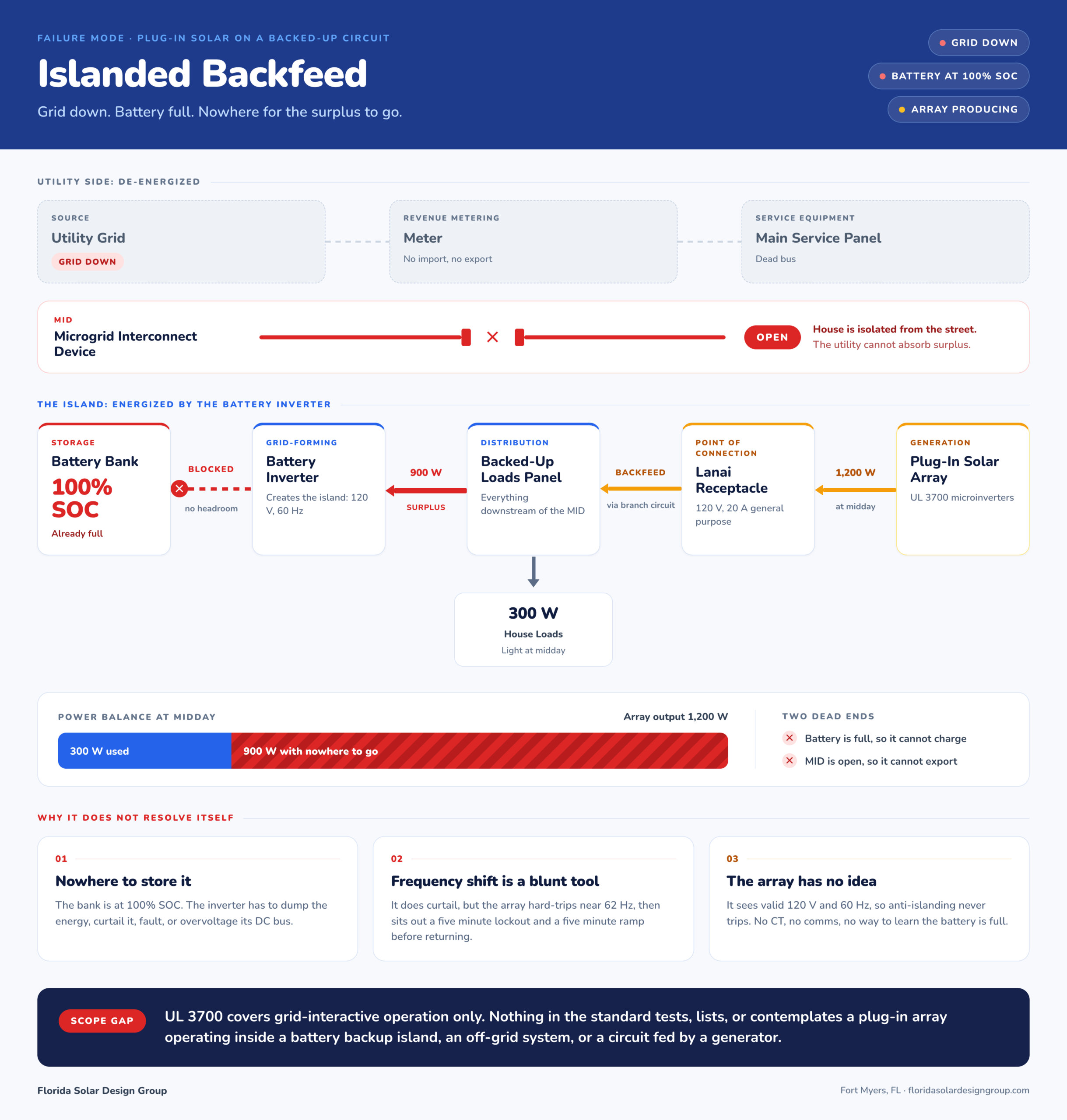
You have a battery and inverter system. Powerwall 3, Enphase, EG4 FlexBOSS, Sol-Ark, FranklinWH, take your pick. The grid drops. The microgrid interconnect device opens, isolating your house from the street, and the battery inverter starts forming its own 60 Hz waveform to run the backed up loads panel.
Your plug-in array is sitting on the lanai, plugged into a receptacle fed by that backed up panel. It sees 120 volts, 60 Hz, everything nominal. It has no idea anything changed. It starts producing.
You now have an uncontrolled generator operating inside your island, and not one component in the system knows it is there.
If house loads happen to exceed what the array is making, nothing bad happens. But at two in the afternoon in March, with the battery already full and the house running light, that power has nowhere to go. It flows backward toward the battery inverter, which is suddenly being asked to absorb energy it did not request from a source nobody told it about.
Some inverters handle it. Some fault out. Some push the frequency up trying to shut down whatever is doing this. What none of them do is handle it gracefully, because none of them were commissioned expecting it. Best case, you get a nuisance shutdown of your backup system during a hurricane outage, which is the single worst moment for that to happen. Worst case, the DC bus overvoltages and you are shopping for a new inverter.
Your Battery Inverter Has Exactly One Way to Say Stop
When the battery fills up, the inverter needs to tell the solar to back off. It has one tool for that. It nudges the AC frequency up a little above the normal 60 Hz, and a properly behaved solar inverter reads that as a signal to make less power.
Modern equipment does listen. That part works fine. What it does not do is stop gracefully. The array eases off partway, hits its limit, and then shuts down hard. And once it shuts down, it will not come back for five minutes, and then it takes another five minutes to ramp back up to full output. Ten minutes of nothing, triggered by a nudge.
Off-grid, that turns into a loop. The array cuts out, the battery starts draining, the frequency settles back to normal, the array waits out its timer, comes back, refills the battery, and cuts out again. Your system spends a sunny afternoon cycling on and off instead of producing.
Here is the part that matters. The frequency setting that makes any of this behave depends entirely on what is sitting on the other end. Sol-Ark publishes different numbers for different generations of solar inverter, because the right answer changes with the equipment. That is a setting an installer dials in on purpose, with both pieces of gear in front of him and the manuals open. A plug-in kit gets set up by a homeowner through a phone app in under a minute, and nothing in that process asks what is forming the grid it is about to join.
More importantly, some inverters do not have the capability to frequency shift. And that is a serious problem.
Off-Grid Is Where This Gets Genuinely Dangerous
We do a lot of off-grid work on the islands. Cayo Costa, Keewaydin, North Captiva. Places where every watt of equipment costs real money just to get it there, and where a four hundred dollar plug-in kit looks like the bargain of the decade.
Here is why it is not.
An off-grid home has no utility. The inverter is the grid. It is grid-forming by definition. Plug a UL 3700 kit into a receptacle in that house and the kit will cheerfully begin producing, because it sees a perfectly valid 120 volt, 60 Hz source (or 240V source, as the case may be) and has no way to know the difference.
Off-grid battery banks spend a great deal of time full. That is the design goal. On a clear February day on Cayo Costa, the battery hits 100% by mid-morning, and the charge controllers taper back to almost nothing. That is the system working correctly. Now inject over a kilowatt of AC into the inverter output from a device that does not know the bank is full and has no communication path to ever find out.
Many off-grid inverters cannot accept backfeed on their AC output at all. They were never designed to. Some will fault. Some will push that current into the battery through the charger and overcharge a bank that was already sitting at float voltage. Some will simply be damaged. And unlike a grid-tied house, there is no utility standing by to absorb the surplus and no service truck ten minutes away.
The part people miss entirely: in an off-grid system, charge control is the battery’s safety system. Bypassing it with an uncontrolled AC source is not adding solar. It is removing protection.
If you are off-grid and you want more production, the answer is more DC-coupled PV into your existing charge controllers, or a properly configured AC-coupled string or microinverter with curtailment settings actually commissioned by somebody who understands both boxes. Those are real answers. A balcony kit is not one.
Never Plug One Into a Generator Circuit
Related failure worth its own warning. Plenty of Florida homes have a generator inlet and a transfer switch. During an outage, the generator becomes the source, and to a grid-following inverter it looks close enough to a grid.
Generators cannot absorb power. There is nowhere for it to go. Backfeed a portable generator, and you can drive the engine toward overspeed, damage the alternator, or send the governor into an unstable hunt. An inverter generator will usually just fault. An older open frame unit can be wrecked outright.
Anti-islanding does not save you, because the generator is producing a valid waveform. The microinverter is doing precisely what it was designed to do. Nobody ever told it the utility on the other end was a portable Honda.
Four Outlets Is Not Four Circuits
Now the wiring problem, which applies to everybody, battery or no battery.
The HiFlow Pro supports up to four microinverters in parallel, each plugged into a separate outlet, for 1,200 watts total. The phrase “separate outlets” is carrying an enormous amount of weight in that sentence. In a typical Florida house, four outlets along a lanai or a bedroom wall are very often the same 15-amp branch circuit.
Somebody reads “separate outlets,” spreads four units across four receptacles in the same room, and sincerely believes they followed the instructions. They have just put 1,200 watts of injection onto a single run of 14 gauge wire.
I covered the mechanism in detail in my post on the wiring danger plug-in solar marketing will not tell you about. Short version: the breaker sees only net current at the panel, so when solar is injected downstream of the breaker and the load sits downstream of the injection point, the conductor between them carries current the breaker never sees. The breaker does not trip. The wire heats anyway.
Everything else people do compounds it. Running a kit through an extension cord or a power strip. Adapting the dedicated plug configuration down to an ordinary receptacle because the adapter cost eight dollars. Stacking a kit onto a circuit already feeding a window unit or a garage freezer. None of that is a UL 3700 failure. All of it lives outside what UL 3700 assumed about the circuit.
The Florida Reality Check
Florida still has no plug-in solar statute. Ten states now do. Florida is not among them, and the 2026 session did not change that.
Which means FPL’s ordinary interconnection rules still apply, and those rules were written around permitted systems with a signed interconnection agreement in place before anything is energized. There is no small system carve-out and no notification-only pathway. I walked through the legal landscape for plug-in solar in Florida earlier this year, and nothing has moved since.
Then add the parts specific to living here. Anything hung on a balcony railing or a lanai cage is a wind load, in a market with real product approval expectations. Your insurance carrier will have opinions about unpermitted electrical equipment attached to your house. And condo and HOA balcony restrictions are a separate question from the Florida Solar Rights Act protections that people assume cover everything.
Worth saying plainly, because people conflate solar and backup constantly: a plug-in array is not backup power. It cannot run your house in an outage on its own, and adding it to a system that can run your house in an outage is the specific thing this post is warning you against.
The Bottom Line
UL 3700 is good work, and the Hoymiles HiFlow Pro is a legitimate product. What it is certified to do is push a modest amount of power into a utility-connected branch circuit, in a state that has authorized it, on a circuit whose components are rated for current flowing in both directions.
What it is not certified to do, tested to do, or designed to do is operate inside a battery backup island, inside an off-grid system, or on a circuit fed by a generator. The standard does not contemplate any of it. The listing does not cover any of it. And the failure modes run from a backup system that shuts itself down in the middle of a hurricane outage to a destroyed off-grid inverter on an island with no boat until Thursday.
If you have battery backup and you want more production, the right move is expanding your existing array or properly AC coupling a source your inverter has actually been commissioned to control. If you are off-grid, adding DC-coupled panels to your inverters or properly connected and configured AC-coupled panels can work well. Both of those give you more solar. Neither one gambles your backup system to get it.
If you want to know what your specific equipment can safely accept, contact us. We will give you the straight answer, including the times when the answer is that your system cannot take another watt without a design change.


