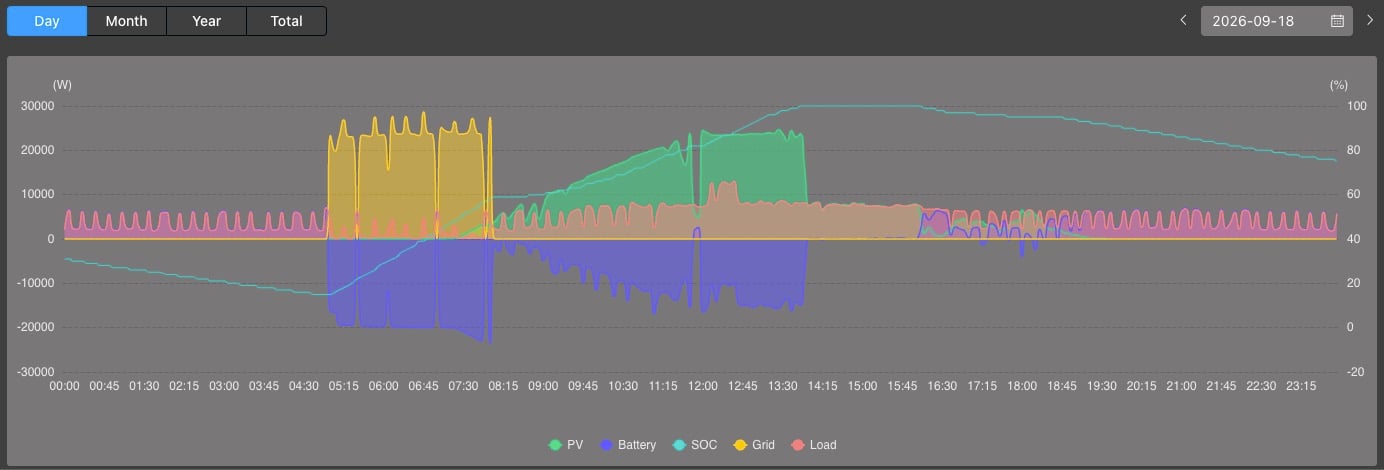
On September 18, an off-grid home in Southwest Florida burned almost three hours of generator fuel before sunrise. Then, starting at two in the afternoon, the solar array was throttled for two solid hours, producing only what the house was using and nothing more, while the sun was still high and strong.
The generator had already filled the battery, so when the array reached its best hours of the day, there was nowhere left to put the power.
Nothing broke. No equipment faulted. Every component did exactly what it was designed to do. That is what makes September the hardest month of the year for off-grid solar in Florida, and why I tell clients to judge their system by what it does in September instead of what it does in April.
Why September And Not December
Ask most homeowners when they expect their off-grid system to struggle, and they will say December. Short days, low sun angle, winter. It sounds right, but it is wrong.
December in Southwest Florida gives you clear skies and almost no air conditioning load. The days are short, but the house barely asks for anything, so the battery coasts through the night with room to spare and the generator never wakes up.
September asks for everything at once. The air conditioner is still running at full summer duty because the dew point has not moved. Daylight has dropped to about twelve hours and fifteen minutes, down from nearly fourteen in June. And the wet season thunderstorm pattern is firing most afternoons. If you are new to how off-grid solar works on our barrier islands, that combination is the backdrop for everything that follows.
No other month stacks all three of those together. That is the whole answer, and everything expensive that happens in September follows from it.
What Actually Happened That Day
This home runs a 120 kWh battery bank. At five in the morning, it was down to 15 percent, which is near the floor. The automatic generator start fired and ran until eight, pushing in roughly 68 kWh and bringing the bank up to 60 percent. Sunrise was around 7:13, so most of that run happened in the dark.
That start was the right call. At 15 percent with no sun coming for another two hours, waiting was not an option. The inverter was close to shutting off at it’s low battery cutoff of 10%.
Solar took over after sunrise and climbed hard. By late morning the array was making well over 20 kW. The bank reached 100 percent just before two in the afternoon, entirely on solar.
And that is where it went sideways. For the next two hours, the array produced almost exactly what the house was consuming and not one watt more. The output held nearly flat while the sun was still near its strongest. The system wasn’t short on power. It was full, with nowhere to send excess solar power.
Conservatively, that throttled window gave up around 32 kWh of free solar energy. This is exactly the problem smart load management is built to solve, by automatically switching on discretionary loads when the bank is full, and the array still has capacity to spare.
The Generator And The Array Fought Each Other
Line those two numbers up. The generator delivered roughly 68 kWh before sunrise. The array threw away roughly 32 kWh that afternoon because the battery was already full.
Something close to half of that generator run was energy the sun was fully capable of providing a few hours later, for free. The homeowner paid for it twice: once in delivered fuel, and once in the solar production that had nowhere to go.
On a mainland home, that is an annoyance. On an island, it is not. Fuel does not arrive by truck. It arrives by boat, on a schedule that bends to weather and tides, and the delivery itself often costs more than what is in the tank. Every avoidable generator hour on island property is real money and real logistics.
The generator started at the right time. It just had no idea when to stop.
Target Charge Is The Wrong Question At Five In The Morning
Almost every automatic generator start system decides using one number: battery state of charge. Below a threshold, the generator runs. Above another, it stops. That is a thermostat.
The thermostat is asking how full the bank is. At five in the morning, that is the wrong question. The right question is how much charge does this house need to hold together until the array can carry the load, and how confident am I in today’s solar array production.
Those produce very different answers. A bridge to a productive sunrise on a clear September morning is maybe an hour of runtime. A target charge threshold on the same morning ran nearly three.
The controller has no way to ask the better question. It does not know sunrise is two hours out. It does not know solar noon here falls after one in the afternoon, which is the same reason off-grid arrays should not all face south at the textbook angle. It does not know that today’s morning forecast was clear and the roof was about to make serious power. You can look up the sun position for your own address on the NOAA solar calculator, but your generator controller cannot.
The Storm Came Later, And It Still Mattered
The thunderstorms on September 18 did not arrive at midday. Production held strong through two in the afternoon, and the real collapse came around four, when output dropped by more than 80 percent in a matter of minutes.
By then the bank was already full, so the storm did not cost the homeowner a full charge. What it cost was the evening. Instead of solar carrying the house into dusk and leaving the battery near the top, the bank started working at four in the afternoon and never stopped. Sunset was still more than three hours away.
That is the part people underestimate. In September, the battery often starts its night in the late afternoon. By the following morning, this bank was down to 37 percent, and the generator was about to run again.
Full Charge Is Not Optional, And That Is The Squeeze
There is a second reason the generator runs, and it has nothing to do with keeping the lights on.
Lithium banks need to reach a full charge periodically and hold there long enough for the battery management system to balance the individual cells. Skip that for too long, and the cells drift apart. Once drift gets bad enough, the bank starts throwing faults and shutting down, and the homeowner loses power for reasons that have nothing to do with how sunny the week was. I have seen banks pulled out of service over exactly this.
On September 18, solar got there on its own, about two hours before the storm hit. That worked.
It was also lucky. Move those clouds two hours earlier, which happens this time of year, and the bank tops out in the low nineties, and the balance does not happen. String several of those days together and the only way to force a full charge is a long generator run, at exactly the time of year you are trying hardest to conserve fuel.
That is the September squeeze. You need a full charge more than usual, you can count on getting one less than usual, and the insurance policy is the most expensive thing on the property.
Your System Looks Overbuilt In April Because It Was Built For September
This is where off-grid design gets genuinely hard, and where owners get frustrated with their own systems.
You cannot design for the average day, because the average day never actually happens. You design for the worst case, and around here the worst case is September. When we have a full year of real production and consumption data to work from, we size the battery bank statistically rather than by rule of thumb, precisely so the worst case is a number instead of a guess.
Which means that for most of the year the system looks like too much equipment. In April the array is producing more than the house can use by mid-morning, the battery is full, the generator never starts, and the owner looks at the monitoring app and wonders what all that money bought.
It bought September. That is what reliability costs.
And engineering your way to a September with zero compromises is brutally expensive. You would need enough array and enough storage to ride through several consecutive storm-shortened days at peak cooling load, leaving you with a system that is absurdly oversized the other ten months. For most properties, accepting some September inefficiency is the correct engineering answer, not a failure.
You Will Pay For September In One Of Three Currencies
Once you accept that September costs something, the useful question is what form you want to pay it in. There are three, and you should pick on purpose instead of by default.
Fuel. Let the generator run and absorb the operating cost. Cheapest up front, worst ongoing, and worst of all on an island where delivery is the real expense.
Capital. Oversize the array and the bank until September stops calling the generator. It works. It is expensive. You stare at unused capacity from October through August.
Behavior. Move discretionary loads into the morning solar window instead of the evening. Water pumping, water heating, water treatment, laundry, golf cart charging, anything that can wait. This one is free. It also requires a person to pay attention, which is why almost nobody picks it.
Most owners end up paying in fuel, not because they chose to, but because it is the only one of the three that requires no decision at all. And most of the off-grid homes are unoccupied this time of year, so there is not much you can do from a behavioral standpoint.
The Fix
This particular system has a rudimentary way of controlling how long the generator runs based on time of day. It is not predictive, meaning that it does not have a crystal ball to tell the generator how sunny the upcoming day will be. But it can help to reduce generator run time.
For example, the generator started at 5:00 am. We can tell the generator that if it starts around this time when the batteries drop to 15%, only run until the batteries reach 25%, because presumably, the sun will come up, exceed the house load, and start to charge the batteries. If the batteries reach 25% by 6:30 am and drop back down to 15% by 8:00 am, the generator simply runs again until the batteries jump back to 25%, hopefully helped by early morning solar power.
This cycles the generator more often, and hovers the battery closer to empty, but it can drastically reduce generator run time when the day ahead is sunny.
If the next day is not sunny, and the battery doesn’t reach 100%, and drops back to 15% around midnight, the system can be programmed to charge to 60% in that timeframe, because there is a long night ahead. This requires predicting an average load from midnight to sunrise. That is challenging to nail perfectly, especially because it changes throughout the year and with occupancy habits.
Observation, management, and adjustments help to reduce generator run time and fuel burn, but it’s not a perfect science, and it’s a lot of work. Owners are rarely engaged enough, caretakers are not adequately capable of doing it, and I can’t look at every house every month and make these kinds of adjustments without high cost. So some inefficiency in September just has to be accepted.
The Bottom Line
September is the audit month for off-grid solar in Southwest Florida. Peak cooling load has not let go, daylight has shrunk to about twelve hours, and the storms are still coming. Every weakness in a system design shows up in the September generator hours.
But the lesson from this particular day is not about panels or batteries. This system had plenty of both. The generator and the array were working against each other, and nothing in the control logic could see it happening. A generator that fills the bank before the sun gets a chance is not backup. It is a very expensive way to buy something the roof was going to hand you for free.
The goal is not a system that sails through September untouched. That system costs more than it is worth. The goal is a system where September behaves the way you predicted and budgeted for. A generator that runs sixteen hours in September is fine if you planned on sixteen hours. The problem here was not that the generator ran. It was that nobody could have told the owner in advance how long it actually needed to.
If you run an off-grid or island property in Lee, Charlotte, or Collier County and your generator hours have crept up over the past few seasons, do not start by adding panels. If possible, pull a full month of production, consumption, and runtime data and see what your system actually does under load. Look specifically for afternoons where production goes flat while the sun is still high. That flat line is your generator telling on itself.
If your system is old enough that it cannot give you that data at all, that is its own answer. On a recent island replacement, the biggest upgrade was not capacity, it was visibility. You cannot manage generator runtime if you cannot see. Every management system relies on an accounting system.