

The wife wanted air conditioning at night. The husband wanted to deliver on that promise. Their ten-year-old off-grid solar system would not let them, and worse, they had no way to know why.
This is the reality of older off-grid systems in Southwest Florida. They work until they don’t. When the batteries start dropping faster than expected, or the solar array is not keeping up, the homeowner has no data to diagnose the problem. They just know the inverter went dark at 2 AM and the mini-splits stopped running.
We recently completed a full off-grid system replacement for exactly this kind of client. We did not install the original system. It was a rugged old workhorse by all accounts, but it was obsolete, underpowered, and blind. Here is what we replaced, what we put in, and why the biggest upgrade was not what most people would guess.
What the Old System Looked Like
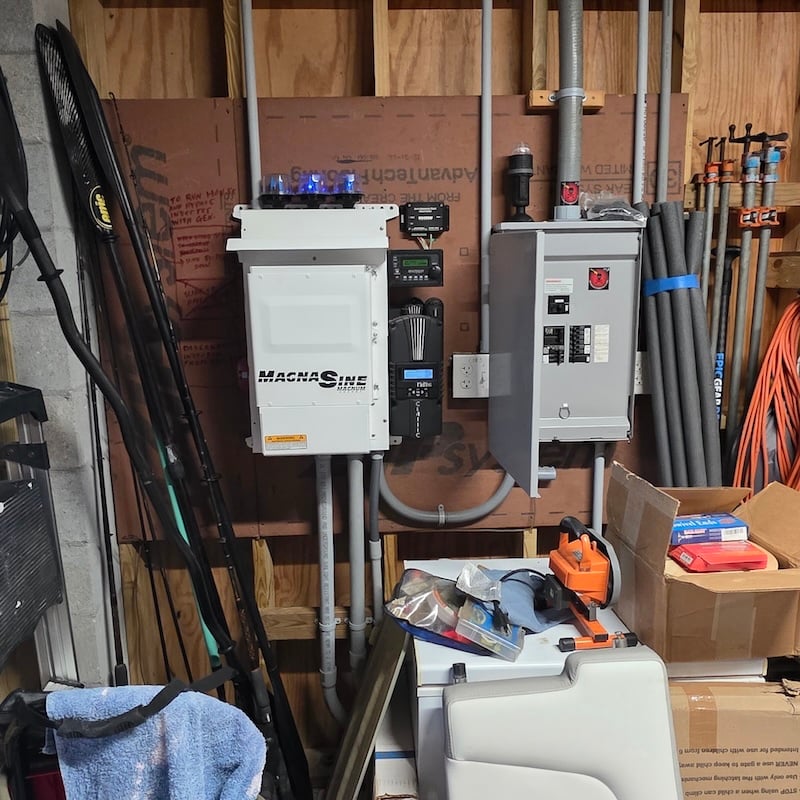
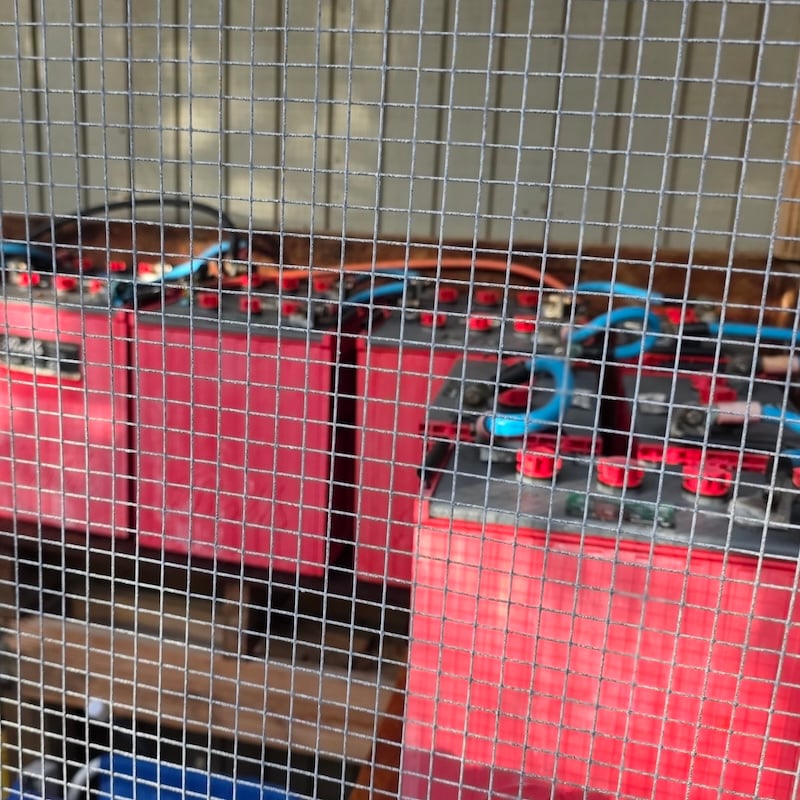
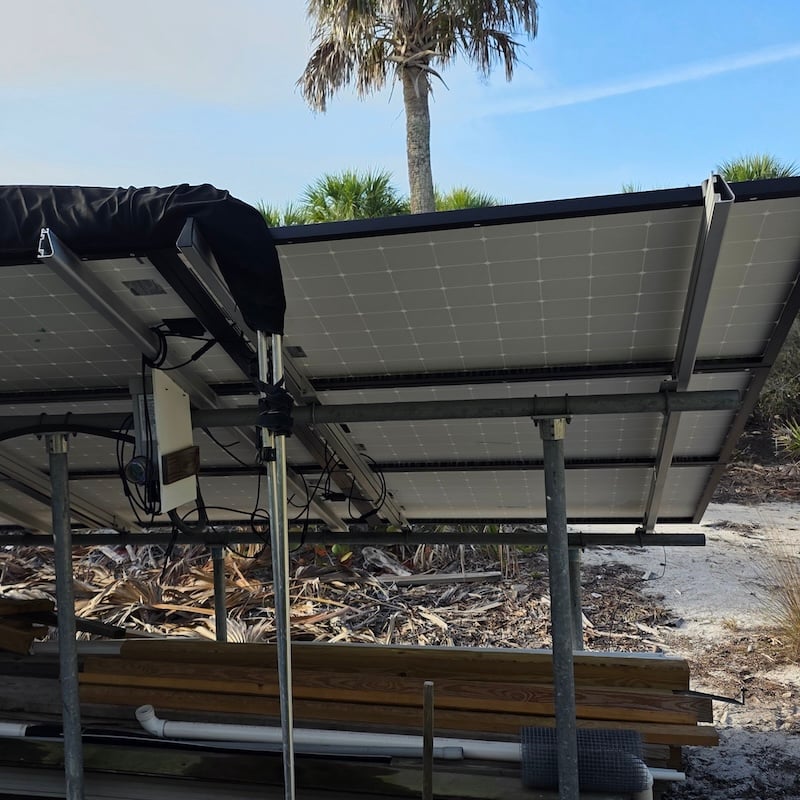
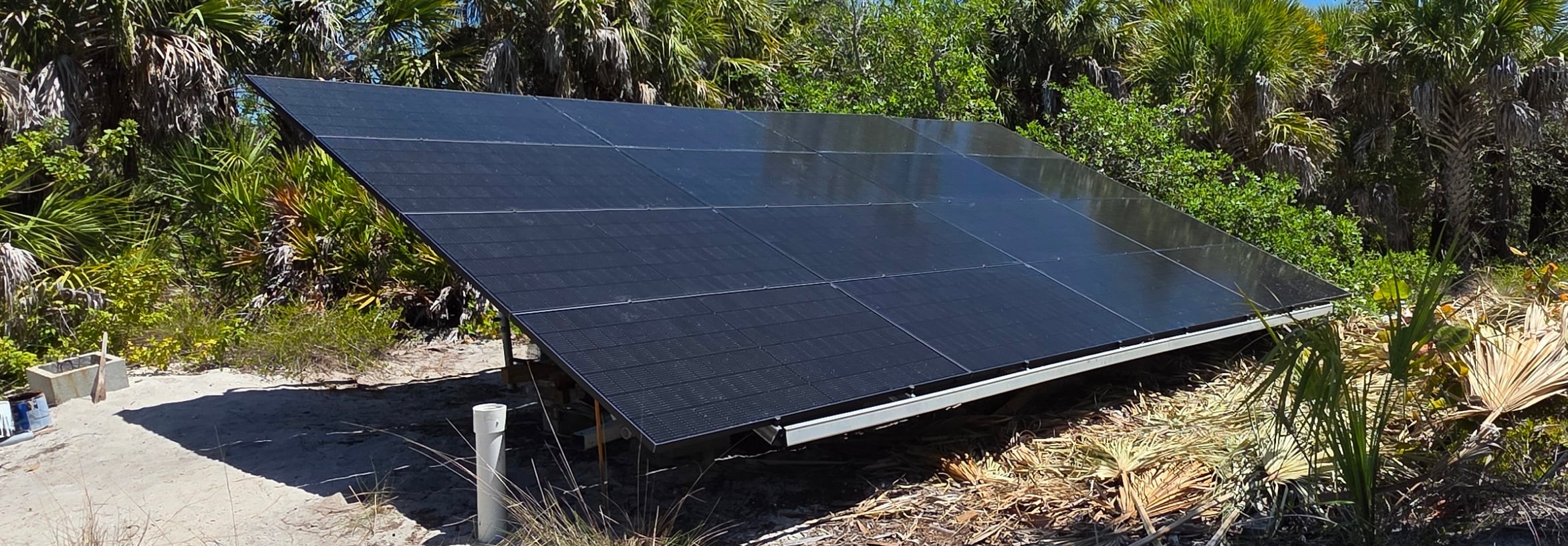
The existing setup was about a decade old. A 4.4 kW “dumb” inverter, twelve 335-watt solar panels on a ground mount, and a bank of flooded lead-acid batteries with corroded terminals. No monitoring. No cloud connection. No way to see a graph of what the system did yesterday, let alone right now.
The array had taken physical damage from windborne debris during recent hurricanes. The batteries required periodic water top-offs and manual cell checks. The inverter had served faithfully for years, but it could not deliver enough surge capacity for the pumps and three mini-split air conditioners the owners wanted to run, especially when guests were staying and the cooling demand doubled. Lights dimmed whenever something big turned on.
They were running out of energy at night, waking up in darkness. No coffee maker, no Internet. They could not tell if the issue was insufficient solar generation during the day, poor battery capacity, or both. No data meant no answers. They were guessing.
What We Installed
The replacement is a generational leap:
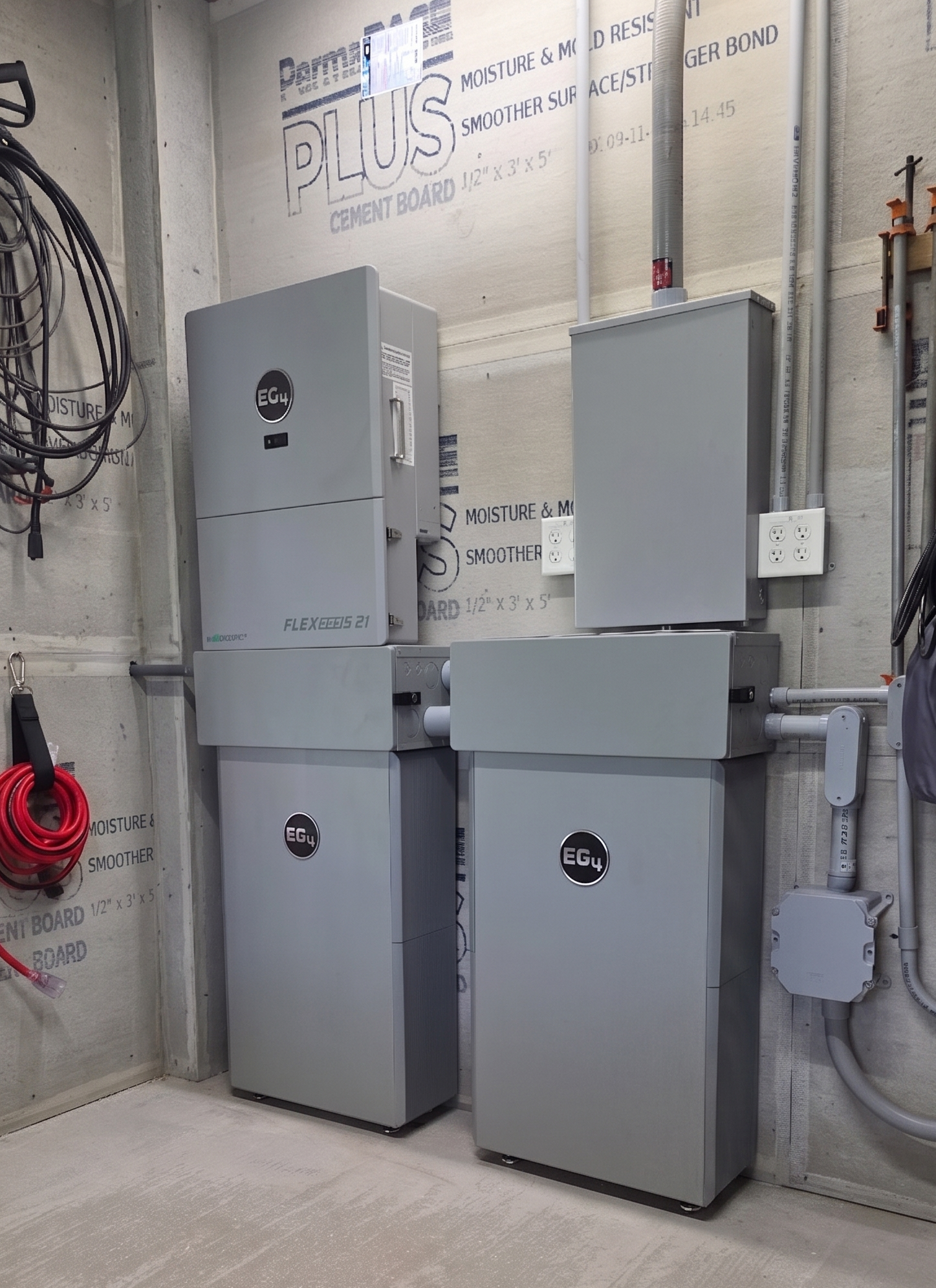
- EG4 FlexBOSS21, a 16 kW all-in-one inverter with plenty of headroom for surge loads and future expansion
- Two EG4 All-Weather lithium iron phosphate batteries to replace the dirty lead-acid bank
- Sixteen 460-watt bifacial panels on the existing ground mount, replacing the twelve 335-watt panels
The numbers alone tell a clear story. Inverter output went from 4.4 kW to 16 kW. Solar array nameplate went from roughly 4 kW to 7.36 kW, with the bonus backside generation that bifacial modules pick up from the ground reflection. Battery chemistry went from flooded lead-acid to modern LFP, eliminating watering, corrosion, and the gradual capacity loss that plagues older battery technology. Plus the whole system is more efficient, with lower internal resistance and conversion losses.
That alone would be a worthwhile upgrade. But the real story is not the bigger inverter or the larger array.
The Real Upgrade Is Visibility
For the first time, this client can see exactly what is happening in their system at any moment.
That may sound like a small thing. It is not. When you are off-grid, visibility into your system is the difference between making informed decisions and flying blind. Every watt matters, every cycle matters, and without data you cannot improve the way you use energy.
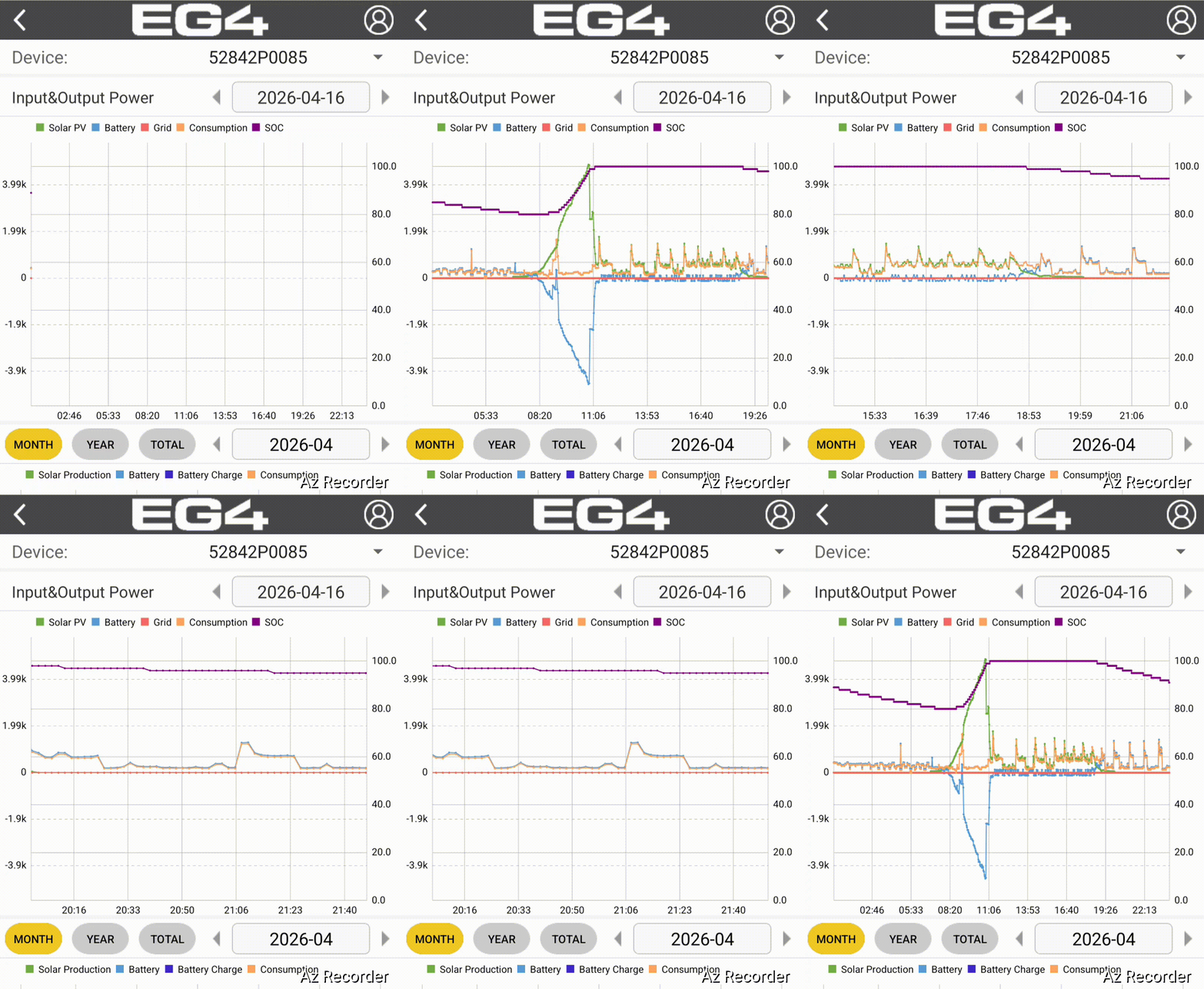
On the first day after commissioning, we pulled up the monitoring portal on the EG4 app and looked at the power graph. You could clearly see four distinct events during the evening, each lasting about fifteen to twenty minutes, pulling around 1.2 to 1.5 kW off the system. Those were the mini-split air conditioner compressor cycles. Four cycles in a few hours, each one precise and measurable.
That is actionable data. Now the owners can see how often the compressors kick on, how long they run, and how much energy they consume over a night. They can compare nights. They can see how battery state of charge tracks against their consumption. They can adjust thermostat setpoints and see the impact the next morning.
None of this was possible on the old system. They could look at the analog meter on the inverter, see that voltage was dropping, and shrug. That was it.
Monitoring Puts Power in the Homeowner’s Hands
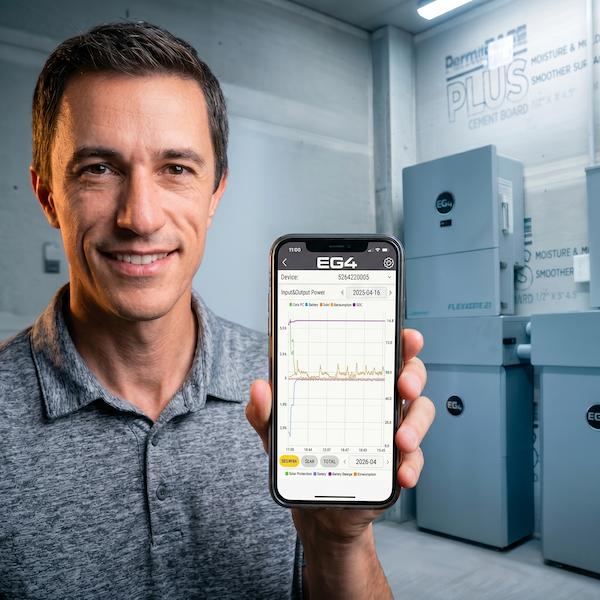 The word “power” gets thrown around a lot in solar content, and it is almost always used to mean electricity. That is fine, but the more important meaning here is control. Being able to see your system puts you in charge of it.
This is especially true for off-grid homeowners, where every decision about loads, habits, and system sizing has direct consequences. With a modern monitoring platform, you can tell within a few days whether your battery bank is sized correctly, whether your array is producing what it should for the time of year, and whether a specific appliance is a bigger energy hog than you realized.
If you are researching off-grid solar options in Southwest Florida, the monitoring capabilities of modern equipment should be near the top of your evaluation criteria, not an afterthought. Old off-grid installations offered nothing of the kind. You had to guess, adjust, and hope.
The Old System Was Not a Failure, Just Obsolete
I want to be fair to the old equipment. That 4.4 kW inverter ran for a decade in a harsh coastal environment without a catastrophic failure. Those Magnum Magnasine inverters were workhorses. The lead-acid bank did its job until it did not. Off-grid homeowners who installed systems ten or fifteen years ago got their money’s worth out of them. And all of these components are finding new life, repurposed by a neighbor.
The issue is that technology has moved faster than those systems could keep up with. The performance gap between a 2015-era off-grid inverter and a 2026-era all-in-one like the EG4 FlexBOSS21 is enormous. Surge capability, efficiency, communication protocols, safety features, and monitoring have all improved dramatically. An off-grid home running a decade-old system today is leaving a huge amount of capability on the table.
Replacement is not always the right call. Sometimes a partial upgrade, a battery swap, or an inverter add-on makes more sense. That is a case-by-case decision. In this case, the client had outgrown the original system entirely, and a clean-sheet replacement was the only path to delivering what they wanted.
Modern Systems Are Not Perfect
I would be lying if I said modern off-grid equipment never has issues. It does.
Dark start is a real and annoying problem. If the batteries get fully depleted, most modern inverters cannot self-start from the solar array alone. You need an external jump from a generator, a portable power source, or grid power if it is available. This is preventable with correct settings and reasonable caution, but new off-grid owners can learn this lesson the hard way.
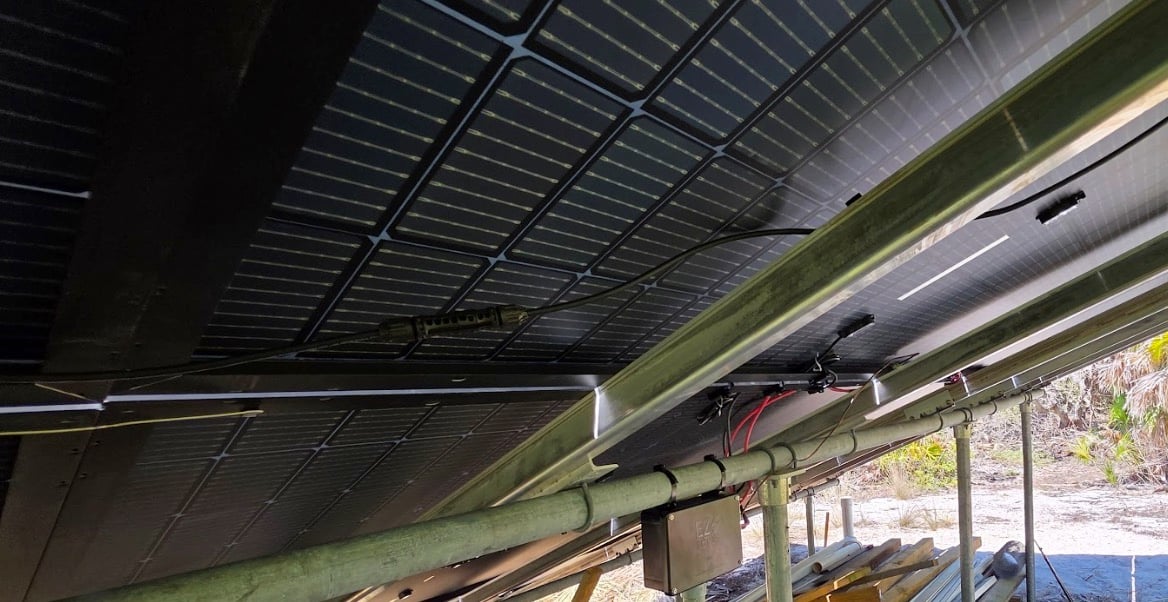
Safety-related shutdowns happen. Arc fault detection is now required in many configurations, and ground fault detection has become more sensitive. These features save lives and prevent fires, but they can also shut a system down for reasons that are not obvious. Figuring out the root cause of an AFCI trip usually requires someone who knows what they are looking at. Sometimes these issues have no easy solution – if a new inverter detects insulation resistance issues or arc faults from an old solar array with compromised wiring or panels, sometimes there is no good option but to replace the panels. This can be costly, but it’s necessary for everything to work safely and properly. Sometimes these projects are like peeling an onion, and that’s why a complete retrofit is the preferred pathway.
Firmware mismatches and communication glitches between batteries and inverters are common during the first weeks of operation. Different manufacturers implement the CAN and RS-485 protocols with slight variations, and a software update on one side can create a temporary conflict until the other side catches up. It usually resolves on its own, but it can be frustrating.
These are real tradeoffs for the massive gains in capability and visibility. I mention them because homeowners considering an off-grid system should go in with realistic expectations. Modern systems are smarter, more powerful, and more informative than their predecessors, but they also have more surfaces where things can go slightly wrong.
Installation Is Actually Simpler
Here is something that does not get mentioned enough. Modern off-grid systems are often easier to install than the dumb systems they replace.
An all-in-one inverter like the FlexBOSS21 combines the charge controller, battery inverter, and grid and generator interface into a single unit. The older generation of off-grid systems required a separate charge controller, a separate inverter, sometimes a separate battery management system, and a mess of wiring between them. Pulling out the old components and replacing them with a single wall-mounted unit, paired with two LFP battery storage units, dramatically reduces complexity.
Fewer components means fewer failure points, shorter wire runs, and a cleaner installation. It also means the homeowner has fewer things to understand and maintain.
The Bottom Line
The real upgrade in modern off-grid solar is not the bigger inverter, the larger array, or even the better battery chemistry. Those all matter, but they are not what change the homeowner’s life.
The real upgrade is that you can finally see what your system is doing, in real time and over time. That visibility turns an off-grid home from a black box into a manageable, tunable, informed operation. It lets the wife run air conditioning at night. It lets the husband deliver on that promise with confidence. And it lets both of them know, with data, exactly why their system works the way it does.
If you are running a ten-plus-year-old off-grid system in Southwest Florida and wondering why you keep running out of power at night, get in touch. We will assess what you have, tell you honestly whether a partial upgrade or a full replacement makes more sense, and show you what a modern system can actually do.


