

Why Off-Grid Homes With Serious Power Needs Should Take a Hard Look at the EG4 GridBoss
The EG4 GridBoss gets filtered out early by most off-grid homeowners. It says “grid-interactive” on the box, there’s no grid, conversation over. That logic is costing people money and complexity they could avoid.
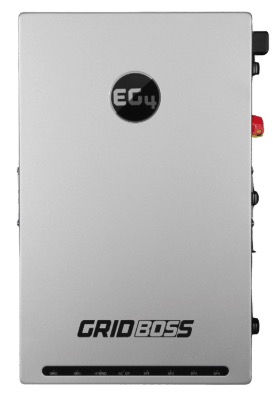
The GridBoss is a microgrid interconnect device built to manage relationships between power sources on a shared AC bus. On a grid-connected system, one of those sources is the utility. On an off-grid system, that port simply stays open or connects to a generator. What remains is a device that handles bypass, distribution, generator input, and smart load control, all in one box. For the right system, that’s an extremely compelling value proposition.
Here’s the full case for putting a GridBoss in your off-grid system.
What the GridBoss Actually Does
The GridBoss establishes and manages a microgrid. Multiple power sources connect to it: EG4 hybrid inverters, AC-coupled solar inverters from other manufacturers, and a generator. It coordinates those sources so they work together without conflict, and it controls what loads are on at any given moment based on system conditions.
In a grid-interactive installation, the utility is one of those sources. In an off-grid installation, you’re running with whatever combination of inverters, solar, and generator your system includes. The GridBoss manages that combination just as effectively. The grid port isn’t required. It’s an option.
The device is native to EG4’s compatible hybrid inverter lineup. That means it communicates directly with the FlexBOSS 18, FlexBOSS 21, and FlexBOSS 18KPV for tight, automated system operation. Other solar inverters can be added as AC-coupled sources, but the primary inverter role belongs to those EG4 units.
Every Off-Grid System With a Generator Needs a Bypass
Start here, because this argument is airtight on its own. If your off-grid home has a generator, you need a manual bypass. Not eventually. From day one.
Inverters fail. They need firmware updates. They need to be serviced, swapped out, or isolated for testing. When you take an inverter offline on a grid-tied home, the utility keeps the lights on. On an off-grid home with no bypass path, the moment that inverter goes down, you lose power to the house. If you’re a full-time resident, that’s not a theoretical risk. It’s a question of when.
The standard answer is a 200-amp manual bypass switch. It’s a legitimate solution. It does one thing: it lets you route generator power directly to your load panel, bypassing the inverter entirely. Good gear, clean installation, problem solved. It also costs money, takes wall space, and adds another set of terminations to your installation.
The GridBoss includes that bypass function as part of its standard operation. During normal operation, power flows through the inverters and the GridBoss manages all the coordination. When you need to take an inverter out of service, the GridBoss routes generator power directly to the load side, bypassing the inverter stack. House stays on. Work gets done.
When you do the honest cost comparison between a quality 200-amp bypass switch installed and the incremental cost to add GridBoss functionality, the math tightens quickly. You’re not choosing between a bypass switch and a GridBoss. You’re deciding whether to buy a GridBoss that includes bypass as one of several built-in functions, or to buy a bypass switch and then purchase additional equipment separately for everything else the GridBoss handles.
One Generator Connection for the Whole System
Off-grid systems with multiple inverters have a generator input problem. Each inverter needs access to generator power. Without the GridBoss, that means circuit protection, distribution hardware, and the wiring runs to get generator power to each inverter individually. More components, more potential failure points, more installation time.
The GridBoss accepts a single generator input and distributes it to all connected EG4 inverters, up to three, without requiring additional circuit protection hardware between them. One connection from the generator to the GridBoss. Done. The GridBoss handles the distribution to each inverter from there.
For off-grid systems running two or three inverters in parallel, this is a real simplification. Reducing the generator interface to a single wiring point makes commissioning cleaner and the installed system more maintainable long-term.
The GridBoss as Your Distribution Center
Multi-inverter off-grid systems need a place where all those inverter outputs combine into a single power bus for the home’s loads. Without the GridBoss, that means additional distribution hardware: a subpanel, a bus bar assembly, or some form of transfer arrangement to bring everything together. That hardware has a cost, takes space, and adds to installation labor.
The GridBoss is that distribution point. Inverter outputs connect to it, loads connect from it, and it manages the unified power bus for the whole system. One box handles what would otherwise require separate distribution equipment.
When you total what the GridBoss replaces in a multi-inverter system – bypass switch, distribution hardware, generator input protection and distribution, plus all the control and monitoring capability it adds – the installed price looks different than it does at a spec sheet glance. You’re not adding a device to your system. You’re replacing several devices with one that also does more than any of them individually.
Smart Load Management Changes How an Off-Grid System Runs
The GridBoss includes smart load control that most off-grid homeowners haven’t thought through fully. Smart loads are circuits the GridBoss can switch based on live system conditions: battery state of charge, available solar production, generator runtime, or time-of-day scheduling.
In practice, this means that when your batteries are full and your solar array is running hard, loads that don’t need to run continuously can come on automatically to use that production rather than clip it. Water heater, pool pump, EV charging, secondary HVAC zones. When batteries drop below a threshold, those loads shed automatically without anyone touching a switch.
For a large off-grid home, this matters more than it might seem. An off-grid system without smart load management relies entirely on the occupants to regulate discretionary consumption. That works when someone is paying attention. It fails when the generator is running at two in the morning because a high-load circuit was left on and nobody noticed the batteries were at 20 percent.
Smart load management is the difference between an off-grid system that runs efficiently without constant oversight and one that runs the generator more than it needs to. For island properties, vacation homes, or any off-grid installation where manually managing the system every hour isn’t realistic, it’s a meaningful capability.
Inverter Compatibility
The GridBoss is designed around EG4’s compatible hybrid inverter lineup: the FlexBOSS 18, FlexBOSS 21, and FlexBOSS 18KPV. That’s where the native communication, automated features, and straightforward commissioning live. If you’re building an off-grid system and want the full benefit of everything the GridBoss offers, those are your inverter options.
One thing worth knowing: you don’t have to run three of the same model. The FlexBOSS 18, FlexBOSS 21, and FlexBOSS 18KPV can be mixed and matched within the same system. That gives you real flexibility when sizing for a specific load profile or when a project calls for a combination that no single model covers on its own.
Third-party solar inverters can be added as AC-coupled sources alongside the EG4 units. That works, but it takes more configuration and some of the automation features that come standard with native EG4 integration may not carry over fully.
Non-EG4 inverters as the primary system inverters are not a supported configuration. The GridBoss assumes EG4 at the core.
When the GridBoss Is Not the Right Choice
Not every off-grid system belongs in this conversation. If you have a single EG4 hybrid inverter, no generator, and no interest in smart load control, the GridBoss adds complexity that doesn’t pay off. A properly sized single-inverter off-grid system is a capable and clean solution. Adding the GridBoss to a system that doesn’t need it is the wrong call.
If your loads are modest, your battery bank is sized to meet them, and your system has no realistic growth path, keep it simple. The simplest system that meets the requirements is almost always the best system.
The crossover point is clear. Single inverter, no generator, straightforward loads: the GridBoss isn’t the right fit. The moment you move to two inverters, you need distribution hardware regardless. You’re likely running a generator. You probably have load diversity that benefits from smart control. At that point, the GridBoss is not just a reasonable choice. It’s the most cost-effective way to build the system.
Three inverters make the case even more convincing. The alternatives get expensive and complicated fast.
The Bottom Line
The EG4 GridBoss was built for grid-interactive use, but its core capabilities translate directly to off-grid systems with no utility connection. It covers the manual bypass that every generator-backed off-grid system should have. It simplifies generator input to a single connection for the whole inverter stack. It serves as the distribution center that multi-inverter systems require. It brings smart load management to systems that benefit enormously from automated load control.
For a large off-grid home in Southwest Florida, whether that’s a rural property or an island home accessible only by boat, the GridBoss is worth evaluating before you start sourcing individual components to fill those same roles separately.


