Off-grid solar in Southwest Florida is not the same animal as a grid-tied system with a battery backup bolted on. When you pull the grid out of the picture entirely, the inverter carries everything. It has to generate a stable 120/240V split-phase sine wave from whatever the batteries and solar panels give it, start motors on a hot August afternoon, run through a generator input cleanly, and do all of this reliably year after year in a humid, corrosive coastal environment. The inverter choice matters more than almost any other decision in the system design.
Today, the all-in-one inverter market has matured to the point where there are genuinely excellent options available for serious off-grid homes. These are the brands and models we are recommending right now, and why.
What Makes an Off-Grid Inverter Different
A grid-tied or hybrid inverter leans on the utility grid to form its AC voltage reference. Off-grid operation flips that relationship entirely. The inverter is the grid. It has to maintain frequency and voltage stability with no external reference, handle wildly unbalanced loads across L1 and L2, surge-start inductive loads like well pumps and AC compressors without collapsing, and charge batteries efficiently from both solar and generator input.
In Florida specifically, you also need to account for heat. An inverter rated to full power at 25 degrees Celsius is a different machine at 45 degrees Celsius inside a South Florida utility room in July. Enclosure rating matters too. Salt air is aggressive. Units rated NEMA 4X or IP65 are the baseline for island and coastal installations.
The Units We Are Recommending Today
We currently spec and install three inverter families for off-grid homes in Southwest Florida: the EG4 FlexBOSS line, the Sol-Ark residential line, and the Sol-Max AIO (formerly Midnite AIO). Each has a different profile and fits different situations. None of them are wrong choices. They are just different tools.
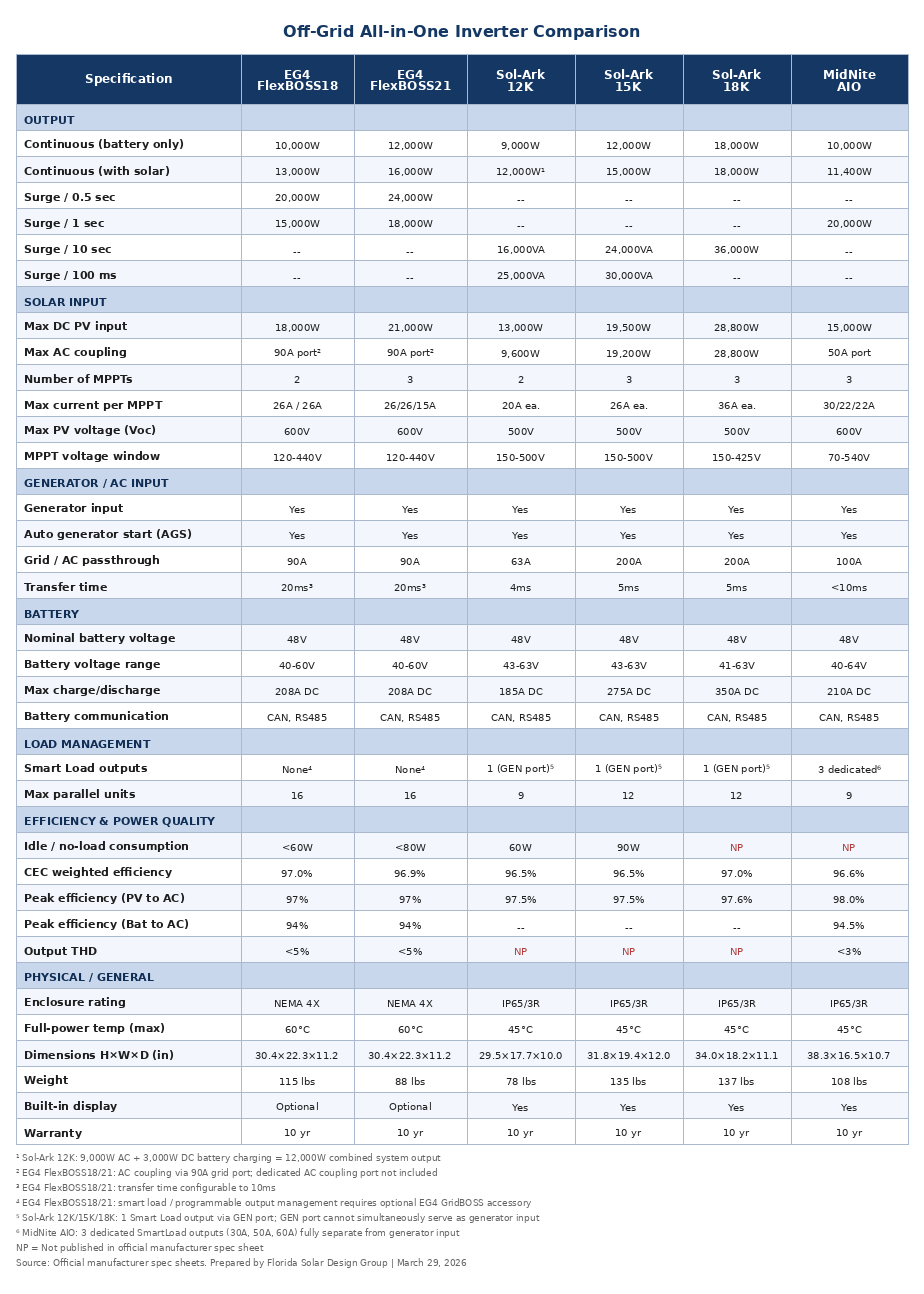
Here is a quick comparison chart before we get into the details. You can also download this as a PDF here.
Download spec sheets here:
EG4 FlexBOSS18
EG4 FlexBOSS21
Sol-Ark 12K
Sol-Ark 15K
Sol-Ark 18K
Sol-Max AIO
EG4 FlexBOSS18 and FlexBOSS21
The EG4 FlexBOSS series is our go-to for off-grid island and remote property systems. The FlexBOSS18 delivers 10,000 watts continuous from battery alone and surges to 20,000 watts at half a second, with a locked rotor rating of 195 amps. That is more than enough to start a 5-ton AC unit. The FlexBOSS21 steps that up to 12,000 watts continuous and 24,000 watts peak, with three MPPTs and 21 kilowatts of DC solar input capacity.
The practical reason we lean toward the FlexBOSS line for island work is simpler than the specs suggest: installation ease, availability, and field reliability. These units are widely stocked locally and at regional suppliers. When you are moving equipment by boat to a property with no road access, the last thing you want is a six-week lead time on a replacement unit. The FlexBOSS series is also notably compact and light, which matters when you are carrying things down a dock and across a beach.
Perhaps most importantly, is EG4’s seamless integration with their own batteries. Keeping everything within the same ecosystem, from the same manufacturer, makes everything work together well, without manufacturer finger-pointing when things go wrong.
One thing worth knowing about the EG4 FlexBOSS units: the 60-degree Celsius full-power rating is real. Most competing inverters derate at 45 degrees. In a non-air-conditioned equipment room in August, that headroom makes a measurable difference in daily production and system stability. The NEMA 4X rating also makes them genuinely suitable for coastal environments where salt air and humidity would destroy a lesser enclosure.
Neither FlexBOSS unit includes built-in programmable load management outputs. If you want to automate load shedding or opportunity load control, that requires adding EG4’s GridBOSS accessory. Worth knowing before you price the system.
A note on the EG4 18kPV and why we don’t offer it: The EG4 18kPV was EG4’s flagship all-in-one before the FlexBOSS line existed, and it is essentially what the FlexBOSS21 was designed to replace. The 18kPV includes a 200-amp grid passthrough, which is a useful feature for grid-tied installations but adds cost and complexity that off-grid users simply do not need. EG4 recognized this and built the FlexBOSS series specifically to strip out the grid-tied overhead and optimize for off-grid and hybrid performance at a lower price point.
The numbers bear this out. The FlexBOSS21 delivers more continuous output with solar (16kW vs. 12kW), more usable PV input (21kW vs. 18kW), and a higher peak surge (24kW vs. roughly 18kW) than the 18kPV, and it typically costs less. For a pure off-grid application, you are paying more for the 18kPV and getting a less capable inverter in the categories that actually matter.
The 18kPV is not a bad inverter. It has a long field history and solid support. But when EG4 themselves built a better off-grid option at a lower price, it stopped making sense to specify the older unit. We follow the product, not the brand loyalty.
Sol-Ark 12K, 15K, and 18K
Sol-Ark has been building its reputation in the off-grid and hybrid market for years, and the current lineup earns it. The 12K is a capable all-in-one for smaller off-grid homes with modest loads and up to 13 kilowatts of DC solar. The 15K steps up to 15,000 watts continuous with solar, three MPPTs, a 200-amp grid passthrough, and 24,000 volt-amps of 10-second surge capacity. The 18K is in a class by itself in the residential space: 18,000 watts continuous from battery alone, 36,000 watts of surge for 10 seconds, three MPPTs handling up to 28,800 watts of DC solar, and a 350-amp battery charge and discharge rating.
All three Sol-Ark models include a Smart Load output built into the GEN port. This lets you designate a load, such as a water heater, EV charger, or pool pump, to energize only when the battery is above a user-defined threshold. The tradeoff is that the GEN port does double duty: you configure it as either a smart load output or a generator input, but not both at the same time. For homes with a generator that also want smart load functionality, that is a design constraint worth planning around. However, off-grid situations can use the Grid input for the generator, sparing the Smart Load output for that purpose.
The Sol-Ark units transfer from grid or generator to battery in 4 to 5 milliseconds, which is fast enough that most sensitive electronics, including computers and medical equipment, never see the transition. The 4ms spec on the 12K in particular is exceptional for a unit in this price range.
One practical note: Sol-Ark units derate at 45 degrees Celsius, which is a meaningful consideration for Florida equipment rooms that are not temperature-controlled. Plan for adequate ventilation or cooling if you are installing these indoors in an unconditioned space.
Sol-Max AIO
The Sol-Max AIO is the most feature-complete unit on this list from an installation engineering standpoint. At 11,400 watts continuous with solar and 10,000 watts on battery alone, it is not the highest-output unit here, but it brings capabilities none of the others match out of the box.
The three dedicated SmartLoad outputs, rated 30 amps, 50 amps, and 60 amps, are independent from the generator input. You can run a generator and manage three separate opportunity loads simultaneously, with each output programmable based on battery state of charge or solar availability. For a complex off-grid home with a generator, a well pump, a water heater, and a pool system all needing intelligent control, this is a meaningful advantage that would otherwise require a separate load management panel.
Sol-Max also supports the full 600-volt DC input allowed by the NEC, versus 500 volts on the Sol-Ark units. That allows longer, more efficient string designs, which can reduce wiring cost and resistive losses on larger arrays. The CBI hydraulic-magnetic breakers on every input and output are a quality detail that most AIO units skip. Hydraulic-magnetic breakers are 100-percent continuous duty rated, which matters in a system that runs hard 24 hours a day.
The Sol-Max AIO also publishes the best efficiency numbers in this group: 98 percent peak PV-to-AC and 94.5 percent battery-to-AC. In an off-grid system where every watt-hour matters, those fractions add up over time.
Finally, Sol-Max offers it’s own brand of battery, keeping everything in the same ecosystem for seamless communications like EG4, and the batteries are solid options with a great price point.
How We Decide Which Unit to Specify
The short version is that we match the inverter to the site, the load profile, and the logistics of the installation.
For island and remote boat-access properties, the EG4 FlexBOSS line wins on portability, ease of installation, field serviceability, and parts availability. We used the FlexBOSS21 on a recent Cayo Costa off-grid project and it was the right call for that application.
For larger off-grid homes with significant AC loads, whole-home backup requirements, and a generator as a primary backup source, the Sol-Ark 15K or 18K is something to consider. The 200-amp passthrough on the 15K and 18K means you can back up an entire main panel without a sub-panel, which simplifies permitting and installation considerably. The 18K is in a category of its own for homes with heavy inductive loads or multiple large HVAC systems. There are some downsides in terms of manufacturer warranty and service support, but the Sol-Ark brand has proven hardware with a good track record.
For complex off-grid builds where the customer wants granular load management, or where a sophisticated battery-management strategy matters, the Sol-Max AIO earns its place. The three independent SmartLoad outputs and the superior efficiency numbers make it the right choice for high-end off-grid design. The smaller output works well in parallel inverter systems with 3 or 4 inverters for redundancy. The programming is dead simple, albeit poorly documented. The customer support is personalized, coming from a small company. The Sol-Max AIO also shines for smaller systems in a single-inverter package.
What All of These Units Have in Common
Every inverter on this list supports 48-volt lithium battery systems with closed-loop BMS communication, integrates automatic generator start, is UL 1741 listed, and carries a 10-year warranty. All of them handle 120/240-volt split-phase output for standard American residential wiring. All of them can operate completely independently of the grid.
The differences are in the details: output capacity, surge headroom, PV input capability, passthrough current, load management sophistication, enclosure rating, and thermal derating behavior. Those details matter enormously when you are designing a system that has to work every day with no utility to fall back on.
A Note on Battery Pairing
Every unit on this list pairs with EG4 AllWeather LFP batteries, Sol-Max PowerFlo batteries, and most major 48-volt lithium battery brands. We are not going to cover battery selection in depth here, but the inverter and battery combination needs to be planned together. Closed-loop BMS communication, battery voltage range compatibility, and maximum charge and discharge current all have to line up.
We size battery banks based on the home’s actual load profile and the desired days of autonomy, not on a default formula. An off-grid system with undersized batteries and a correctly sized inverter is a system that will run its generator constantly. We have fixed a lot of systems like that over the years.
The Bottom Line
If you are building or upgrading an off-grid solar system in Southwest Florida, the inverter is not the place to cut corners or guess. The EG4 FlexBOSS18 and FlexBOSS21, the Sol-Ark 12K, 15K, and 18K, and the Sol-Max AIO are the units we have confidence in today based on their specs, field performance, and manufacturer support. Each fits a different profile, and choosing correctly requires understanding your load, your site, and your priorities.