

Six proposed amendments to the National Electrical Code would give plug-in solar its first official home in the code. They were all written by one company, a plug-in solar manufacturer, and they were filed as emergency amendments to skip the normal three-year revision cycle.
I read all six, and scanned through roughly 1,400 pages of attached exhibits. A couple of the ideas are good. But the central rule, the one that actually lets a plug-in solar kit connect to your house, would allow installations that I would never sign off on, and the package skips the exact failure modes I have been writing about all year.
Let me be clear up front: I am not opposed to plug-in solar. Done right, it gives renters, condo owners, and people who can’t afford a full rooftop system a way to make some of their own power. I’d like to see it succeed. But it is not as simple as plugging a panel into the wall, and a code change that pretends it is will hurt the technology more than it helps.
Here is what the plug-in solar NEC amendments do, what they get right, and where they fall short for a Southwest Florida homeowner.
What the Six Amendments Would Do
The National Fire Protection Association published the proposals on October 22 as Tentative Interim Amendments, TIAs 1951 through 1956. A TIA is an emergency patch to the code between editions. Public comments closed November 20. In plain English, here is the package:
1951 defines a “Plug-in Photovoltaic System” and creates a new section of the code for cord-and-plug power sources.
1952 is the core rule. It lets a power source connect at a receptacle if it stays under 60 amps at 240 volts (or 20 amps at 120 volts), the outlet is labeled, the panel isn’t overloaded, and the equipment is listed.
1953 lets the plug itself count as the required disconnect, the same way an appliance cord does.
1954 requires labels at the outlet and at the panel that feeds it.
1955 spells out the math for when more than one backfeeding source shares a panel, like a plug-in array plus a bidirectional EV charger.
1956 says non-export systems don’t need a utility interconnection agreement, and export-capable systems just notify the utility within 30 days after plugging in.
You can read the full text on NFPA’s NEC page under Tentative Interim Amendments. Each proposal is only a page or two.
What They Get Right
To be fair, the problem they describe is real. Plug-in kits are selling by the thousands online, a UL standard for them now exists, and the first certified plug-in microinverter hit the U.S. market in July. Meanwhile, the code has no word for this equipment. An inspector has nothing to cite and nothing to check against.
A defined term would help. So would labels, especially the choice to put the panel label on the panel that actually feeds the circuit instead of the main disconnect, which in a condo is often locked in an electrical room. And the multi-source math in 1955 is correct. It keeps the same busbar protection rules installers already use for rooftop systems instead of inventing a new allowance.
Those are good ideas. They belong in the 2029 code cycle. That is the correct regulatory pathway
“Europe Has Millions of These” Doesn’t Hold Water
Every plug-in solar pitch leans on Germany, and these amendments are no exception. Their supporting text points to roughly four million plug-in systems installed there. The implication is simple: Germany does it safely, so we can too.
Germany does do it safely. It does it under rules that look nothing like what’s being proposed here.
Start with the cap. Germany limits a plug-in system to 800 watts of inverter output. That’s it. The 240-volt tier in these amendments allows up to 60 amps, which works out to more than 14,000 watts, roughly 18 times the German limit. That isn’t a balcony kit. That’s a full-size home solar system on a plug.
Then there’s voltage. European homes run at 230 volts. American outlets run at 120. The same wattage on a U.S. circuit pulls about twice the current, and current is what heats wire. So 800 watts on a German circuit stresses the wiring about as much as 400 watts would here. Germany’s own safety margin, translated to American wiring, is half what it sounds like.
And Germany got there by deliberately rebuilding its rules around plug-in solar, with a dedicated product standard, conservative limits, and simple registration. Florida hasn’t done any of that. Pointing at Europe while proposing limits many times higher on lower-voltage circuits, with no dedicated circuit requirement, doesn’t follow the European model. It’s borrowing its reputation.
The Core Rule Gets the Panel Math Wrong
Here is where it starts to fall apart. Your electrical panel has a busbar, the metal spine that all the breakers clip onto. The code limits how much current can be fed into it from both ends. The standard rule adds up the solar breakers plus the main breaker and caps the total at 120 percent of the busbar rating.
Amendment 1952 leaves the main breaker out of that math. On a typical 200-amp panel, its version would allow 240 amps of solar breakers on top of a 200-amp main. That is not a rounding error. That is more than double what the existing rule allows. Perhaps this was an error or oversight by the submitter, but it can’t be ignored.
The kicker: amendment 1955, filed by the same company in the same package, does the math correctly. If both were adopted, the code would contain two different answers to the same question.
The breaker sizing has a similar gap. It sets a minimum breaker size but no maximum, and it skips the standard 25 percent margin for equipment that runs for hours at a time. Solar runs for hours at a time.
Nothing Requires a Dedicated Circuit
This is the one that worries me most, because it is the most common way plug-in solar actually goes wrong.
I covered the basic physics in my post on the wiring danger plug-in solar marketing won’t tell you about. The short version: when solar plugs into an outlet in the middle of a circuit, the breaker only sees the current coming from the panel. The wire between the solar outlet and whatever is plugged in further down the line carries the solar current plus the panel current. The breaker never sees the total, so it never trips. The wire heats up anyway.
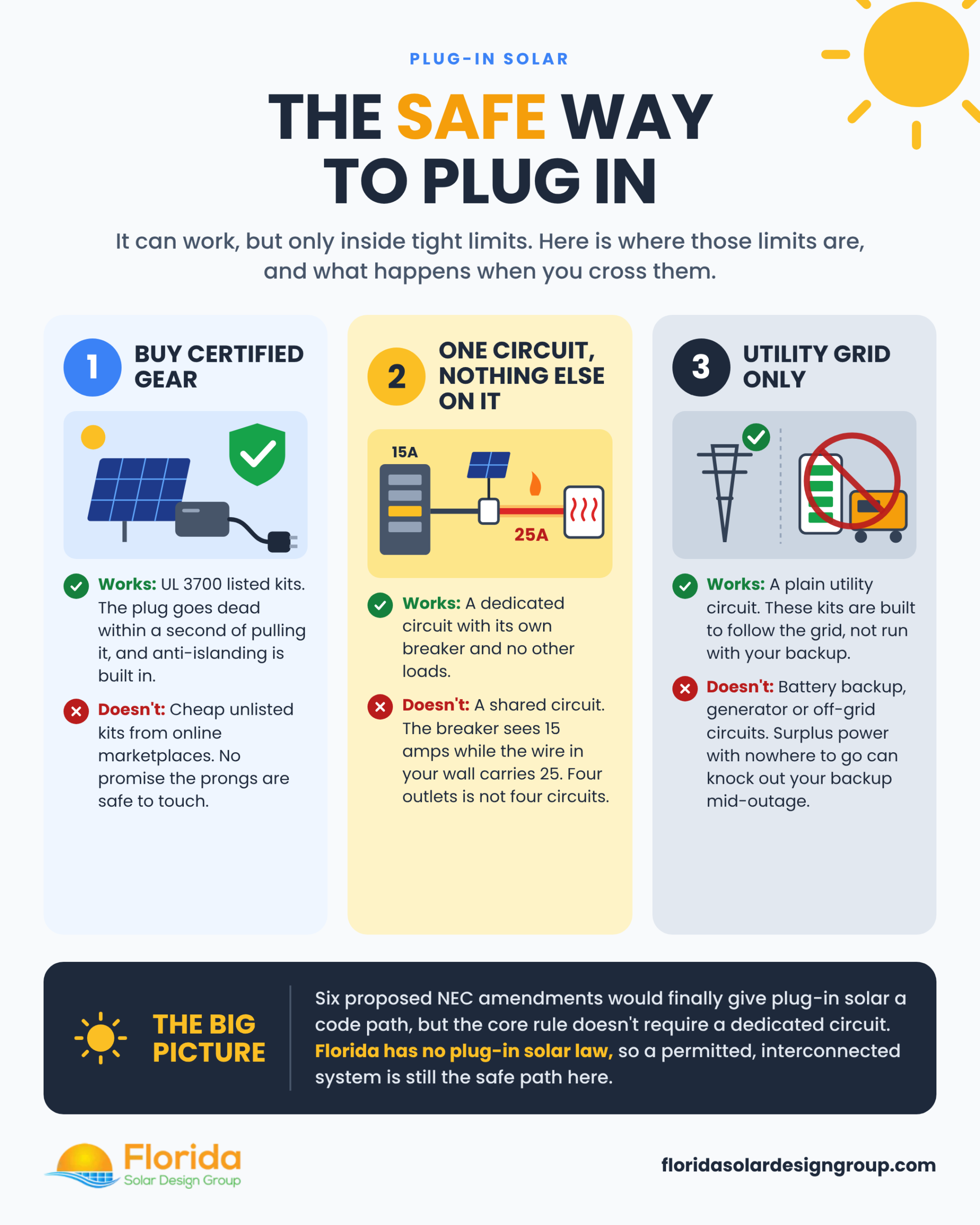
On a shared 20-amp kitchen or lanai circuit, the proposed 120-volt tier would allow up to 20 amps of solar. Add a space heater or a window unit downstream, and that wire can see close to double its rating with no breaker trip.
The only real fix is a dedicated circuit with nothing else on it. One of the six amendments mentions a “dedicated receptacle outlet” for labeling purposes, but the actual connection rule never requires a dedicated circuit. And four outlets along one wall are very often one circuit, no matter what the instruction sheet implies.
Ordinary Outlets and Breakers Aren’t Built for This
Here is a detail that didn’t make it into the amendments at all. The new UL standard for plug-in solar only covers kits connected to circuits where every part (the outlet, the breaker and any GFCI device) is listed for current flowing in both directions.
Almost nothing in a typical Florida home meets that description. Standard outlets, breakers and GFCIs were designed for current flowing one way, from the panel out to your stuff. Whether they protect you properly when current flows backward is an open question that installers are actively debating.
The amendments require the plug-in kit to be listed. They don’t require the circuit it plugs into to match the conditions of that listing. That means a certified kit could be installed, permitted and inspected in a way its own certification never covered.
No Exclusion for Batteries, Generators or Off-Grid Homes
Plug-in solar kits are designed to follow a utility grid. They sense the grid’s voltage and frequency and push power into it. They are not designed to run alongside your battery backup system, a generator, or an off-grid inverter that is creating its own grid.
I wrote a whole post on why plug-in solar was never designed for your battery system. During an outage, a plug-in kit on a backed-up circuit doesn’t know the utility is gone. It keeps producing. If the house isn’t using that power and the battery is already full, the surplus has nowhere to go. Best case, your backup system faults off in the middle of a hurricane outage. Worst case, you damage an inverter.
Generators are worse, because they can’t absorb power at all. And on our off-grid island jobs, an uncontrolled AC source can push a full battery bank past the point its charge controls were protecting.
The amendments don’t exclude any of these circuits. In Southwest Florida, where a growing share of homes have battery backup or a generator transfer switch, that is not a minor oversight.
The Utility Notification Rule Doesn’t Belong in the Code
Amendment 1956 says that if a kit can export power, you just tell the utility within 30 days after plugging it in. Non-export kits don’t need an agreement at all.
The problem is that the electrical code doesn’t control utility interconnection. In Florida, connecting solar to the grid runs through Public Service Commission rules and your utility’s interconnection process, which requires approval before you operate in parallel with the grid. A line in the NEC saying “notify within 30 days” will be read by sellers and buyers as permission. It isn’t.
There is also a money problem. As I explained in my post on whether plug-in solar is legal in Florida, export without an approved net metering setup may not be credited at all, and depending on how the meter is configured, power flowing backward can even be counted against you.
Is This Really an Emergency?
The TIA process exists for genuine hazards that can’t wait for the next edition of the code. The argument in these proposals is that products are selling, states are passing laws, and automated permitting software can’t approve what the code doesn’t define.
All true. None of it is an emergency in the code sense. The real hazard, unpermitted kits plugged into shared circuits, isn’t going to stop because a TIA exists. The people buying uncertified kits from online marketplaces aren’t checking code amendments first.
What a rushed amendment can do is put a code stamp on installations with known problems. The defects above are exactly the kind of thing the regular revision process, with full public input and panel debate, is designed to catch. I submitted comments opposing all six as emergency amendments and asked the submitter to bring the good parts back in the 2029 cycle.
I’m Not the Only One Raising Flags
Derek the SolarBoi, one of the most prominent voices in our industry on social media, took a hard look at these same proposals. His title doesn’t leave much room for interpretation. Give it a watch.
What Florida Homeowners Should Do Right Now
Florida still has no plug-in solar law. At least ten states do now, but Florida isn’t one of them, and these amendments wouldn’t change that. Even if they are adopted, Florida’s building code adopts a specific edition of the NEC, and your utility’s interconnection rules still apply either way.
If you are considering a plug-in kit anyway, stick to the three rules in the infographic above. Buy equipment certified to the UL plug-in standard. Put it on a dedicated circuit with nothing else on it. And never plug it into a circuit fed by a battery backup system, a generator or an off-grid inverter.
If the goal is meaningful savings or real outage protection, a properly designed and permitted solar system is still the practical path here. That isn’t a sales pitch. It’s the only path in Florida right now with a code, an inspection and a utility agreement behind it. Alternatively, use a portable battery backup system that has solar inputs, although there is no code-compliant pathway to permanently mounted solar for these, either.
The Bottom Line
The proposed plug-in solar NEC amendments fix a real gap. The code should define plug-in solar, and some of these ideas (the definition, the labels, the multi-source math) deserve a place in the 2029 code.
But the core connection rule gets the panel math wrong, doesn’t require a dedicated circuit, ignores whether your outlets and breakers can handle backward current, and says nothing about battery backup, generator, or off-grid circuits. Those aren’t details. They are the ways plug-in solar actually fails in the field.
I’m not against plug-in solar. I’m against pretending it’s simple. It can work inside tight limits, the kind Europe actually uses. These amendments don’t draw those limits tightly enough. If you want to know what your home can safely handle, contact us, and we’ll give you the straight answer.


