To every inverter manufacturer whose equipment I install: your automatic generator start software is the weakest part of an otherwise good product. I know because I got tired of waiting for you to fix it and built a better one myself.
The first working version took a morning. I spent the next few days sanding down the rough edges, and now one of my customers controls their generator in ways your software does not allow. This is an open letter, so I will be blunt. If a solar contractor in Fort Myers with a laptop can do this, you can do it in a sprint.
Every major manufacturer’s servers can accept a software layer to adjust settings that affect the inverter’s AGS parameters. This is the way to do it, not through complicated firmware updates and confusing settings screens.
What automatic generator start is supposed to do
For the homeowners reading along, automatic generator start (AGS) is the feature that lets a battery inverter start a generator when the battery runs low and shut it off once the battery has recovered. In an off-grid home, it is what keeps the lights on through a week of clouds. In a grid-tied home with a standby generator, it is what carries you through a long outage when the sun does not cooperate.
Southwest Florida gives AGS plenty of work. September is brutal for off-grid solar homes: short days, heavy clouds, and air conditioning that never rests. Add a hurricane and a fuel shortage, and how smartly your generator runs stops being a convenience. It becomes the difference between a tank that lasts the week and one that does not.
I have written before about generators versus solar with batteries. Plenty of homes end up with both. When they do, the software that makes the two cooperate matters more than either machine.
What most AGS software gives you instead
On most of the equipment I work with, AGS comes down to two numbers: the battery level that starts the generator and the battery level that stops it. Some platforms add an exercise timer. A few add quiet hours. Nearly all of it lives in an installer menu the homeowner never sees.
Want to run the generator for an hour before company arrives? Walk outside and push the button. Want to know how many hours it ran last month? Read the hour meter and do the subtraction. Want to know it failed to start at 2 AM? You will find out when the air conditioner goes quiet.
Some of you do better than this, and I will happily say so in public. I have not yet seen one platform that does all of it, in one place, on a phone, for the person who owns the system.
Battery levels that change with the clock
Here is the first thing my customers ask for. A single start level and a single stop level are wrong for most of the day.
At 6 AM the sun is an hour away from charging the battery for free. Burning fuel to fill the battery at dawn means your solar panels have nowhere to put their energy by mid-morning. At 9 PM the math flips. There is a long night ahead, and you want a bigger cushion before the generator calls it quits.
So the system I built uses time windows. Each window has its own hours, its own start and stop battery levels, and its own maximum run time. In the example below, the generator holds the battery higher overnight and does less and less as sunrise approaches.
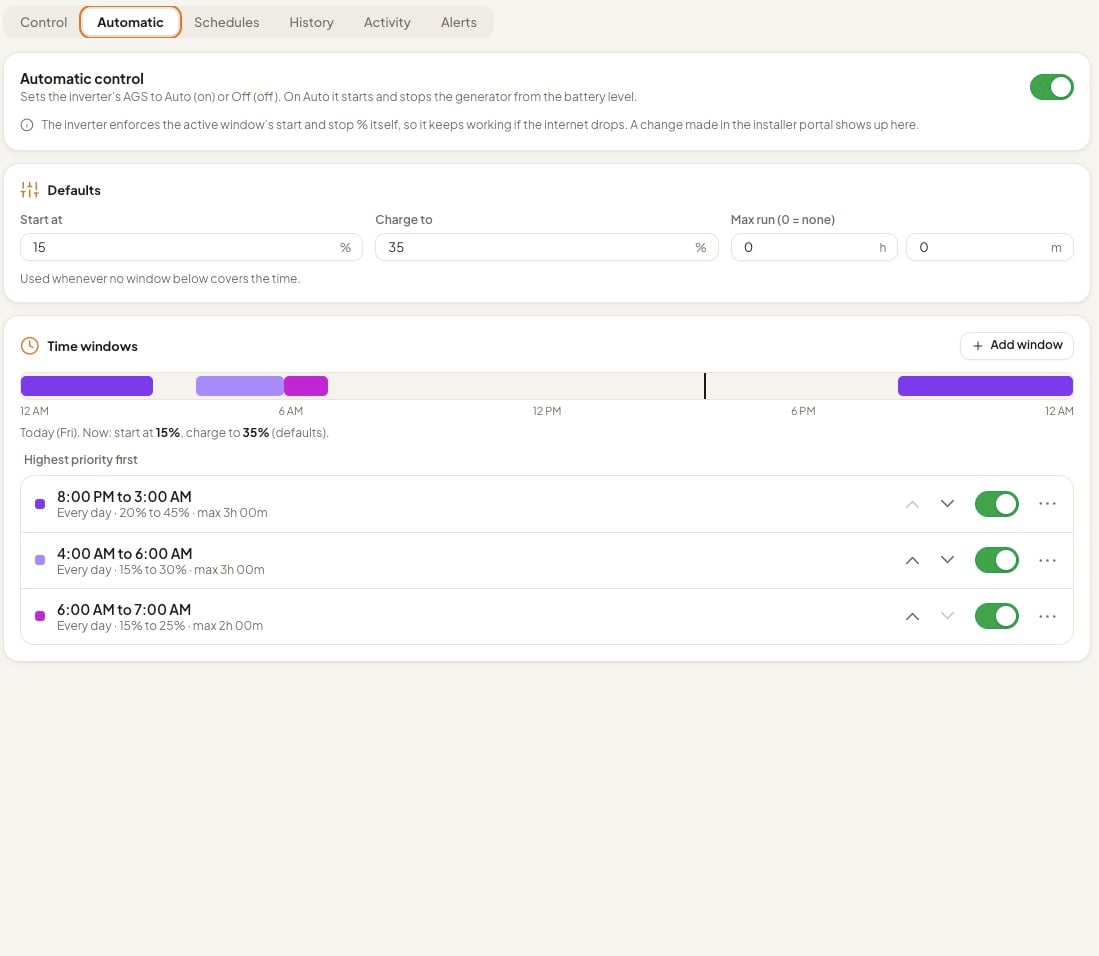
The inverter enforces the active numbers itself. If the internet drops, automatic starting keeps working. That detail matters, and it is one a manufacturer can do far better than I can from the outside.
The time windows are completely adjustable, with as many windows as you want, each with its own priority level.
A Run Now button with a time limit
The second request is almost embarrassingly simple. People want to start the generator from their phone, tell it how long to run, and trust that it will stop.
The control screen shows what the generator is doing right now: running or stopped, power, voltage on each leg, frequency, and battery level. Under that is Run Now. Pick a run time, optionally pick a battery level to stop at, and go.
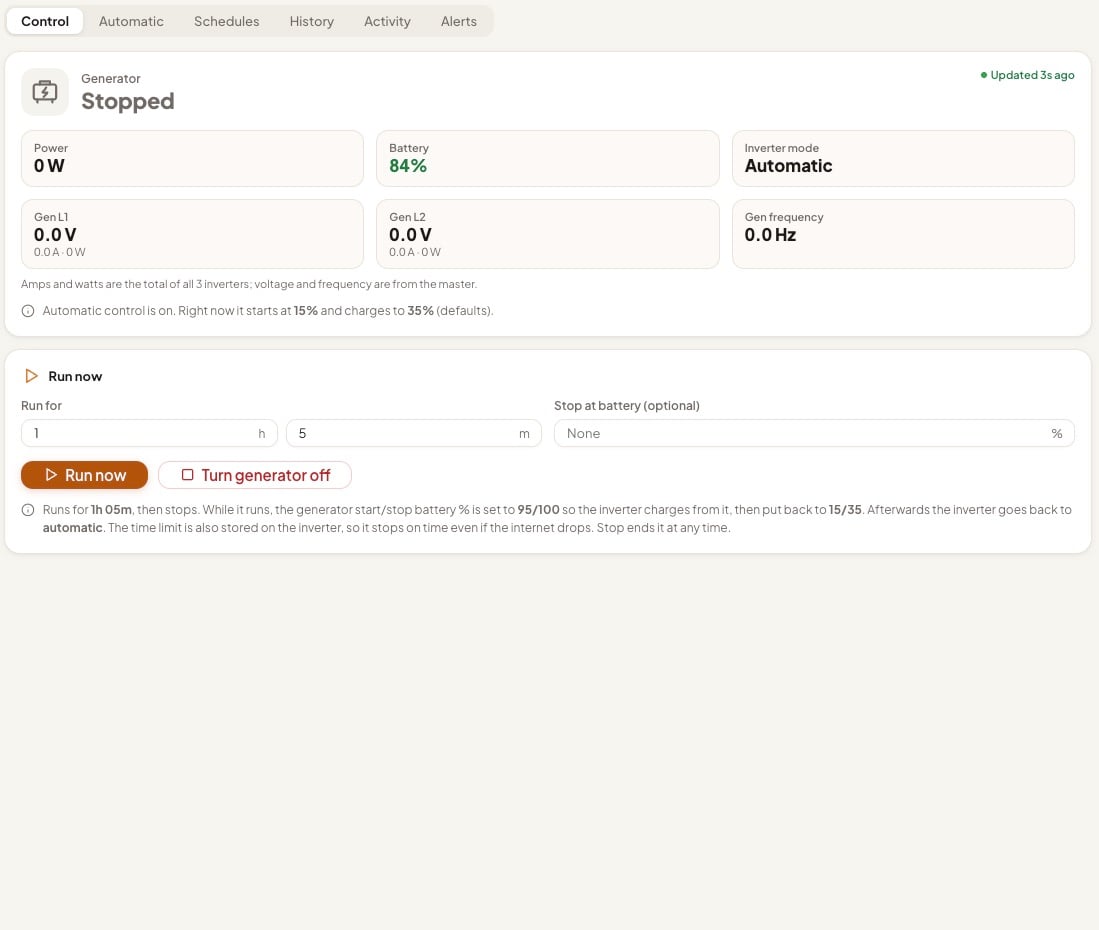
The time limit is stored on the inverter as well, so the run ends on time even if the connection is lost halfway through. When the run is over, the inverter goes back to whatever it was doing before. Nobody has to remember to put it back in automatic.
Scheduled runs and weekly exercise
A generator that never runs is a generator that will not start when you need it. Generator makers will tell you to exercise the machine regularly. Most inverter software treats that as someone else’s problem.
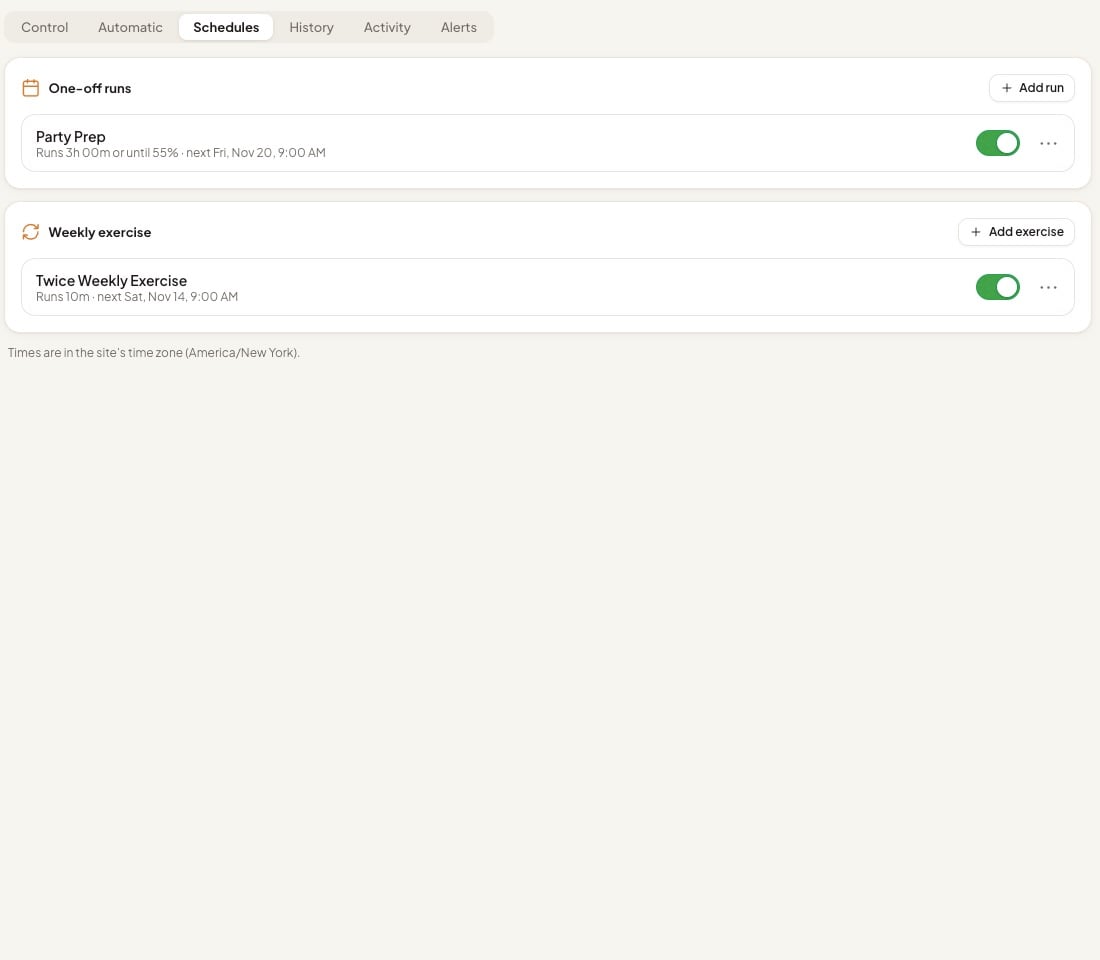
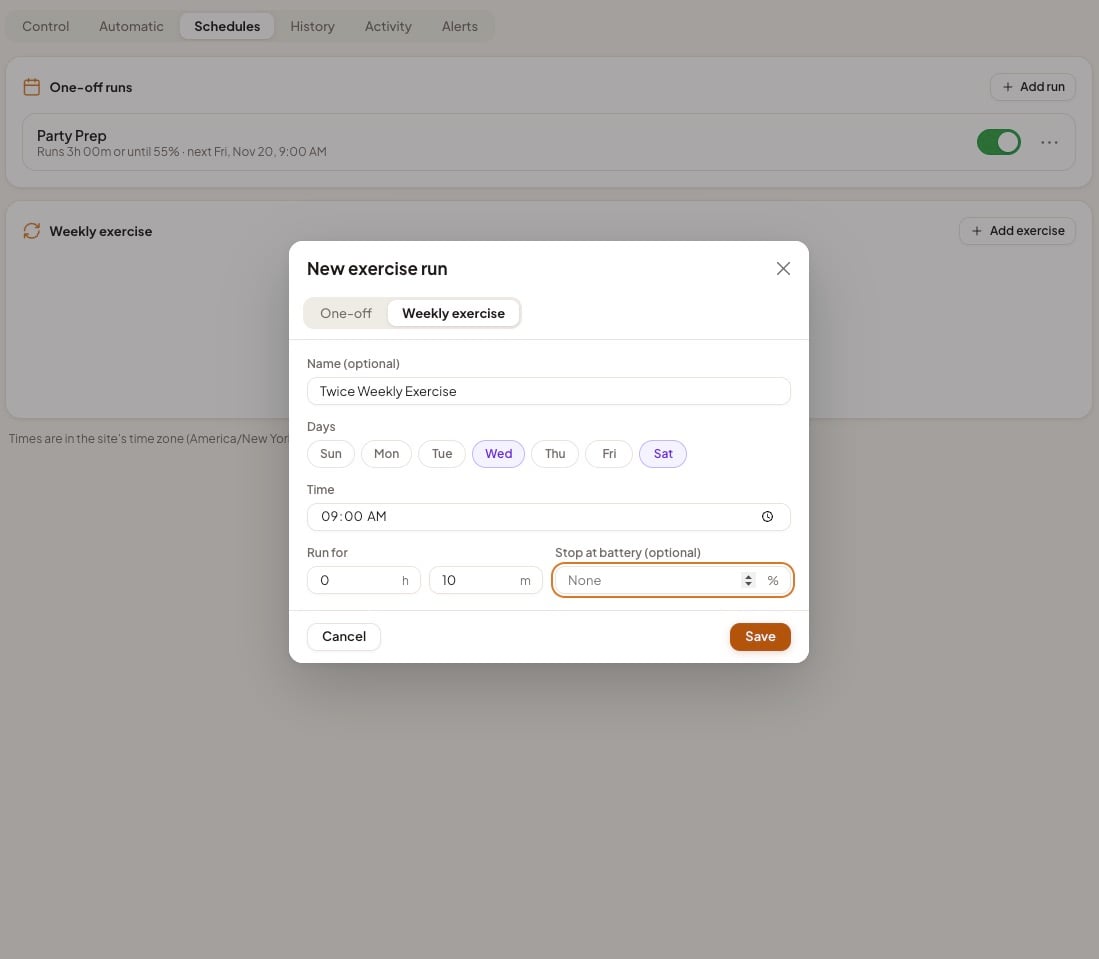
Here, a weekly exercise is a schedule: pick the days, the time, and the length. A one-off run works the same way. If you have a houseful of guests arriving Friday and want the battery topped off before they land, you set it once and forget it.
Setting one up takes about fifteen seconds.
History that answers real questions
I have said before that the real win in an off-grid upgrade is visibility. The same goes for generators. An hour meter tells you one thing. Owners want to know three: how long did it run, why did it start, and what did it do for the battery?
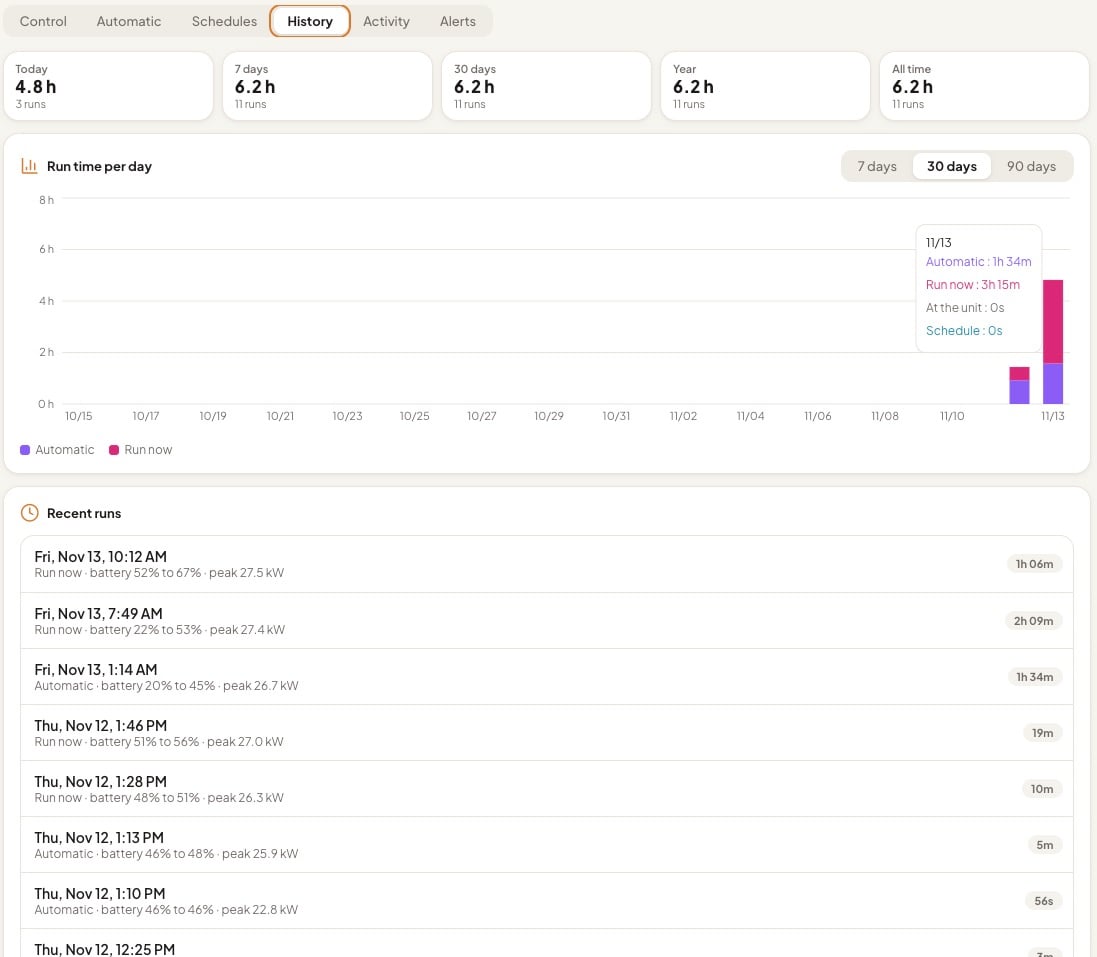
The history screen answers all three. Run hours by day, colored by cause: automatic, manual, scheduled, or started at the generator itself. Below that, every run with its start time, the battery level before and after, and the peak power.
On a bridgeless barrier island, every gallon of fuel arrives by boat. Run hours are not trivia out there. They are the fuel budget.
Alerts and a record of who did what
A lot of our customers are not here in August. Their property manager is, or their caretaker, or nobody at all. So the system sends an email or a phone notification when the generator starts and when it stops.
More importantly, it watches for what should happen and says so when it does not. If the generator was told to start and never produced power, someone hears about it. If it was told to stop and is still running, the stop command goes out again, and someone hears about that too.
Access can be shared, so the owner and the caretaker both have the controls. Every start, stop, and setting change is logged with a name and a time. When the generator ran for three hours on Tuesday, nobody has to guess who pushed the button.
What else belongs on the list
What I built is a start, not the finish line. A modern AGS should do more, and some of it is not even new. Generator controllers had several of these features back in the 1990s, which makes their absence from a modern all-in-one inverter hard to excuse.
- Charge the battery all the way to full (or some other percentage) if it has not been full in a set number of days.
- No-run hours (quiet times), with separate settings for weekends. And while we’re at it, why not offer programmable one-off quiet times?
- Start on a heavy load, not only on a low battery. Schneider (previously Xantrex), and Outback did this with heavy loads triggering AGS after 2 minutes, 15 minutes, 30 minutes, etc. We can do even better today with infinitely flexible criteria.
- Smart criteria. Imagine if you could tie some of the above together. Something like: start the generator automatically if a load of over 5 kW exists consistntly for 15 minutes, but only if the battery state of charge is under 60%.
The periodic full charge is the one I want next. Lithium batteries need a full charge every so often to keep the cells balanced and the battery gauge honest. A battery that drifts between 20 and 45 percent through two cloudy weeks never gets one. A rule that says “charge to full if it has not happened in so many days” fixes that without anyone thinking about it.
The same logic applies to exercise. A weekly exercise run is wasted fuel if the generator already ran for two hours on Tuesday. Exercise unless it has already run is the smarter rule. None of this is hard.
The hands-on start is the request I hear constantly. On a lot of all-in-one inverters, you cannot start the generator yourself and trust it to shut off. If the battery is a bit low and bad weather is on the way, you just want to top it off and walk away. That is the whole reason Run Now has a time limit and a battery target, and it is why I built that screen first.
Some of the existing solutions out there make you hunt through non-intuitive menus to get to the generator settings. There is no reason for that. It’s like an engineer designed the user interface (because that’s what happened, without consulting anyone who knows about UI/UX design). You don’t even need an expert today. Any AI tool will give you a better design than any of the available interfaces (except perhaps Enphase’s).
My system already records what caused each start. No-run hours are mostly covered by the time windows, though a hard override that blocks the generator outright belongs there too. Starting on load mattered more in the days of undersized inverters and batteries. I use it less now, but it is still a reasonable option to offer.
One more, and it is simpler than all of the above: a way to tell whether the start signal was sent at all. When a generator does not start, the first question is whether the fault is in the inverter, the control wiring, or the generator itself. My status screen answers that in three words. Starting means the signal has gone out. Running appears only when the inverter sees proper voltage on both legs. Charging appears only when power is flowing into the battery. Add why the start was called and how long the run is set to last, and you have the feedback loop remote monitoring needs.
The larger point is that owners want more programming options built around how they live. That goes well beyond generators.
It was not that hard
I am not telling you this to brag. I am telling you because of how little it took.
The inverter already had every setting I needed. Start level, stop level, maximum run time, and a generator mode of auto, on, or off. All I did was put a better front end on them: keep the right numbers in place at the right time of day, confirm the generator did what it was told, and write everything down.
This is not the first time I have ended up writing the software a manufacturer should have shipped. I would rather not make a habit of it. You have the firmware, the engineers, and thousands of installed systems. You can build this natively, and you can build it better.
I am not naming the inverter, because this is not about one company. The gap runs across the whole category.
Why you should care
Installers choose equipment, and the inverter choice drives everything that follows. I pick hardware on details like this one. So does every designer who has taken a 2 AM phone call about a generator that wouldn’t start or wouldn’t stop.
The first manufacturer to ship a modern, programmable, remotely controllable AGS will have a selling point the others cannot match with a spec sheet. Off-grid and generator-backed homes are not the biggest slice of the market. They are the slice where the customer notices every flaw and tells the neighbors.
The Bottom Line
Manufacturers: automatic generator start should not be two numbers in an installer menu. Give owners battery levels that change by time of day, a Run Now button with a time limit, schedules, run history, alerts, and a log. I built all of it on top of one of your inverters in a few days. Build it into yours.
I’m pretty busy with my “day job,” which is also a “night job” sometimes. But if you’re interested in hiring me for some consulting work on the side, I would consider it.
Homeowners: if you are pairing a generator with a battery system, ask four questions before you buy. Can I start and stop the generator from my phone? Can the start and stop levels change by time of day? Will it tell me when the generator starts, stops, or fails? Can I see how long it ran and why? If the answer is no, you are buying a generator that runs on its schedule instead of yours.
If you have a generator and a battery system in Southwest Florida that do not cooperate, call Florida Solar Design Group. Making the two work together is exactly the kind of problem we like. Custom solutions are possible. I’ve done it.