Thinking About Buying Plug-In Solar Panels in Florida? Read This First
APsystems just announced a new U.S. “plug-in” microinverter (the EZ1) aimed at small, DIY-friendly solar setups for balconies, patios, terraces, gardens, and other tight spaces. The headline feature is simple: connect the microinverter to modules, then plug it into a wall receptacle with an included AC cable and start producing power.
If you’re in Florida and you’re considering buying one of these products, you need to understand where this idea works, where it fails, and where it can create real safety and compatibility problems.
What This Technology Is Also Called
You’ll see the same concept marketed under a bunch of names:
- Balcony solar (common internationally)
- Balkonkraftwerk (Germany’s “balcony power plant” term)
- Plug-in solar
- Plug-and-play solar
- Cord-connected solar
- Portable solar (plug-in)
Has This Been Tried Before? Yes. Mostly Outside the U.S.
This is not a brand-new idea. Germany has been the center of gravity for balcony solar for years. Germany’s plug-in solar market accelerated after technical rules and policies started explicitly allowing plug-in devices and simplifying adoption.
Germany has continued pushing it mainstream. For example, Germany’s economy ministry has described policy changes and consumer rights around plug-in solar in recent updates, including expanded rights for apartment owners and tenants to install plug-in systems.
And Europe is still formalizing product standards in this space. In late 2025, a German solar industry group highlighted what it described as a first dedicated product standard for plug-in solar devices (DIN/VDE V 0126-95).
Translation: In places like Germany, this works because the regulatory framework was intentionally adjusted to support it. Florida has not done that.
What Happened When the U.S. Tried It?
In the U.S., plug-in solar has mostly lived in the “niche / early adopter” zone because rules are not standardized state-to-state, utilities have their own interconnection requirements, and inspectors default to existing PV rules that were written for permitted, hardwired PV systems.
One major development: Utah passed legislation creating a defined category for “portable solar generation devices” and exempting them (under specific conditions) from typical state interconnection agreement requirements. That kind of explicit carve-out is the exception, not the norm. Florida does not have an equivalent statewide framework.
Separately, the national conversation is picking up steam (and you’ll see more states flirt with it), but that does not automatically change what your Florida building department, insurer, or utility company expects.
Florida Reality: Permanent Mounting Is the Line You Don’t Cross
Here’s the key distinction that gets glossed over in marketing:
- Portable setup (not permanently attached to a building) is one conversation.
- Building-mounted PV on a dwelling (roof, wall, balcony railing, etc.) is a completely different conversation.
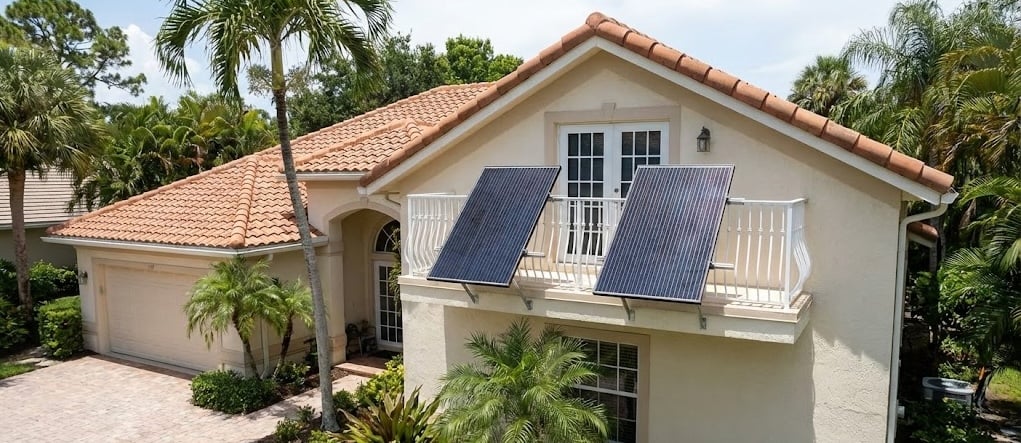
In Florida, once you permanently mount PV equipment on a dwelling, you’re squarely in permit + inspection + code-compliance territory. That usually means engineering, structural review (wind loads matter here), electrical permitting, and compliance with PV safety rules.
Rapid Shutdown: Not Optional on Dwellings
The National Electrical Code Section 690.12 requires rapid shutdown for PV system circuits installed on or in buildings to reduce shock hazards for emergency responders.
The NEC has clarified exceptions over time (for example, certain non-enclosed detached structures), but the big-picture intent is the same: PV on buildings (especially dwellings) needs a rapid shutdown approach that meets code.
If a plug-in system is permanently mounted to a dwelling, you should assume rapid shutdown is required and that it needs to be done in a way an inspector will accept. When you start adding devices and design changes to satisfy that requirement, the “simple cheap plug-in solar” story starts falling apart.
Why This Gets Costly Fast in Florida
Florida is not forgiving on anything attached to a structure. Wind load engineering and code-compliant attachment methods are part of the deal, especially on exterior railings and elevated surfaces. Even “small” modules can become dangerous in high winds if the attachment method is not engineered and installed correctly.
For many buyers, the soft costs (engineering, permitting, inspections, compliant mounting) can easily exceed the cost of the small PV hardware itself.
Safety Pitfall: Generators and Plug-In Solar Can Be a Bad Mix
Most plug-in microinverter products are designed to synchronize with a stable AC grid reference.
If you lose utility power and you run a portable generator (or a standby generator system) while a plug-in PV inverter is still connected to your wiring, you can create unstable conditions. Best case, it trips off. Worst case, you damage equipment.
Simple rule: Never assume a plug-in inverter is compatible with generator operation unless the system is specifically designed and wired for that scenario.
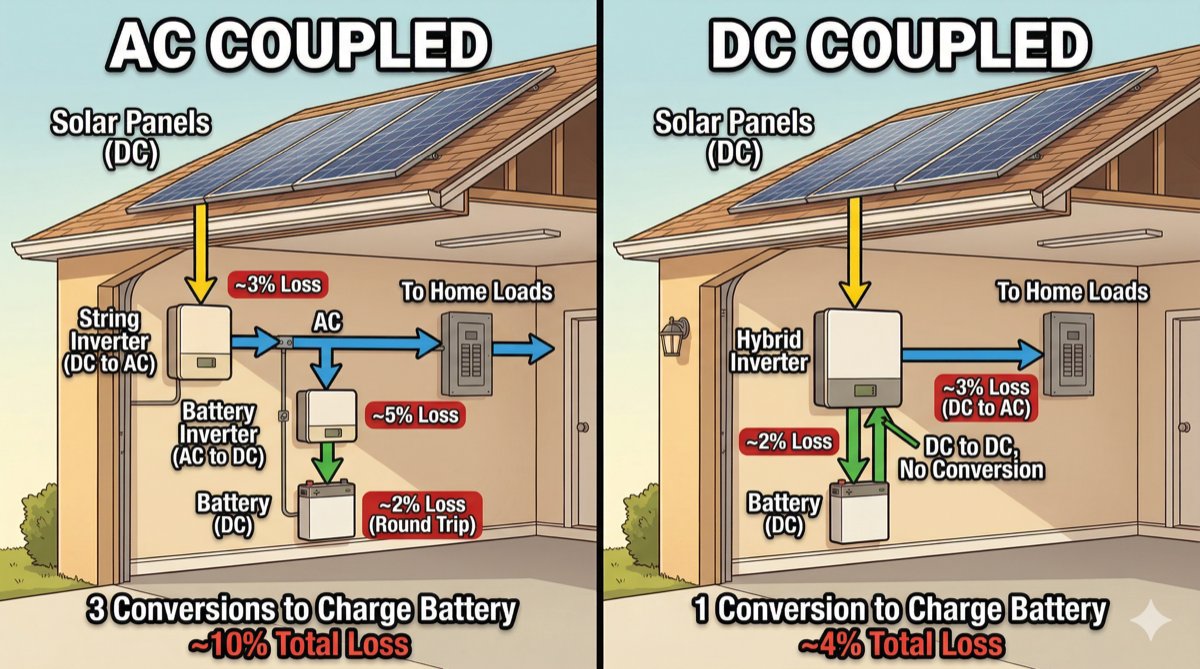
Compatibility Pitfall: Hybrid Inverters and AC Coupling
A lot of homeowners now have (or are adding) hybrid inverters and batteries. That’s where plug-in solar can get messy.
Some hybrid systems are designed to accept AC-coupled PV only through specific ports, under specific settings, and with specific control logic. Others may block backfeed in certain operating states to avoid unstable behavior. As an example, EG4’s GridBOSS platform includes AC-coupling control logic and settings intended to manage AC-coupled inverters, including opening relays in certain conditions and controlling behavior based on battery SOC, voltage, time windows, and power flow.
EG4 has also published guidance for AC coupling configurations in GridBOSS/FlexBOSS systems.
What this means for buyers: “It plugs into an outlet” does not mean “it plays nicely with whatever inverter/battery system you already have.” Wrong location, wrong port, wrong operating mode, or a grid outage at the wrong moment can create faults, nuisance trips, or worse.
Capacity and Cost Per Watt: Manage Expectations
These plug-in systems are generally small. They can help cover daytime “always-on” loads (router, fridge cycling, standby loads, lighting), but they are not a meaningful answer to Florida’s big electrical drivers like central A/C, pool heating, EV charging, or large resistance loads.
And because the system is small, cost per watt is typically high compared to a conventional permitted roof system where design, permitting, and labor are spread across a much larger array.
Utility Interconnection: The Part Buyers Usually Miss
Even if you ignore permitting for a moment, there is a separate issue that matters just as much: utility interconnection.
In Florida, you do not get a legal grid-tied solar interconnection by “just plugging something in.” Utilities generally require an approved interconnection application and agreement before you are allowed to operate generation in parallel with the grid. In practice, you typically can’t complete that process without an electrical permit and an inspected installation.
If you operate grid-tied generation without an interconnection agreement, the utility can treat it as an unauthorized parallel generator. At best, you get a warning. At worst, you get your service disconnected until it’s resolved.
Now here’s the real kicker for plug-in solar products: they have no practical way to guarantee “house-only” operation. The inverter will push power into your home wiring, and if your instantaneous production exceeds your instantaneous usage, the excess will flow backward through your service and export to the utility grid. That export can happen even with a small system, especially mid-day if your home loads are low.
Some buyers assume, “It’s small, so it won’t export.” That is not a safe assumption. These systems can produce enough power to exceed a light-load house in the middle of the day, which means export is absolutely possible.
There is also a financial pitfall that’s rarely discussed: exporting without a net metering / interconnection setup can cost you money. Many standard digital meters and even many smart meters are configured to bill based on the absolute value of energy flow (or otherwise do not credit export unless you are on an approved net metering or buyback rate). That means energy flowing backward can still be counted as consumption, or at a minimum not credited, depending on how the meter and tariff are configured.
Bottom line: If you don’t have an interconnection agreement, you shouldn’t assume you’re allowed to export, and you definitely shouldn’t assume you’ll be credited for it. With plug-in solar, export can happen automatically any time production is higher than your house load, and there’s no built-in export limiting to prevent it.
Where Plug-In Solar Can Make Sense in Florida
- True portable use (not permanently mounted to a dwelling)
- Temporary setups for education, testing, or hobby use
- Detached, non-dwelling structures in limited scenarios (still requires care and local interpretation)
- Renters or condo owners who want a small, removable system and understand the limits
If you’re using it like an appliance and keeping it truly portable, you avoid a lot of the building-mounted PV triggers. The moment you permanently mount modules to a dwelling, you should expect the same permitting and safety requirements as any other PV system.
Practical Buyer Checklist
- Is it portable, or are you about to attach PV to a building?
- Does your home have a generator, interlock, transfer switch, or standby system?
- Do you have (or plan to add) a hybrid inverter / battery?
- Is the product properly listed for U.S. grid interconnection use (UL 1741 class equipment is the common universe here)?
- Are you prepared for permit + inspection if you mount it to the dwelling?
- Do you understand how you will meet rapid shutdown requirements if it’s building-mounted?
Bottom Line
Plug-in solar is real, and it’s proven in places where the rules were adjusted to support it. Florida has not done that. If you keep it truly portable, it can be a niche tool. If you permanently mount it to a dwelling, you’re back in the world of permitting, engineering, inspections, and rapid shutdown.
If your goal is meaningful savings or a serious resilience plan, a properly designed and permitted PV system is still the practical path in Florida.