

There is a story going around that FPL’s time-of-use rate is a money printer. The pitch is simple. Add a battery, buy power for almost nothing overnight, and stop paying the expensive daytime rate. Cut your bill in half while you sleep. The problem is that some of the numbers behind that pitch are wrong, and not by a little. The off-peak rate people keep quoting is off by roughly three times. The idea itself is sound. The math just has to be done honestly, on your actual house, not on a tidy monthly average that hides everything that matters.
What FPL’s Time-of-Use Rate Actually Is
FPL offers a residential time-of-use option called RTR-1. It layers on top of the standard residential rate, RS-1, and changes one thing. Instead of paying a single flat price for every kilowatt-hour, you pay a high price during on-peak hours and a much lower price the rest of the time.
All-in, on-peak power runs about 26.9 cents per kilowatt-hour. Off-peak runs about 6.0 cents. For comparison, the standard flat RS-1 rate is roughly 12.26 cents all-in for the first 1,000 kilowatt-hours in a month. So on-peak is more than double the flat rate, and off-peak is less than half of it. That gap is the entire reason anyone considers this.
The peak hours are not the same all year. From April through October, on-peak is noon to 9 pm on weekdays. From November through March, it splits into a morning window from 6 to 10 am and an evening window from 6 to 9 pm. Weekends and the major federal holidays are off-peak around the clock. If you want the official schedule and the current figures, pull them straight from FPL’s rate information, because these numbers do change.
The Arbitrage Is Real, With or Without Solar
The spread between 27 cents and 6 cents is what you are trying to capture. Every kilowatt-hour you can move out of the peak window and into the cheap one is worth about 21 cents. A battery is the tool that moves it. Charge the battery overnight when power is cheap, then run your house off the battery during the peak so you are not buying 27 cent electricity. You bank the difference, minus the round-trip efficiency loss of the battery.
The part that surprises people is that you do not need solar panels for this to work. A battery by itself, charged off-peak and discharged on-peak, is a straight rate arbitrage play. Solar makes the economics stronger because it charges the battery for free during the day and offsets your usage, but the time-of-use spread stands on its own. That is a genuinely different way to think about storage in Florida, where most battery conversations start and end with hurricane backup.
The Off-Peak Number You Saw Online Is Probably Wrong
Here is where most of the online math falls apart. You will see claims that FPL off-peak power costs under two cents per kilowatt-hour, or that the base rate is under eight cents. Those are not all-in numbers. They are single line items lifted out of the tariff, usually the base energy charge or one rider, with the fuel charge and the rest of the riders quietly left off.
Your real bill is the sum of several pieces: base energy, fuel, conservation, capacity, environmental, storm protection, and a small transition credit. Stack all of them and off-peak lands right around 6 cents, not 1.7. On-peak is close to 27 cents, not the 14 cent energy adder by itself.
This is not an academic distinction. Using an off-peak rate of under two cents instead of six roughly doubles the projected savings. A deal that looks like free money at the wrong number looks a lot more ordinary at the right one. It can still be worth doing. It is just not the slam dunk the headline promised.
Monthly Averages Lie
Almost every quick savings estimate starts with your average monthly consumption, often a generic figure for a typical home. For a flat rate, that is fine. For a time-of-use rate, it is close to useless.
A monthly total tells you how much you used. It tells you nothing about when. And when is the whole ballgame here. Two homes with identical monthly bills can land on completely different sides of this decision depending on whether their usage stacks up during the noon to 9 pm peak or spreads into the cheap hours. A retiree who runs the air conditioning hard all afternoon and a family that is gone until 6 pm will get opposite answers from the same average.
The only way to get this right is to look at the actual hour-by-hour profile, all 8,760 hours in a year. If you own an Enphase system with consumption monitoring, you already have this. You can export a full year of interval data, the SAM 8760 file, and model your real house instead of a statistical stand-in.
The Calculator I Built
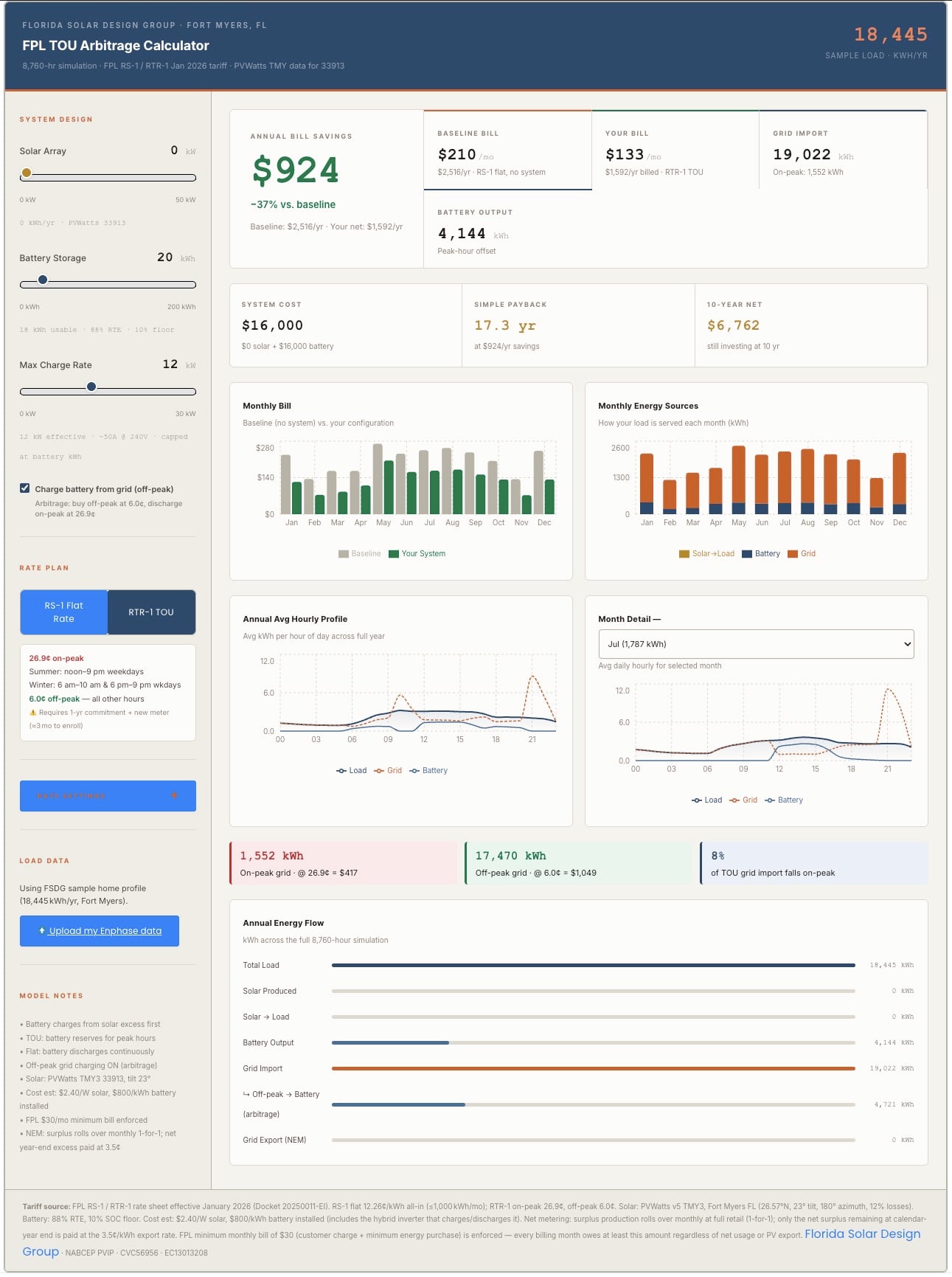
That is exactly what the FPL Time-of-Use Savings Calculator does. It runs a full 8,760 hour simulation right in your browser. You can start with a representative Southwest Florida home or upload your own Enphase data. Then you set the variables that actually move the result: solar array size, battery capacity, the inverter’s charge rate, and whether the battery charges from the grid during off-peak hours.
Under the hood, it uses the correct all-in tariff rates, not the cherry-picked ones. It models FPL net metering the way FPL actually runs it, with surplus production rolling over at full retail value and only the year-end net excess paid out at the lower export rate. The battery dispatch is smart about it too. It only buys the off-peak grid power that your solar will not already cover, so it does not overstate your savings.
It is free, and it sits with the rest of my solar tools and calculators. If you want to estimate your annual solar production first, the solar panel output simulator is a good companion.
The Risk That Never Makes the Headline
Time-of-use is not a one-way bet, and the ways it goes wrong are not exotic.
First, RTR-1 is a commitment. It requires a 12-month enrollment and a new meter, and getting onto the rate can take around three months. You cannot test it for one bad billing cycle and walk away. If your household changes inside that year, you live with it.
Second, behavior. Buy an electric vehicle and start charging it during the peak window and the math does not just shrink, it inverts. You are now running a large load through the 27 cent door instead of the 6 cent one. A battery only saves you here if it is big enough and charges fast enough to carry that load, and plenty of systems are not.
Third, the failure case. If your battery drops offline during a Southwest Florida summer, every hour of air conditioning from noon to 9 pm is suddenly billed on-peak. That is a genuinely ugly bill, and the only free workaround is sweating it out with the air conditioning off until the system is back. There is also a floor under all of it. FPL enforces a minimum monthly bill, so your savings can only go so far no matter how clever you get.
Sizing the Battery Is Where Deals Are Won or Lost
If you do this with storage, the hardware decisions carry the outcome. We design around Enphase, Tesla Powerwall 3, EG4 FlexBoss and GridBoss, Sol-Max AIO (formerly Midnite AIO), Sol-Ark, and FranklinWH, and the right pick depends on your loads and your goals.
The two numbers that matter most are usable capacity and charge rate. The battery has to hold enough energy to cover your on-peak load, and it has to recharge fast enough overnight to be full before the next peak. A typical hybrid inverter caps battery charging somewhere around 12 kilowatts. You can stack inverters, but at some point you are pushing a very large load onto a 200 amp service. An undersized battery on a time-of-use rate is a half-measure that leaves you buying peak power during the exact hours you were trying to avoid.
This is the same design discipline that goes into battery backup for Florida homes. Whether the goal is rate arbitrage or hurricane resilience, an honestly sized system is the difference between a plan that works and a plan that only looks good on paper.
The Bottom Line
FPL’s time-of-use rate can save a Southwest Florida homeowner real money, especially with a properly sized battery, but it is not the guaranteed windfall being sold online. Off-peak power is about 6 cents, not under 2, and the 12-month commitment means one new EV, one change in routine, or one battery failure can turn a smart move into an expensive lesson. The decision is too house-specific to make from a monthly average and someone else’s spreadsheet.
Run your own numbers, hour by hour, with the correct rates. Use the FPL Time-of-Use Savings Calculator, upload your Enphase interval data if you have it, and see what your actual house does on this rate. If the result looks promising and you want a system designed to hold up to it, that is what we do at Florida Solar Design Group.


