

Most solar equipment manufacturers handle warranty claims the same way. You call support. You troubleshoot over the phone. They ship you a replacement unit. Your installer pulls the old one off the wall, puts the new one on, and hopes the problem doesn’t come back. Nobody from the factory ever shows up. Nobody with deep product knowledge ever lays hands on the equipment to figure out what actually went wrong.
Enphase does something different, and it deserves a shout out.
Enphase Energy employs a nationwide team of Field Service Technicians (FSTs) who are factory-trained, factory-employed, and dispatched directly to job sites to diagnose and repair complex warranty issues. These are not subcontractors. These are not independent technicians from a gig platform. These are Enphase employees with deep knowledge of the product internals who show up, open the equipment, and fix it.
Why Factory Technicians Matter
When a microinverter or battery has a straightforward failure, the standard warranty process works fine. Enphase issues an RMA, ships a replacement, and the installer swaps it out. That covers most situations. But some problems are not straightforward. Communication faults that affect an entire array. Intermittent issues that don’t show up on a single site visit. Controller problems that could be a relay or a circuit board. Battery issues that require swapping an internal power control unit rather than replacing the entire enclosure. These are the cases where the standard swap process doesn’t get you anywhere because the root cause is still unknown, or it’s unknown but beyond what an installer can address.
That is where the FST team steps in. They carry diagnostic tools and replacement components that most installers don’t have access to. They can swap a circuit board or relay inside a system controller without pulling the entire unit off the wall. They can replace a power control unit inside a battery enclosure, something that has happened on systems we have installed. They can run firmware diagnostics that go deeper than what the installer portal shows. In many cases, this means a faster, less invasive repair that gets the system back online without a full equipment replacement.
From an installer’s perspective, this is a big deal. We are good at installing systems. We are good at troubleshooting the things we can see and measure. But when the problem lives inside a sealed enclosure at the component level, we are not always in the best position to fix it. Opening up a controller to swap a relay is not something installers carry parts for or have been trained to do. It is a specialized skill that belongs with the manufacturer, and Enphase recognizes that.
Proactive Outreach, Not Just Reactive Repair
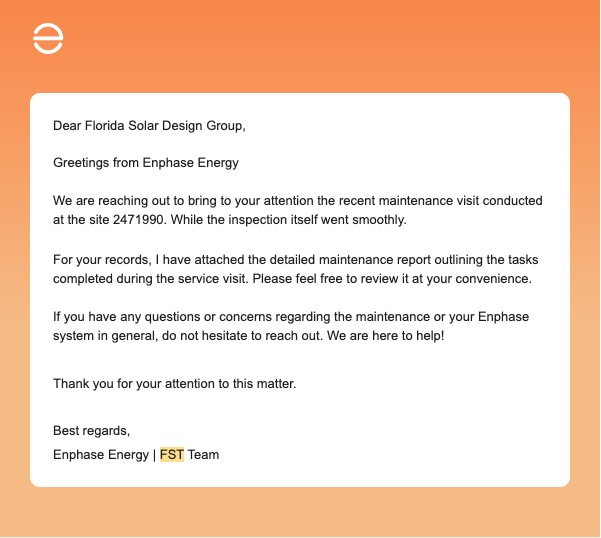 Here is the part that genuinely surprised me the first time I saw it. Enphase has reached out proactively to homeowners to address known product deficiencies before those homeowners even reported a problem. Think of it as a voluntary recall, except without the scary language and red tape. Enphase identifies a pattern, determines which systems are affected, and contacts the homeowner directly to schedule a visit from a field service technician to correct the issue.
Sometimes this happens without any installer interaction at all. Enphase goes directly to the homeowner, schedules the appointment, and handles the repair. In a world where manufacturers routinely try to weasel out of warranty obligations, deny claims on technicalities, or drag out the process until the customer gives up, this proactive approach is refreshing. It signals a company that is more interested in getting the product right than in minimizing warranty expense.
I have seen this play out on systems we installed. Enphase identified an issue, contacted our client, and had a technician on site before we even knew there was a problem. That is not normal behavior from a manufacturer. That is the kind of thing that builds long-term trust with both homeowners and the installers who recommend the product.
The Labor Warranty Gap
Here is something most homeowners do not fully understand about solar warranties. The product warranty on Enphase microinverters is 25 years. That covers the equipment itself. If a microinverter fails in year 15, Enphase will send you a replacement. But the labor to install that replacement is a different story.
Enphase offers a standard labor reimbursement program that covers the first two years after system activation. During that window, the installer who does the warranty swap gets a labor stipend that may or may not cover the full cost of replacement. After two years, that reimbursement disappears unless the installer purchased an extended Labor Protection Program (LPP), which adds either three or eight additional years of coverage.
Most installers do not purchase the LPP for every system. Because the failure rate of Enphase products is so low, we do not recommend it. You will be better off paying as you go for any unlikely and unfortunate warranty-relared labor costs.
Most installer labor warranties cover defects in workmanship, not product defects from third-party manufacturers. If your Enphase microinverter fails in year five, the product is still under warranty. Enphase will send a replacement. But who pays the installer to go up on the roof, pull the old unit, and install the new one? In many cases, that cost falls on the homeowner.
This is where the FST program quietly fills a gap that most people do not even know exists. When Enphase dispatches a field service technician to your home for a complex warranty issue, there is no charge to the homeowner. There is no charge to the installer. Enphase absorbs the labor cost because the technician is their employee, doing their work, on their dime.
How the FST Process Actually Works
I want to be clear about something. The FST program is not a service you can call up and request. You cannot call Enphase and say “send me a field tech.” It is part of an escalation process that can be initiated in a couple of ways. Sometimes the installer drives it through the normal warranty support channels when a problem proves too complex for a standard RMA swap. Sometimes Enphase’s own support team recognizes that an issue requires hands-on factory expertise and dispatches an FST on their own. And sometimes, as I described above, Enphase identifies a systemic product issue and proactively sends FSTs to affected homes without anyone asking.
It is not 100% clear when the FST organization takes over a case. There is no published checklist or threshold that says “if X, then FST.” But after installing Enphase products since 2009, I have learned the ins and outs of their customer service organization well enough to recognize when a problem points to an FST-level issue. Communication faults across an entire system. Repeated failures of the same component. Internal hardware problems that point to a circuit board issue. These are the patterns.
I have also had success reaching out directly to the FST management that covers our area in Southwest Florida when issues are not being resolved effectively through the standard telephone support channels. I do not say that to brag. I say it because the reality of manufacturer support is that first-tier phone reps are often working from scripts, and sometimes I understand the technical issue better than the person I am speaking to. Knowing that a particular problem is an FST-level issue, and knowing who to contact to get that process started, can save weeks of back-and-forth troubleshooting that was never going to solve the problem anyway.
That kind of institutional knowledge is one of the less obvious advantages of working with an installer who has been in the Enphase ecosystem for over 15 years. We know what the standard support process can handle and when it is time to escalate.
Root Cause Analysis vs. Swap and Pray
When an installer swaps a failed unit, the old unit usually gets shipped back to the manufacturer in a box, or is sometimes discarded. Maybe someone at the factory runs a post-mortem. Maybe they don’t. The installer never finds out what went wrong, and neither does the homeowner. If there is a pattern, like a batch of components with a higher failure rate, it takes longer to identify when the data is fragmented across thousands of independent installers doing their own thing.
When an Enphase FST diagnoses a problem on site, they are collecting data in real time for the company. They can identify failure patterns, flag design issues, and provide feedback that goes directly to the engineering team. This is how manufacturers improve products. It is how they catch problems before they become widespread. And it is something that the “ship a replacement and hope for the best” model will never accomplish as effectively.
Enphase has also been designing its newer products with field-replaceable components in mind. The 5P battery, for example, was specifically designed so that certain internal parts can be swapped without replacing the entire enclosure. That design decision was made with the FST program in mind. If a power control unit or other internal component goes bad, the technician replaces that specific part. The homeowner keeps the same battery on the wall. The repair takes less time, generates less waste, and costs Enphase less than shipping and scrapping an entire unit.
Not Every Manufacturer Does This
In the residential solar space, the typical manufacturer support model is remote troubleshooting, RMA processing, and leaving the rest to the installer network. The idea that a manufacturer would send its own trained technician to a homeowner’s garage to swap components inside a controller or battery at no charge is genuinely uncommon. The idea that they would proactively reach out to homeowners to fix problems that haven’t even been reported yet is almost unheard of.
It is also worth noting that the FST program is separate from Enphase Care, which is a paid service plan that Enphase recently launched. Enphase Care offers monitoring, remote diagnostics, and covered on-site labor for warranty repairs through a subscription model. Interestingly, Enphase Care is not currently available in Florida. But the FST program operates independently of that. Factory technicians are dispatched based on the complexity of the warranty issue or the scope of a known product deficiency, not based on whether the homeowner has purchased an additional service plan.
Why This Should Factor Into Your Decision
Enphase products carry a premium price tag. Microinverters cost more than string inverters. Enphase batteries cost more per kilowatt-hour than some competitors. That is not a secret, and I have written about it plenty. But when you are evaluating the total cost of ownership over a 25-year product life, the quality of warranty support matters as much as the hardware specs.
A cheaper product with no factory service support might save you money up front. But when something goes wrong in year seven, you are on your own finding an installer willing to do the warranty work, possibly paying for that labor out of pocket, and hoping the replacement fixes the issue. With Enphase, there is a team of factory technicians whose entire job is to make sure complex problems get solved correctly. And in some cases, they will find you before you find them.
I am not saying Enphase is perfect. No manufacturer is. Their products have quirks, their support processes have friction, and their pricing is not for everyone. But the FST organization is a competitive advantage that does not get enough attention. It is one of the reasons we continue to recommend Enphase products in Southwest Florida for clients that want all of the bells and whistles, premium support, and have the budget to support it.
The Bottom Line
Enphase employs factory-trained field service technicians who travel to job sites across Florida and the rest of the country to diagnose and repair complex warranty issues at no charge. They perform component-level repairs that most installers cannot. They proactively reach out to homeowners when known product issues are identified. And they collect real field data that drives product improvements. In an industry where most manufacturers outsource warranty labor to their installer network, this is a meaningful differentiator. If you are comparing solar and battery options and wondering whether the Enphase premium is justified, the FST program is one more reason it might be. If you want to talk about Enphase systems for your home, contact Florida Solar Design Group and we will walk you through your options.


