

Plug-in solar panels are the hottest thing in European energy. Germany alone has over a million registered balcony solar systems. You buy a panel and a microinverter online for a few hundred bucks, hang it on your railing, plug it into a wall outlet, and start generating electricity. No electrician. No permit. No utility approval.
Sounds amazing, right?
It can be. But it can also melt the wiring inside your walls and start a fire that you never see coming. And the reason it can do that is something most plug-in solar marketing will never explain to you.
The Circuit Overload Problem Nobody Talks About
Here is the scenario that should keep you up at night.
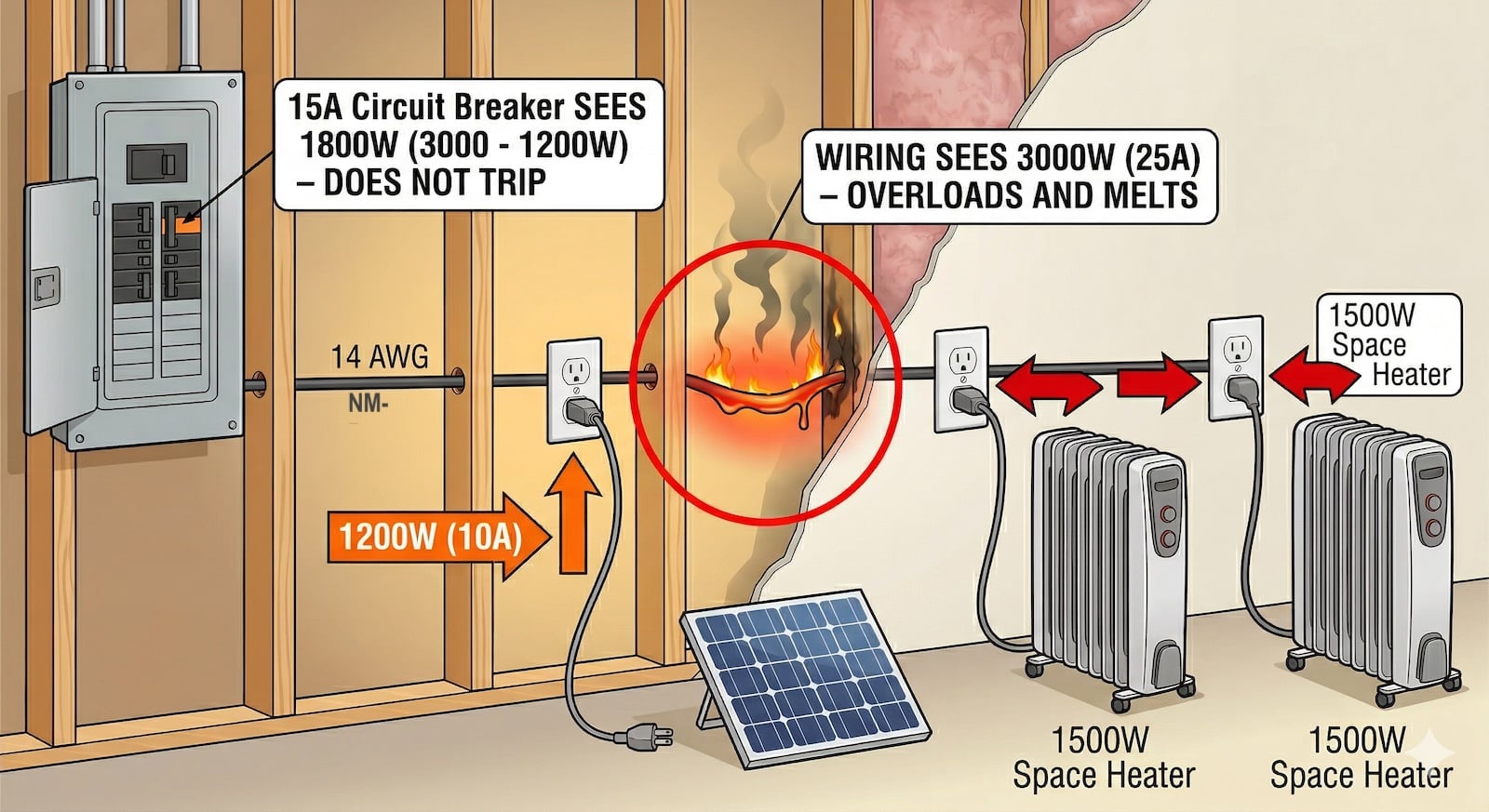
You have a standard 15-amp, 120-volt branch circuit in your home. That circuit is rated for 1,800 watts. It runs from your breaker panel through the walls to a series of outlets. You plug a 1,200-watt plug-in solar array into the first outlet on that circuit. Two outlets downstream, you have a couple of space heaters pulling 1,500 watts each.
Now here is where it gets dangerous. The 15-amp breaker at the panel sees the net current flowing through it. The solar array is pushing 1,200 watts into the circuit while the space heaters are pulling 3,000 watts out. From the breaker’s perspective, it only sees 1,800 watts (3,000 minus 1,200) flowing through it from the utility side. That is exactly 15 amps. The breaker does not trip. Everything looks normal at the panel.
But inside your wall, the wiring between the solar outlet and the space heater outlets is carrying the full 3,000 watts. That is 25 amps on 14-gauge wire rated for 15. The wire overheats. The insulation softens. If this continues, the wire melts, arcs, and your wall catches fire.
The breaker never trips because it never sees the full load. The solar input is masking the true current on the downstream wiring. This is called breaker masking, and it is the single most dangerous aspect of plug-in solar that goes unregulated when people ignore the rules.
Why Does Europe Allow This?
Germany has been doing plug-in solar (they call it Balkonkraftwerk, or balcony power plant) for years. Over a million systems are registered. Millions more are likely operating without registration. And by all accounts, the safety record is remarkably clean.
How? Limits.
Germany caps plug-in solar at 800 watts of inverter output. At that power level, even in the absolute worst-case scenario on the oldest wiring in the country, the additional current is low enough that it cannot overheat a properly functioning circuit. The math just does not get scary at 800 watts on a 16-amp European circuit (230 volts).
German regulators studied the problem, identified the threshold where breaker masking becomes dangerous, and set the limit well below it. They also simplified registration, gave renters the legal right to install systems over landlord objections, and made the whole process about as complicated as buying a toaster.
The result is an energy democracy movement. Apartment dwellers who could never put panels on a roof they do not own are generating their own electricity. Spain, Italy, Poland, and France are following the same playbook. The European model works because the limits are conservative, the inverters are certified, and the systems are small enough that the wiring physics stay safe.
But the real key here is amperage. At double the voltage, circuits only carry half the current, all else being equal. 800W of solar in Europe is like 400W of solar in the U.S. in terms of ampacity. That means the safe limit here, for the same wire size, is about half the solar they can install in Europe to maintain the same restrictive safety levels.
The Push to Bring It to America
The U.S. is now trying to catch up. Utah passed the first state law explicitly allowing “portable solar generation devices” up to 1.2 kW without utility interconnection approval, provided the equipment meets NEC and UL standards. California introduced similar legislation. As of early 2026, more than 20 states have introduced or are considering plug-in solar bills. The Clean Energy States Alliance published a detailed guidebook for state policymakers navigating the technical and regulatory issues.
Wyoming introduced a bill. Ohio has bipartisan support. This is not a blue-state initiative. A Republican state representative in Utah framed it simply: this is about removing a regulation and letting people produce a little of their own energy.
But the U.S. faces challenges that Europe does not. American homes use a split-phase 120V/240V electrical system. Our branch circuits are 15 or 20 amps at 120 volts. Our outlet and breaker standards are different. And our National Electrical Code was not written with the idea that a consumer would plug a power source into a wall outlet and backfeed a branch circuit.
Every NEC amendment proposal to formally allow plug-in solar was rejected in the 2026 code cycle. The code-making panels were not ready. That does not mean it will not happen. It means the standards are still catching up with the technology, and until they do, there is a gap between what is being sold and what is officially allowed.
I wrote about the legal landscape for plug-in solar in Florida in detail earlier this year. The short version: Florida has no statewide framework, no simplified pathway, and no exemption. If you permanently mount panels to a building in Florida, you need engineering, permits, and code compliance, period.
How the Industry Is Making It Safer
The legitimate plug-in solar companies are not ignoring the safety issues. They are engineering around them.
UL Solutions launched the UL 3700 certification in early 2026, specifically for plug-in solar systems. A UL 3700 certified system includes automatic power cutoff (the plug goes dead within a fraction of a second when disconnected), anti-islanding protection (the system shuts down during a grid outage so it does not backfeed the utility), and overload monitoring to limit current on the branch circuit.
Some companies are building smart outlets that actively monitor the circuit and disconnect the solar input if they detect a breaker-masking condition. Others are using zero-export technology, where the inverter tracks the home’s consumption in real time and only produces as much as the house is actually using, ensuring nothing flows back toward the panel or the grid.
These are real engineering solutions to a real physics problem. And they are why the technology is moving forward rather than getting shut down entirely. UL 1741 compliance for the microinverter is the baseline. UL 3700 is the next level. Products meeting these standards are designed so the failure mode you saw in the overload diagram simply cannot happen, because the inverter will not push more power than the circuit can safely handle.
But What About the Male Plug?
If you have ever been around generators, you have heard of the “suicide cord.” That is a cord with male plugs on both ends, used by people who want to backfeed their house through an outlet during a power outage. You plug one end into the generator, the other into a wall outlet, and you have just created a situation where the prongs on the exposed plug are energized with 120 volts if anyone pulls one end loose. It is called a suicide cord for a reason.
Plug-in solar inverters have a male plug too. So why is this not the same problem?
Because a properly certified plug-in solar inverter (UL 1741 compliant) will not energize the plug unless it detects a live grid connection. The inverter continuously monitors the outlet for the grid’s 60 Hz AC waveform. If it does not see it, or if the voltage is outside the normal range (like when the plug is dangling in the air), the inverter does not turn on. The prongs stay dead.
This is anti-islanding protection, and it is the same technology that has been standard on every grid-tied solar inverter for decades. It is the reason your rooftop solar system shuts down during a power outage. The inverter will not operate without a stable grid reference. When you unplug a certified plug-in solar system from the wall, the inverter detects the loss of grid voltage and de-energizes the output in a fraction of a second.
A generator does not do this. A generator just runs. It does not care whether the cord is plugged in or not. It does not monitor anything. That is why a generator with a male-to-male cord is lethal, and a certified solar microinverter with a male plug is not.
The key word in all of this is “certified.” If you buy a random inverter off the internet that does not carry UL 1741 or UL 3700 listing, none of these protections are guaranteed. And that brings us to the part where people get themselves in trouble.
The Idiot Factor
The safety engineering in certified plug-in solar products is genuinely impressive. But all of it depends on one thing: the end user not defeating the safety features.
Here is what goes wrong.
People buy cheap, uncertified inverters from overseas marketplaces. No UL listing. No anti-islanding. No overload protection. They plug them into a shared branch circuit with no idea what else is on that circuit. They chain multiple panels together and exceed the safe limit for their wiring. They plug in 1,200 watts on a circuit that already has a heavy load running. They do not know and do not care what breaker masking means.
Germany’s track record is excellent, but even there, the handful of safety incidents involved people who tampered with their systems, added unauthorized batteries, or exceeded the rated limits. One fire in 2024 involved a 1.78 kW system with a lithium battery, installed outside the regulated 800-watt framework. The system was operating well above what the standards were designed to protect.
The limits exist for a reason. An 800-watt system on a European circuit, or even a 1,200-watt system on a dedicated 20-amp U.S. circuit, stays within the thermal limits of standard residential wiring. Exceed those numbers on a shared circuit with heavy loads, and you are right back to the overload diagram: wire gets hot, insulation fails, fire starts, and the breaker never trips because it does not see the problem.
If you are going to use plug-in solar, buy certified equipment, know what circuit you are plugging into, and do not stack loads on the same circuit. If you are the type of person who thinks safety warnings are for other people, plug-in solar is not for you.
Where Does This Leave Florida?
Right now, Florida is on the sidelines. There is no state legislation enabling plug-in solar. The NEC does not formally allow backfeeding through a wall outlet. Florida permitting requirements apply to any permanently mounted solar system, and building departments here are not going to give you a pass because you saw a cool product on Amazon.
That said, this technology is coming. The policy momentum across more than 20 states is hard to ignore. UL 3700 certification gives regulators a framework they can point to. And the fundamental argument is hard to argue with: if Germany can put a million of these systems on balconies with virtually no safety incidents, the U.S. can figure it out too.
The question is not whether plug-in solar will be legal everywhere. It is whether the standards and limits will be in place before the cheap uncertified products flood the market and someone burns their house down. We have already seen this movie with rapid shutdown devices. A safety mandate that may be doing more harm than good in some cases.
I want plug-in solar to succeed. It opens a door for renters, apartment dwellers, and people who cannot afford a full permitted system. But the physics do not care about your politics or your enthusiasm. A 15-amp circuit carrying 25 amps will overheat whether you are a climate activist or a libertarian. Respect the limits, buy certified equipment, and do not be the person who proves the skeptics right.
The Bottom Line
Plug-in solar is a legitimate technology with a proven track record in Europe. Germany has over a million systems installed with minimal safety issues because the limits are conservative, the equipment is certified, and the regulations are clear. The U.S. is moving in the same direction, with Utah leading the way and more than 20 states considering legislation.
But plug-in solar is only safe when the user respects the limits. Overloading a shared branch circuit with uncertified equipment can cause breaker masking, wire overheating, and fire. The certified inverter’s male plug is safe because it de-energizes instantly when disconnected from the grid, unlike a generator suicide cord. And the new UL 3700 standard adds another layer of protection.


I support plug-on solar but want to make sure the breaker masking issue can be safely dealt with.
Your article states “a 1,200-watt system on a dedicated 20-amp U.S. circuit stays within the thermal limits of standard residential wiring”. A 20-amp breaker can support a 2400 W power draw. With another 1200 W of power coming from a plug-in solar system, that would represent 3600 W power flowing on the home branch circuit, or 30 amps. What does not that not represent a safety scenario? Is the home wiring spec’ed to a higher amperage than the circuit breaker?
The key word is “dedicated,” as in the circuit is dedicated to the inverter output with no loads on the circuit.