

Here’s something that might seem trivial – until it starts messing with your solar production reports: FPL’s electric bill dated Aug 14 to Sep 15, 2025 claims to cover 32 days.
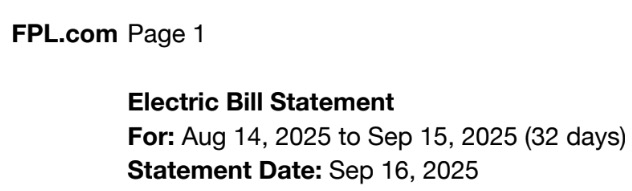
But go ahead and count it on a calendar. Aug 14 to Sep 15 is 33 days if counted inclusively, which is how virtually all solar monitoring software is. This includes Enphase, SolarEdge, Tesla, and SolarAssistant for calculating energy data. Even exclusive (end-date minus start-date) math yields 32 full 24-hour periods. So what’s going on here?
FPL is considering the billing period to be midnight on August 14th to Midnight on September 15th. So the billing period actually only covers up to the full calendar day of September 14th. But technically, the billing period ends right as September 15th begins. That’s pretty silly in my opinion, but that’s how they do it.
The next bill will list September 15th as the start date. Don’t worry – they are not trying to bill you twice for that date!
Why This Actually Matters
Solar customers and energy nerds rely on consistency between their utility bills and solar monitoring platforms to:
- Calculate real average daily usage
- Compare solar production vs utility consumption
- Track battery charging/discharging cycles accurately
When the utility bill lists a 32-day billing cycle but includes 33 calendar days, it can lead to inflated daily usage figures and mess with your ROI calculations—especially when you’re trying to analyze self-consumption vs grid usage or verify if your battery covered overnight loads.
Is This a One-Off or a Pattern?
FPL confuses the billing period for no rational reason. It has been like this for many years, and it’s strange that nobody has called them out on it. But for solar customers trying to match their utility data to solar monitoring logs, it’s a major annoyance.
What You Can Do
- Always double-check the date range on your utility bill, not just the dates, but compare it to the number of “days.”
- Use calendar-based tools to count inclusive days (especially when comparing to solar software), or count on your fingers and toes to get an accurate range.
- Manually correct the day count when analyzing usage vs solar offset or daily cost per kWh
- If you’re seeing mismatches in daily usage totals, this could be why
One day might not sound like much—but when your solar performance analysis depends on accurate comparisons, that “phantom day” can throw off more than just your spreadsheet. It can make your system appear to be underperforming when it’s not.
Bottom line: if you’re a solar customer, never take the utility’s word for it when it comes to time periods. Always verify for yourself.

