How Improper Wire Management Causes Solar System Ground Faults
Solar panels rarely fail. Inverters are quite reliable. Batteries have long service lives.
Most solar system problems start with something much smaller.
Wire management.
I recently inspected a system where a PV conductor was rubbing directly against a module frame and clamp hardware. From the ground, the system looked perfect. From ten feet away on the roof, it looked fine. Up close, the insulation was already worn through.
This is how ground faults are born.
What You’re Actually Looking At
In this case, the module wire was routed tightly across the aluminum frame and against stainless mounting hardware. There was no listed wire clip. No strain relief. No clearance from sharp edges.
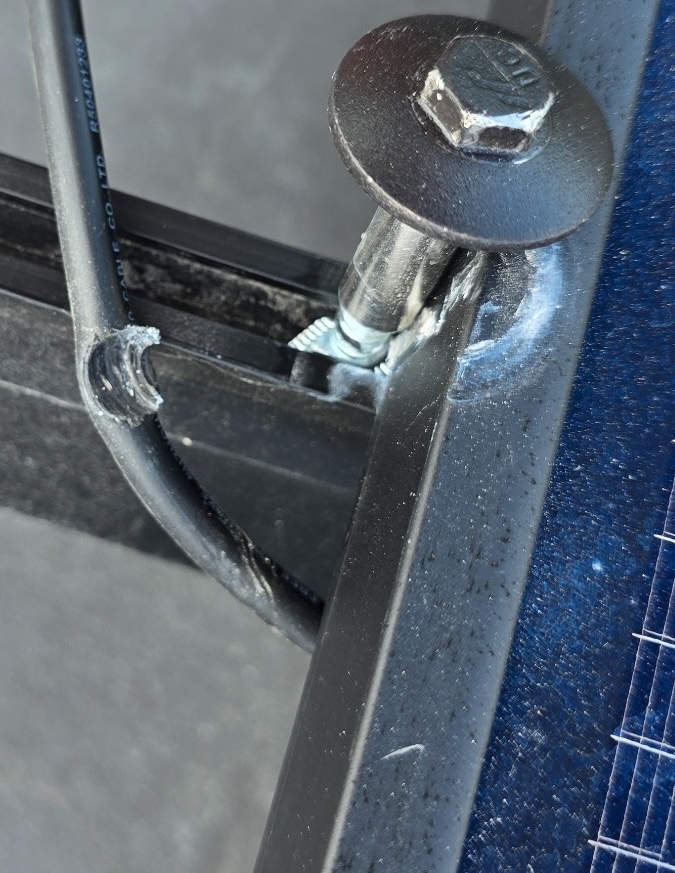
The conductor was under tension and in hard contact with metal. The mid-clamp was tightened down, pinching the wire and damaging the insulation.
Aluminum module frames are not soft. Stainless hardware is not forgiving. PV wire insulation is durable, but it is not armor.
Add daily thermal expansion, wind vibration, and years of UV exposure, and that insulation will eventually lose the fight.
How a Ground Fault Develops
It does not happen overnight.
First, the insulation jacket abrades. You may see a small notch or flattening where it contacts the frame.
Next, the outer jacket thins. In Florida, UV accelerates degradation once the surface is compromised.
Eventually, the conductor makes intermittent contact with grounded metal.
That is when nuisance ground fault errors begin.
On string inverter systems, this often shows up as ground fault or insulation resistance errors. On microinverter systems, you may see arc fault trips or unexplained production drops.
Homeowners call and say, “The system just randomly shuts off.”
It is rarely random.
Why Florida Makes This Worse
In Southwest Florida, we have a perfect storm for accelerated wear:
- High UV exposure year-round
- Extreme roof surface temperatures
- Daily expansion and contraction cycles
- High wind events and storm vibration
- Salt air corrosion
A wire that might survive 15 years in a mild climate can fail much sooner here if it is not properly supported.
This is why details matter.
Why Inspections Often Miss It
Municipal inspections focus on compliance at a point in time. If the system is operational and major requirements are met, it passes.
What inspectors typically cannot see are:
- Backside wire routing
- Contact points hidden under modules
- Wires under tension
- Minor abrasion that has not yet become a fault
A system can pass inspection and still contain a future failure point.
What Proper Wire Management Looks Like
Good wire management is not complicated, but it requires intention.
- Use listed module frame wire clips or rail-mounted clips
- Maintain clearance from all hardware and frame edges
- Avoid tensioned conductors
- Allow slack for thermal movement
- Keep wiring supported off the roof surface
When done properly, the wiring should never be able to rub against metal, even under wind movement.
If a conductor can move and contact aluminum, it eventually will.
The Real Cost of a Small Shortcut
The irony is that this type of failure usually stems from saving minutes during installation. Wires get tucked wherever they fit. Clips get skipped. Slack gets pulled tight.
That small shortcut can lead to:
- Intermittent ground faults
- Arc fault shutdowns
- Reduced system uptime
- Expensive troubleshooting that requires module removal
Diagnosing a ground fault after the fact is far more expensive than installing proper wire management from the beginning.
Final Thoughts
Solar systems are exposed to some of the harshest conditions on your home. They are expected to operate reliably for decades.
Longevity does not depend only on equipment quality. It depends on the small mechanical details that no one sees from the street.
If you already have solar and have never had a detailed mechanical inspection of the array itself, not just electrical testing, it may be worth taking a closer look.
Ground faults do not start as major failures. They start as wires quietly rubbing against metal.