

I’ll be straight with you: I expected a gimmick.
The SmartFlower is one of those products that gets passed around solar circles as a conversation piece. It looks like a giant sunflower. It tracks the sun. It’s compact, self-contained, and just unusual enough that it tends to attract attention at trade shows and on social media. When I got the opportunity to go check one out in person on Cayo Costa, I figured I’d spend a few minutes poking around it and leave with something to write a mildly snarky post about.
That’s not what happened.
This thing is the real deal. Not for every application — not even close — but for what it’s designed to do, the SmartFlower delivers in a way I wasn’t expecting. Let me break down what I saw, what impressed me, what the limitations are, and where it actually makes sense.
What the SmartFlower Actually Is
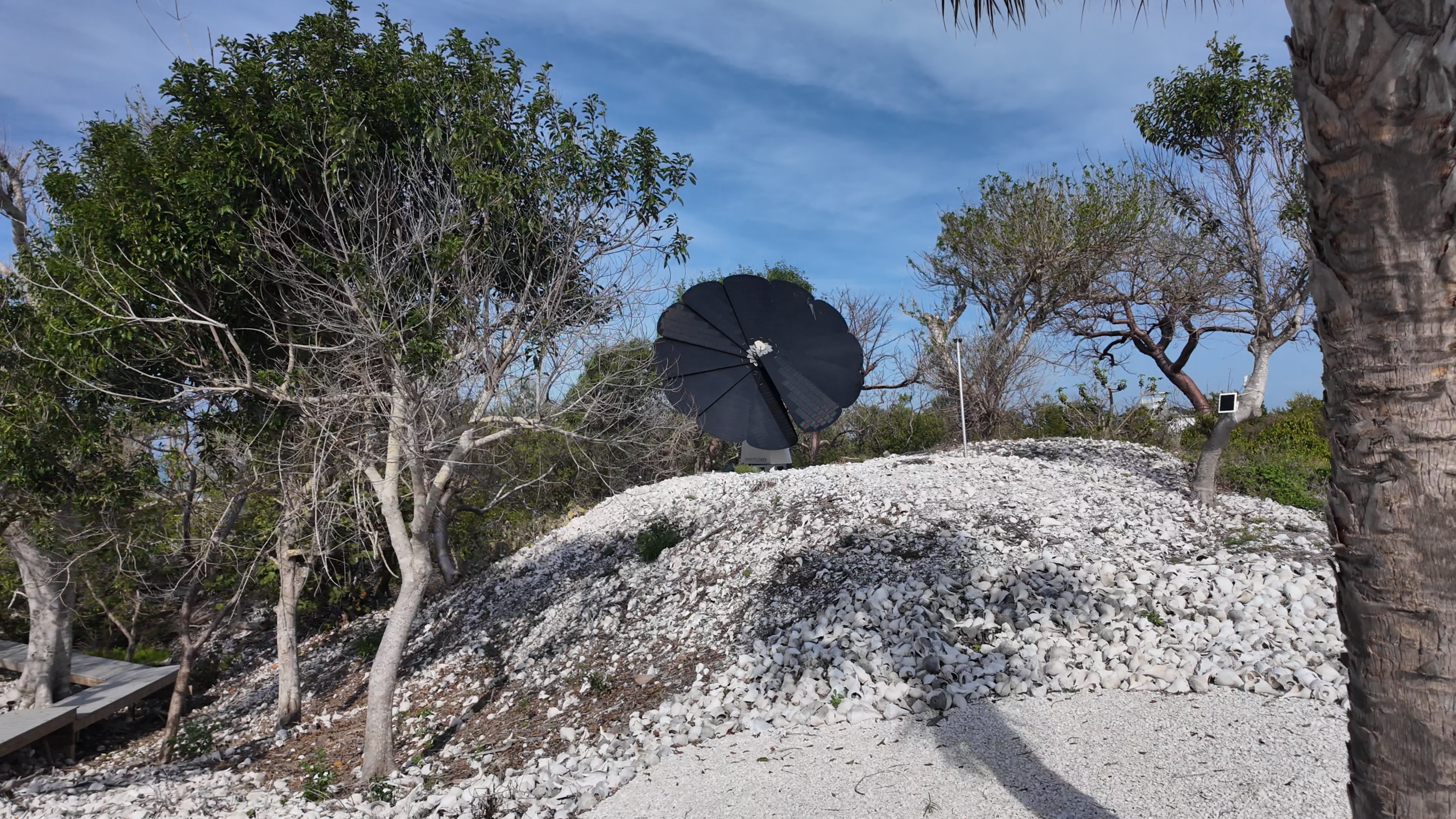
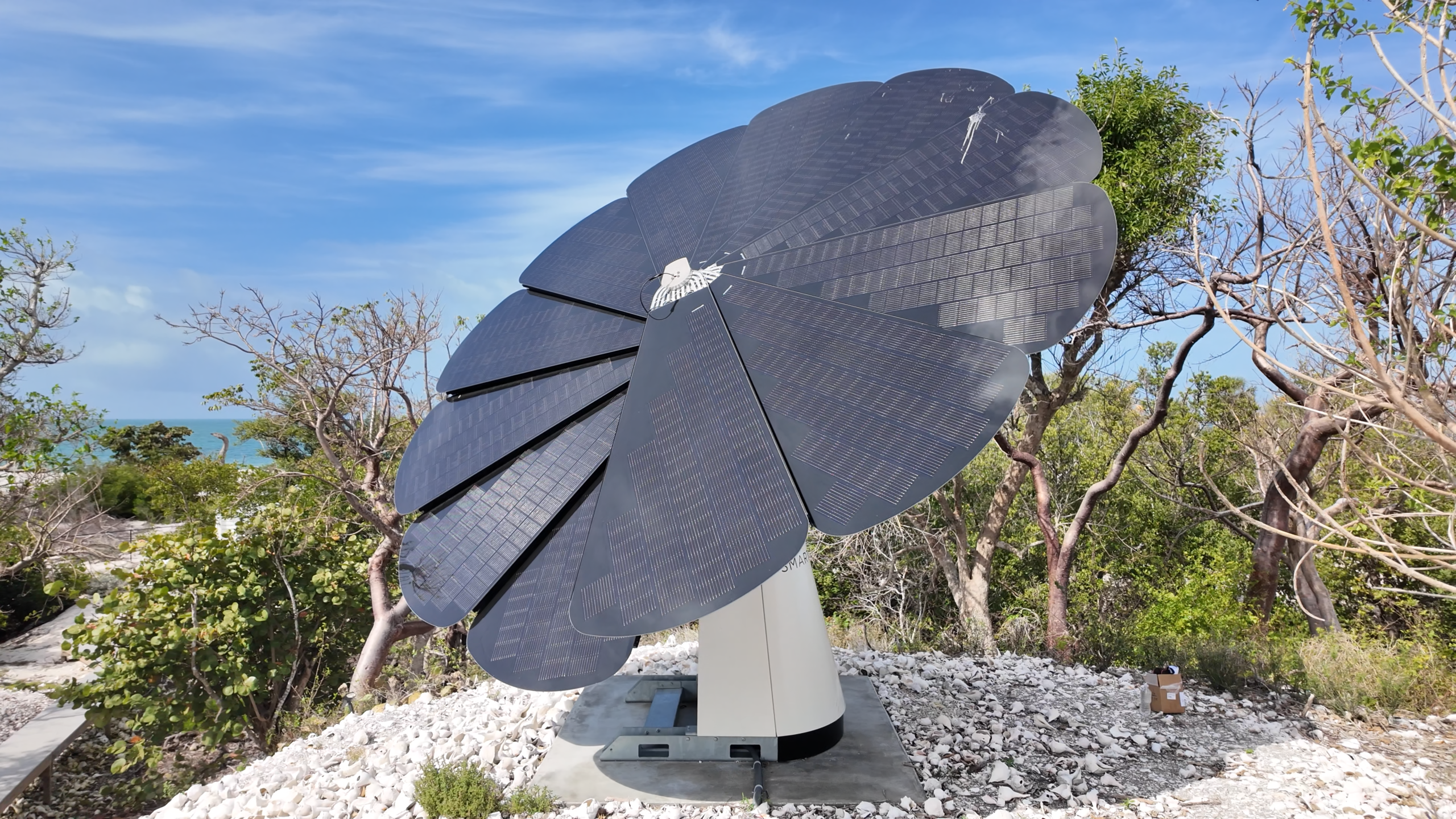
For those who haven’t seen one, the SmartFlower is an all-in-one solar power system built around a dual-axis tracking array. The panels are arranged in a petal pattern around a central hub, and the whole assembly rotates and tilts throughout the day to follow the sun. When it’s done for the day, the petals fold in. When it detects wind over a certain threshold, it folds itself up for protection.
The system includes the inverter and controls integrated directly into the base unit. There’s no separate inverter box on a wall somewhere. The whole thing stands on its own, can be installed on a concrete pad, and is theoretically portable if you’re willing to do the work of moving it.
Output varies by model, but the unit I looked at was producing around 2,200 watts when I checked it against the inverter. The manufacturer claims dual-axis tracking improves production by 40% compared to a fixed-tilt panel of the same capacity. That’s a bold number, but the physics behind it aren’t wrong. A panel that always faces the sun directly is always going to outperform one that’s angled for an average.
Build Quality: I Was Genuinely Impressed
This is where my expectations got reset.
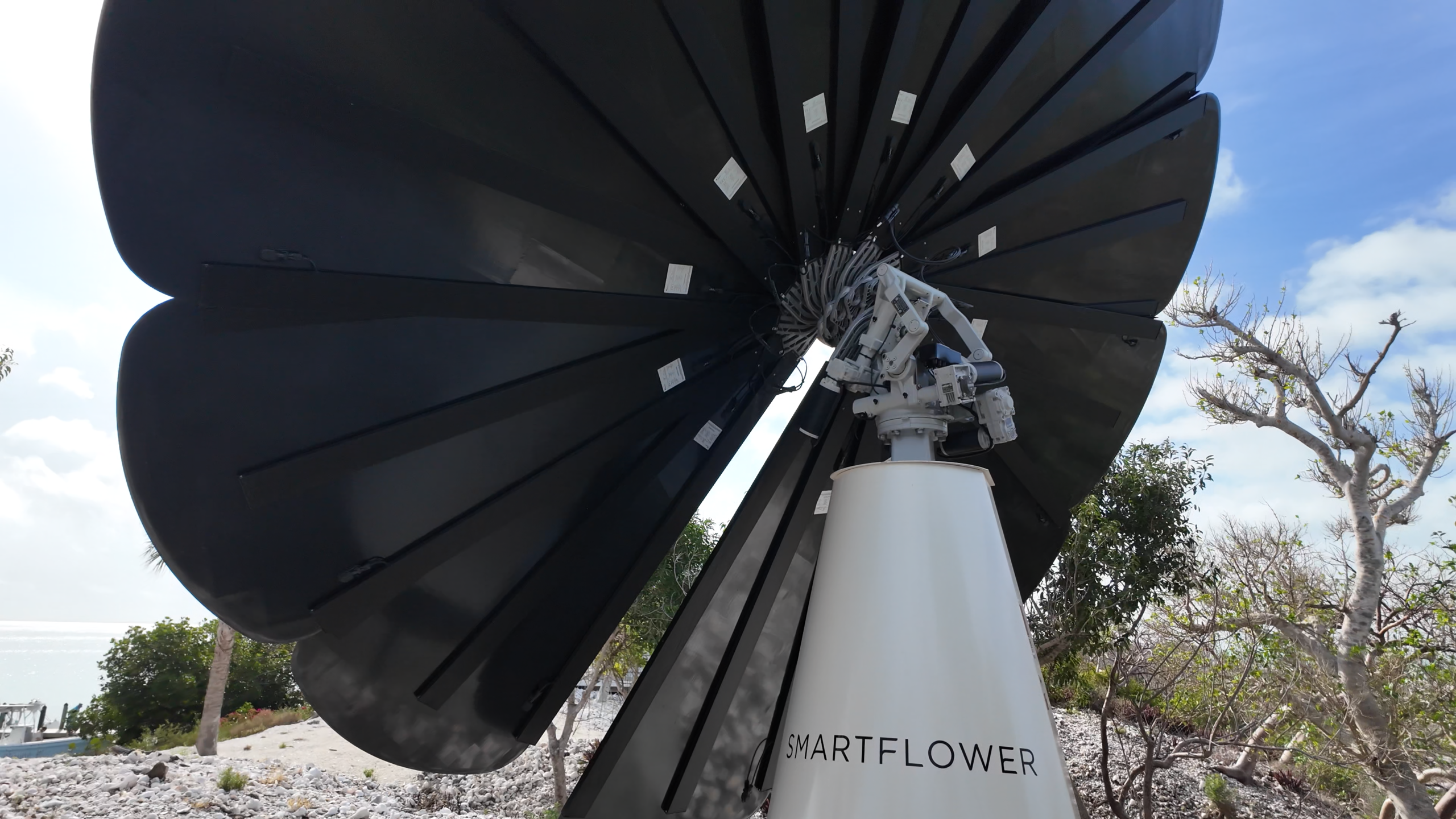
I’ve seen a lot of solar products over 25 years in this industry. A lot of them look great in a brochure and feel flimsy in person. The SmartFlower is the opposite. The mechanical components are solid. The tolerances are tight. The finish quality is good. This is not a product that was designed to look cool at the expense of durability.
The tracking mechanism is the part I scrutinized most closely. Dual-axis tracking systems have moving parts, and moving parts fail. But the engineering on this unit didn’t give me any obvious reasons for concern. It looks like it was built to last, not built to a price point.
Does that mean it will hold up for 20 years in the Southwest Florida heat and humidity? I can’t promise that from a single visit. But the bones are there.
What It Can and Can’t Do
Here’s where I have to be honest about the math.
A system producing around 2,200 watts peak is not going to be a primary power source for a typical Florida home. A house running central air conditioning, water heating, and normal appliances is drawing far more than that on a routine basis. The average Florida home uses somewhere in the neighborhood of 1,200 to 1,500 kilowatt-hours per month. A single SmartFlower, even with excellent tracking performance, isn’t going to cover that.
The installation I visited is running on it, but the occupants are disciplined about their usage. That’s a reasonable lifestyle for a Cayo Costa property where the whole point is living a little simpler, off-grid, away from the grid-connected world. It is not a reasonable expectation for a household that runs the AC at 72 degrees year-round.
For comparison, a typical residential solar installation in Lee or Collier County involves somewhere between 20 and 30 panels producing 8 to 12 kilowatts at peak. That’s four to five times the output of a SmartFlower. If you’re trying to offset a meaningful portion of your FPL bill or power a home with real loads, you need real capacity.
So no, I wouldn’t spec a SmartFlower as the primary system for a conventional home. But that’s not really what it’s for.

Where the SmartFlower Actually Makes Sense
Off-grid is where this product finds its lane, and it finds it well.
Cayo Costa is a barrier island accessible only by boat. There’s no FPL grid out there. Power options are limited: generator, battery, solar, or some combination. In that context, a self-contained solar unit with integrated inverter and sun tracking is genuinely useful. You don’t need to run conduit to a rooftop. You don’t need to coordinate a structural engineer for a roof penetration. You set it up on a pad, point it in the right direction, and let it do its job.
The same logic applies to other off-grid scenarios: remote properties, agricultural operations, backup power for outbuildings, boat docks on canal lots where trenching a power run is prohibitively expensive. Anywhere a compact, self-contained power source makes more sense than a full rooftop installation, the SmartFlower is worth a serious look.
It also works as a supplement. A homeowner who already has a rooftop system and battery backup and wants to squeeze more production out of a property without adding more roof penetrations could potentially add a SmartFlower on a ground pad. The output is modest, but modest is still something.
The Honest Tradeoffs
I’m not writing an ad here, so let me give you the full picture.
First, cost. The SmartFlower carries a premium price tag relative to its output. A rooftop system producing the same 2,200 watts would cost a fraction of what a SmartFlower runs. You’re paying for the tracking, the integration, the aesthetics, and the convenience of a standalone unit. If pure dollars-per-watt is your metric, this is not your product.
Second, maintenance. Any system with moving parts requires more attention than one without. Fixed panels have no motors to service, no sensors to calibrate, no tracking mechanism to inspect. The SmartFlower’s self-folding capability in high wind is a real feature, not just a gimmick, but it does mean there are more things to maintain over the life of the system.
Third, capacity. I keep coming back to this because it matters. If you’re grid-connected and looking for meaningful bill reduction, a SmartFlower alone isn’t going to get you there. Florida Power and Light’s net metering structure rewards systems that produce at scale. A system this size, even performing well, won’t generate enough excess to make a significant dent in your monthly bill.
SmartFlower vs. Traditional Ground Mount
One question I anticipate is whether the SmartFlower is a better choice than a conventional ground-mounted solar array for an off-grid or supplement application.
My honest answer: it depends on the site.
I’m generally not a fan of ground mounts in Southwest Florida. The soil conditions in Lee and Collier Counties create real challenges for ground mount infrastructure. You’re dealing with sand, limestone, high water tables in some areas, and the ever-present hurricane wind load requirements. Engineered ground mount systems for our market require serious structural consideration and permitting that adds cost and time.
The SmartFlower, by contrast, is a compact concrete pad installation. It’s not subject to the same structural calculations as a full ground mount system spanning dozens of feet. For a small off-grid property where you need a modest amount of power without a major construction project, the SmartFlower’s installation simplicity is a real advantage.
For larger off-grid systems where you need 10 or 20 kilowatts, a traditional ground mount or rooftop array is still the right call. But at the SmartFlower’s scale, the comparison is closer than you might think.
What I’d Want to Know Before Installing One
If a client came to me asking about a SmartFlower for a Southwest Florida property, here’s what I’d want to nail down before writing a proposal:
Load analysis first. What are you actually powering? A small Cayo Costa cottage with efficient appliances is a completely different problem than a seasonal vacation home with a full kitchen and window units.
Battery pairing. The SmartFlower produces power during daylight. If you need power at night — and you will — you need battery storage behind it. What inverter are you pairing with it? What’s the battery bank? These questions matter as much as the panel output.
Long-term parts availability. The SmartFlower is a specialty product with a specific manufacturer. If the tracking mechanism needs a part in year 10, is that part available? I’d want that answer before committing a client to the system.
Permitting. Even on private off-grid property, permits may be required depending on the county and what the system is connected to. Don’t skip that conversation.
The Bottom Line
The SmartFlower is not a gimmick. I went in skeptical and came out impressed. The build quality is real, the tracking works, and the system was producing exactly what it was supposed to when I checked it.
That said, it’s a specialty product for specific applications. If you’re grid-connected and looking to cut your FPL bill, this is not your primary solution. If you’re off-grid, supplementing an existing system, or powering a remote property where a full rooftop installation isn’t practical, it’s worth a serious look.


