

I’m not shy about calling balls and strikes in this industry.
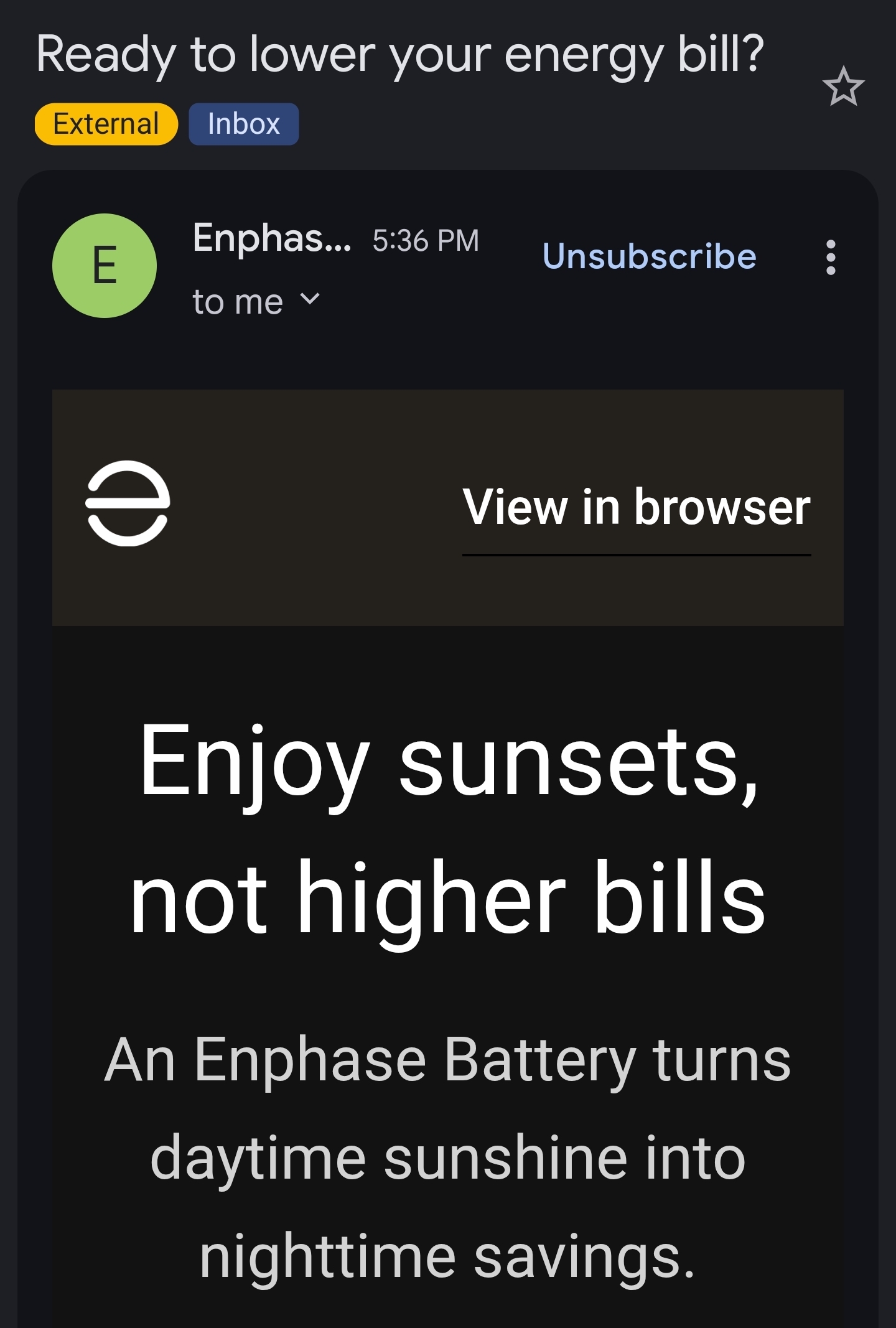
So when I get an email to my personal inbox that basically says “Ready to lower your energy bill?” and “An Enphase Battery turns daytime sunshine into nighttime savings,” I have to stop and say something.
Because for Florida homeowners, that message is, at best, incomplete. And at worst, it’s marketing that plants the wrong idea in people’s heads.
Batteries Do Not Magically Save Money in Florida
Let’s get something straight.
In Florida, under standard residential net metering, a battery does not reduce your electric bill in any meaningful, predictable way that justifies the cost.
If you have full retail net metering, your excess solar during the day already goes to the grid at essentially the same value you’d use it later. You are already “banking” energy without buying a battery system that can easily cost five figures installed.
So when a marketing campaign says you can store sunshine and use it “when electricity is most expensive,” that might be true in certain states with aggressive time-of-use pricing. It is generally not true in Florida.
We do not have widespread residential rate structures that make battery arbitrage profitable. The math just doesn’t work for most homeowners here.
What Batteries Actually Do
Batteries in Florida are for:
- Hurricane backup
- Grid instability
- Peace of mind
- Critical load support
- Resilience
That’s it.
They are excellent for those purposes. I install them all the time. I believe in them for backup.
But I don’t sell fantasies.
You’re not installing a battery because you want to “skip price spikes.” You’re installing it because you want your refrigerator, lights, internet, and some air moving when the grid is down.
That’s a preparedness purchase. A security purchase. It’s about peace of mind.
It is not an ROI play in Florida for the average net-metered homeowner.
The Problem With Blanket Marketing
Here’s what really bothers me.
This email wasn’t targeted only to utility territories where batteries can meaningfully reduce bills. It was sent broadly to anyone with Enphase equipment, including Florida homeowners who already have net metering and stable flat rates.
What happens next is predictable.
Customers call us excited. Customers call us confused. Customers call us convinced they are “missing out” on savings.
Now I have to be the bad guy explaining that no, adding a battery to your already properly sized solar system is not going to magically lower your bill.
That is a lousy customer experience. It creates distrust. It sows discontent where none existed. And it’s avoidable.
Solar and battery economics are location-specific. Utility-specific. Rate-plan-specific. If someone tells you a battery will save you money without first asking questions like these, you should be skeptical:
- Who is your utility?
- What rate plan are you on?
- Do you have net metering?
- Do you have time-of-use pricing?
- How much power do you export annually?
If they don’t ask those questions, they’re selling a narrative, not running the numbers.
Why This Matters
We work hard to educate clients properly.
When national marketing campaigns oversimplify, it creates unrealistic expectations, phone calls driven by confusion, and distrust when the math doesn’t match the promise.
It also makes the local installer look like the one who is “withholding savings,” when in reality we’re just being honest.
I would much rather say the accurate version:
Batteries are expensive. They are not an investment. They are an insurance policy.
If you want that insurance policy, great. Let’s design it properly. But if you’re buying it because an email told you it will lower your bill, slow down and run the math for your specific situation.
The Bottom Line
Battery storage in Florida is about resilience, not revenue.
Could the economics change in the future? Absolutely. Utilities and rate structures can change quickly, and I watch that closely.
Until then, don’t let a marketing headline override the numbers.
If you receive a flashy email promising savings, forward it to us. We’ll sanity-check it against your actual utility, rate plan, and system performance and give you a straight answer.
No sunshine-flavored fairy dust included.


