Soft start kits used to be the default answer for running air conditioning on battery backup. That advice came from an era when inverters were the weak link and compressor inrush would trip systems offline.
Fast forward to today: modern hybrid inverters and battery systems are built to start motors. In most properly sized battery backup designs, an HVAC soft start is no longer a requirement. It may still be a nice-to-have in certain edge cases, but it is no longer the first lever we pull.
What a soft start does (and why we needed it)
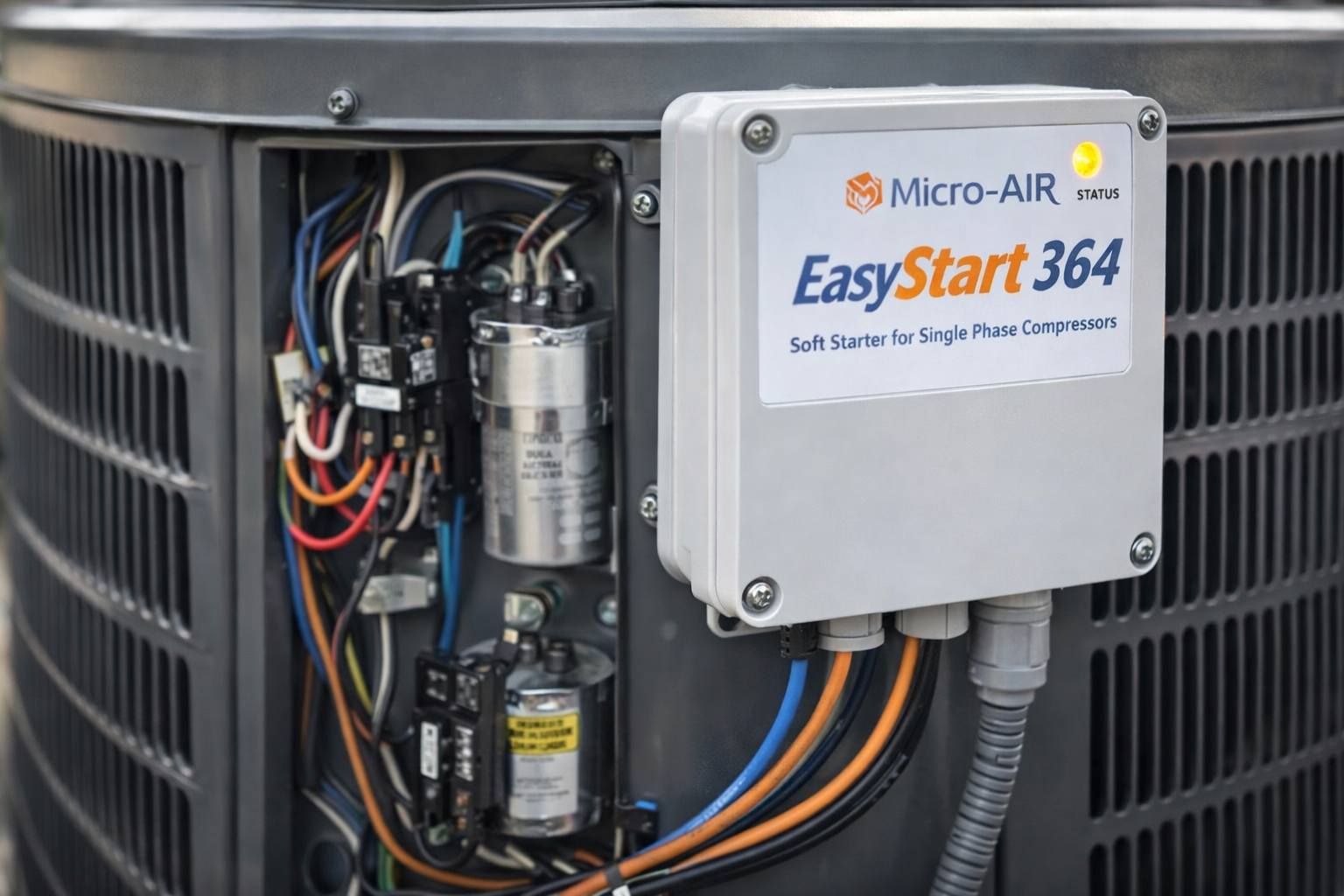
When a compressor starts, it briefly hits Locked Rotor Amps (LRA). That surge can be several times higher than the normal running current. Older battery inverters often could not deliver that instantaneous current without faulting, so soft starts became the workaround.
That history still lives on the internet as “you must install soft starts.” The problem is that inverter capability has changed. A lot.
Generators still struggle with high startup surges that can stall the generator motor. The torque required to start large motors are challenging for some generators, especially cheap portable units.
The new reality: published motor-start capability is huge now
Below is a quick comparison using manufacturer-published LRA or surge specs. Note that not every manufacturer uses the exact same terminology. Some publish LRA directly, others publish a “power start” current, and some publish surge watts over a time window. Where Sol-Ark publishes surge power, I show an equivalent current at 240V so you can eyeball it.
Motor start and surge comparison (real published specs)
| Platform | Published motor start / surge spec | What that means in amps | Your scenarios |
|---|---|---|---|
| Tesla Powerwall 3 | Load Start Capability: 185 LRA | 185A LRA per unit | Scales per Powerwall 3 |
| EG4 FlexBoss18 | Locked Rotor Amps: 195A | 195A LRA per inverter | Two units: 195A × 2 = 390A |
| EG4 FlexBoss21 | Locked Rotor Amps (LRA): 195A | 195A LRA per inverter | Same motor-start spec as FlexBoss18 |
| Enphase IQ Battery 5P (IQ8-BATT) | Power Start capability: 48A (additive per battery) | 48A per 5P | Six 5P: 48A × 6 = 288A |
| Enphase IQ Battery 10C (Combiner 6C ecosystem) | Power Start capability: up to 90A LRA | 90A LRA per 10C | Three 10C: 90A × 3 = 270A |
| FranklinWH aPower | Load Start Capability: 118A LRA | 118A LRA per unit | Scales per aPower unit |
| Sol-Ark 15K-2P | Peak apparent power off-grid: 24,000VA (10s) and 30,000VA (100ms) | At 240V: 100A (10s), 125A (100ms) | Surge spec shown as VA |
| Sol-Ark 18K-2P | Surge power: 36,000W (10s) | At 240V: 150A (10s) | Surge spec shown as W |
What this means for soft starts
A typical Florida 4–5 ton compressor might have an LRA in the rough neighborhood of 90A to 130A. If you have two or three units, the question is no longer “can the inverter start it?” The question becomes:
- Did we size the inverter platform appropriately for motor starting?
- Did we size the battery bank appropriately for sustained runtime and voltage stability?
- Are we trying to start multiple compressors at the same instant with a bunch of other loads online?
On modern platforms like FlexBoss, Powerwall 3, and properly sized Enphase 5P systems, compressor starting is usually not the hard part. Runtime is.
Soft starts don’t save energy
Soft-start units reduce the instantaneous power draw when a motor starts. That does not reduce the energy (power over time) needed for an HVAC system. It just shifts the power curve, delaying the power draw during start-up.
Some people mistakenly believe that reducing the large surge saves them money. That is not the case. The electricity is still used. In fact, it will require a tiny bit more energy because the soft-start unit itself consumes power.
The real upgrade is usually more battery, not more gadgets
When a client says “I want to run the whole house overnight, especially AC,” that is an energy problem. Overnight cooling can chew through battery capacity quickly. The fix is typically:
- More battery capacity for a better overnight experience
- Right-sized inverter stack to avoid nuisance trips
- Load management that is realistic, not wishful thinking
That is also why we price additional batteries aggressively when it improves the customer experience. Better battery performance equals fewer angry phone calls later.
Soft starts still have pros and cons
Potential upside: Reduced inrush stress can be gentler on compressors and may reduce light dimming or voltage sag in marginal designs.
Downside: It is another electronic device living outdoors in Florida heat. It can fail, it adds wiring complexity, and it may raise warranty questions depending on the HVAC manufacturer and installer.
Variable speed compressors change the game
This is where the entire soft start conversation starts to feel outdated.
Many new high-end HVAC systems use variable speed (inverter-driven) compressors. These are not the old-school single-stage, slam-on-at-full-speed compressors that caused massive inrush spikes.
Variable speed systems don’t “kick on.” They ramp up gradually. The onboard inverter drive converts incoming AC to DC and then recreates a variable frequency waveform that controls motor speed smoothly. That means:
- No traditional locked rotor event
- No 100–130A instantaneous spike
- No lights dimming
- No brutal mechanical shock to the compressor
There is effectively no startup surge in the traditional sense.
And here’s the kicker: you cannot install a soft start on these systems anyway. The compressor is already controlled by an internal variable frequency drive. Adding an external soft start is either impossible or would interfere with the manufacturer’s control strategy.
For new construction and off-grid homes
If you’re building a new home, designing an off-grid system, or upgrading HVAC alongside a battery installation, variable speed equipment is a no-brainer if you plan to have a backup power system.
Why?
- Lower peak power demand
- Better compatibility with battery inverters
- Improved comfort (longer, steadier run cycles)
- Reduced humidity swings
- Massive efficiency improvements at part load
In Florida, air conditioning rarely runs at 100% load. Most of the year it operates at partial load conditions. Variable speed compressors shine in exactly that scenario. Instead of cycling on and off like a light switch, they modulate output to match demand.
The result is lower energy consumption and smoother electrical behavior. That’s good for the grid. It’s good for batteries. And it’s good for equipment longevity.
Energy savings are not theoretical
Single-stage systems are either 0% or 100%. Variable speed systems can operate at 30%, 40%, 60% output for extended periods. That avoids the repeated high-power startup cycles.
When paired with battery backup:
- They reduce inverter stress
- They extend overnight runtime
- They minimize voltage sag events
- They eliminate the entire soft start discussion
If someone is serious about resiliency and energy performance, upgrading to a variable speed HVAC system often delivers more value than bolting a soft start onto a legacy compressor.
The bigger shift happening
The industry is quietly transitioning away from brute-force motor starts and toward electronically controlled, inverter-driven loads. As that trend continues, soft start devices will become less relevant in residential design.
Modern battery systems are strong enough to handle legacy compressors. Variable speed compressors make the startup issue disappear entirely.
That’s the direction things are going.
Bottom line
Soft starts are no longer a default requirement for most battery backup systems because modern inverters and batteries can actually start motor loads. If you want a better outage experience, the better spend is typically more battery capacity and a properly sized inverter platform, not another box bolted into a condenser.
Sources
- Tesla Powerwall 3 Datasheet (Load Start Capability 185 LRA): https://energylibrary.tesla.com/docs/Public/EnergyStorage/Powerwall/3/Datasheet/en-us/Powerwall-3-Datasheet.pdf
- EG4 FlexBoss18 Spec Sheet (Locked Rotor Amps 195A): https://eg4electronics.com/wp-content/uploads/2024/12/EG4-FlexBOSS18-Hybrid-Inverter-Spec-Sheet.pdf
- EG4 FlexBoss21 Spec Sheet (Locked Rotor Amps 195A): https://eg4electronics.com/wp-content/uploads/2024/10/EG4-FlexBoss21-Spec-Sheet.pdf
- Enphase IQ Battery 5P Power Start capability (48A additive): https://sunwatts.com/content/manual/IQ_Battery_5P_Power_Start_capability.pdf
- Sol-Ark 15K-2P-N Datasheet (Peak apparent power 24,000VA 10s; 30,000VA 100ms): https://www.sol-ark.com/wp-content/uploads/2024/06/SK150-0001-002-15K-2P-N-EN-Datasheet.pdf
- Sol-Ark 18K 2P-N Datasheet (Surge power 36,000W 10s): https://www.sol-ark.com/wp-content/uploads/2025/09/SK180-0000_18KDataSheet_Rev3_15Oct2025.pdf
- FranklinWH aPower specs (Load Start Capability 118A LRA): https://www.franklinwh.com/support/overview/components-of-franklin-home-power
- Enphase IQ Battery 10C Datasheet (Power Start capability up to 90A LRA): https://enphase.com/download/iq-battery-10c-data-sheet
Note: Not every manufacturer uses the same label for startup. Some publish LRA directly, some publish “power start” current, and some publish surge power over a time window. The point is not semantic perfection. The point is that modern platforms have enough startup muscle that soft starts are rarely the deciding factor.