

https://floridasolardesigngroup.com/choosing-solar-panels-for-homeThe way solar systems are designed has changed more in the last five years than in the previous twenty. If you have an older string inverter on your roof, or microinverters installed a few years back, or you’re looking at adding a battery system now, you need to understand what AC coupling is and why it changes everything about how these components can work together.
This is not a pitch for new equipment. This is a practical explanation of where the technology is and why the shift matters — especially if you already have solar and are thinking about batteries.
What AC Coupling Actually Means
Solar panels produce DC power. Traditional inverters convert that DC into AC, which is what your home uses. For decades, if you wanted to add a battery to a solar system, the battery had to be on the DC side — wired in before the inverter, sharing the same DC architecture. That required a single integrated inverter, and it meant your solar and your battery were locked together. Change one, change everything.
AC coupling breaks that dependency. In an AC coupled architecture, each energy source converts to AC independently and ties into a common AC bus. Your battery system has its own inverter. Your solar array has its own inverter. They don’t need to know anything about each other’s internal workings. They just both speak AC.
That one design principle opens up a lot of possibilities.
Three Inverters, One House, One System
Here’s a scenario I see playing out in real installations right now. A homeowner has a string inverter that went in 15 years ago. It still works. Five years ago, they added microinverters on a new section of roof. Now they want battery backup. They’re looking at a Tesla Powerwall 3, which is a hybrid inverter with integrated battery storage and its own AC output.
In a DC coupled world, integrating all of this would be a nightmare or an impossibility. You’d be mixing incompatible architectures from three different eras of equipment.
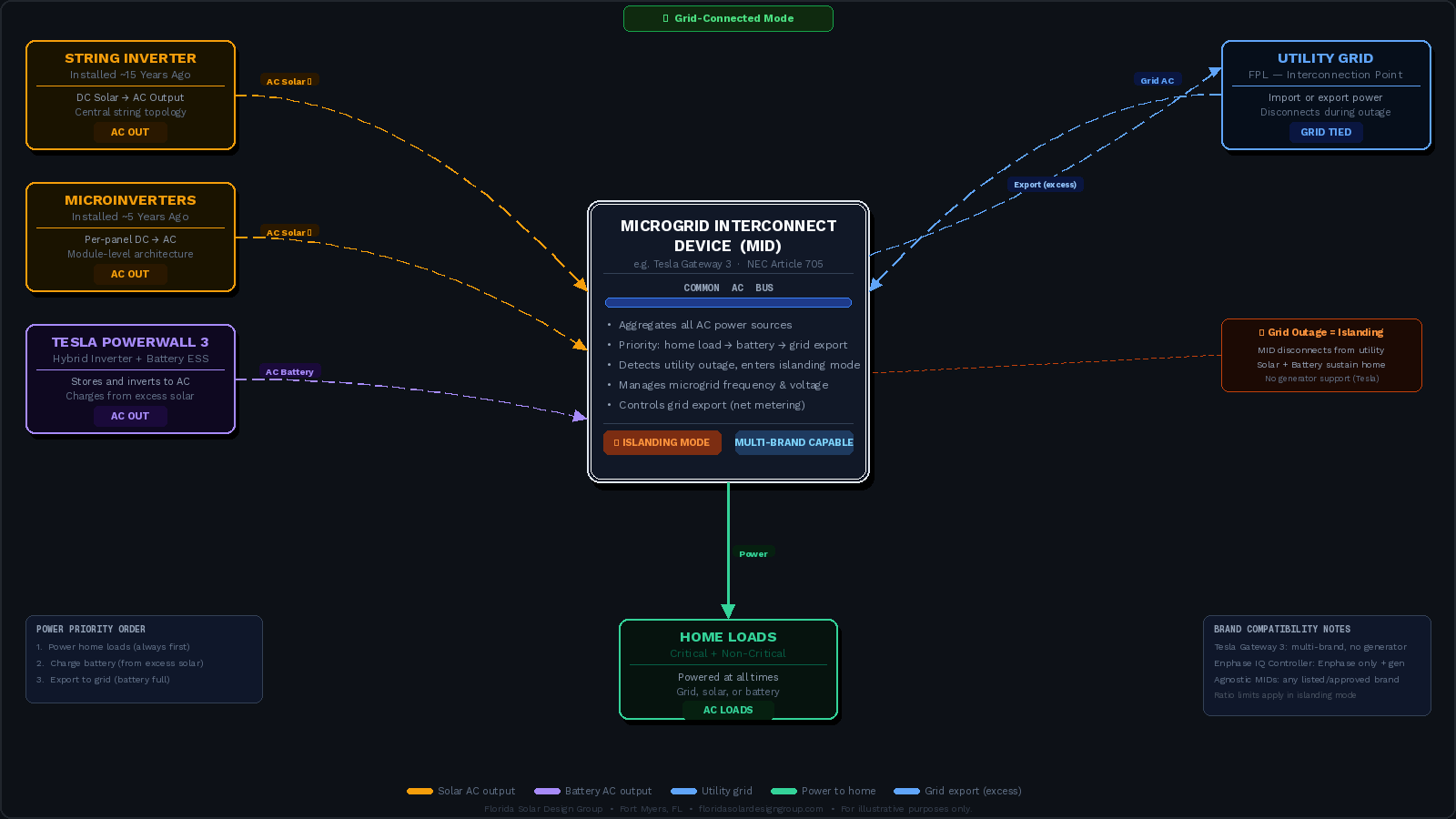
In an AC coupled world, all three of those devices — the old string inverter, the microinverter system, and the Powerwall 3 — can connect to a single microgrid interconnect device. Each one outputs AC power. The microgrid interconnect device doesn’t care where the AC came from. It aggregates everything: solar from the old string inverter, solar from the microinverters, battery power from the Powerwall, and the utility grid itself. Four sources, one AC bus, one device managing the whole thing.
What a Microgrid Interconnect Device Does
The microgrid interconnect device, sometimes called a MID or a smart panel or a transfer switch depending on the manufacturer’s marketing, is the nerve center of an AC coupled system. The National Electrical Code recognizes this category of equipment, though each manufacturer implements it differently.
In normal grid-tied operation, the microgrid interconnect device manages power flow. Solar production that isn’t consumed in the home goes to charge the battery first. Once the battery reaches full charge, excess solar exports to the grid under whatever net metering arrangement you have with FPL. The system is always working in a priority order: power the home, fill the battery, export the rest.
When the grid goes down, the microgrid interconnect device detects the outage and disconnects from the utility. This is islanding mode. Now the device is managing an isolated microgrid that has no connection to the outside grid. It has to balance all of the AC sources and loads internally. Solar generation, battery discharge, and home consumption all have to stay in equilibrium. The MID is what keeps that from becoming chaos.
Brand Agnostic vs. Proprietary — This Is Where It Gets Complicated
Not all microgrid interconnect devices play by the same rules. This is one of the most misunderstood areas of battery storage right now, and making the wrong choice here can create expensive problems.
Some microgrid interconnect devices are designed to be brand agnostic. As long as an inverter is listed and designed to interoperate with that MID, it can participate in the AC coupled microgrid. That’s a powerful advantage if you have existing equipment from multiple manufacturers, which most homes with solar histories actually do.
Tesla’s Gateway 3 is a good example of a MID that can interact with multiple brands of inverters. If you have a SolarEdge string inverter, or Enphase microinverters, or some other listed inverter on your roof, the Gateway 3 can work with it alongside a Powerwall. The tradeoff is that Tesla’s system does not accept generator input. If you want a propane generator as a backup source alongside your solar and battery, Tesla’s current architecture doesn’t support that.
Enphase takes a different approach. Their IQ System Controller is designed to work within the Enphase ecosystem. It can AC couple with the output of a traditional generator — which is a legitimate advantage for people who want generator backup in addition to solar and batteries. But it doesn’t interact cleanly with non-Enphase solar inverters. If you have a string inverter from another manufacturer, you’re not bringing it into the Enphase microgrid.
Neither approach is universally right. Your existing equipment, your backup priorities, and what you’re trying to accomplish all factor into which architecture makes sense for your situation.
The Ratio Problem
AC coupled systems have one design constraint that requires actual engineering, not just plugging things together. When the grid goes down and the system is in islanding mode, there has to be a workable ratio between the inverter capacity of your solar sources and the inverter capacity of your battery.
If you have dramatically more solar inverter capacity than battery inverter capacity, the system can’t absorb the excess power fast enough during islanding. This causes frequency excursions and inverter trips. The solar inverters go offline not because they’re broken, but because the microgrid can’t absorb what they’re producing.
Most manufacturers publish approved ratio limits. Getting the math wrong means a system that works fine on a sunny grid-tied day and falls apart the first time the grid goes down and the sun is shining. This is not theoretical. I’ve seen it. Getting the ratios right is one of the things that separates a properly engineered installation from one that was simply wired up.
There’s also the question of which loads you’re backing up. An AC coupled system in islanding mode is not necessarily backing up your whole house. Most installations use a backed-up load panel or critical loads panel that isolates specific circuits — well pump, refrigerator, lights, a few outlets. If you’re expecting whole-home backup from a single Powerwall during a multi-day outage with limited sun, that’s a conversation about realistic expectations, not just inverter ratios.
The Florida heat load is its own variable. Running central AC from a battery system during a summer outage requires significantly more storage capacity than most homeowners assume. That’s a design conversation, not a sales pitch. I’d rather tell you upfront what a system can and can’t do than let you find out during a hurricane.
Why This Actually Matters for Existing Solar Owners
If you installed solar in the last 15 years in Southwest Florida, there’s a reasonable chance you’ve thought about adding batteries. Hurricane Ian made a lot of homeowners think harder about backup power. So did the subsequent rate changes from FPL that changed how much credit you get for excess solar.
The good news is that AC coupling means your existing solar investment is very likely compatible with a battery system. You don’t have to replace your inverters. You don’t have to start over. The existing AC output of your current inverters can feed into a properly designed microgrid alongside a new battery system.
The part that requires careful work is understanding which microgrid interconnect device makes sense given your existing equipment, your inverter capacity, your desired backup loads, and whether you want generator integration. Those variables produce different answers for different homes.
The Bottom Line
The solar industry has largely settled on AC coupling as the standard architecture for integrating solar, batteries, and backup power in existing homes. The technology works. The NEC recognizes it. The products to implement it are mature and available.
What’s not simple is the configuration. Different microgrid interconnect devices have different brand compatibility, different generator capabilities, different ratio requirements, and different approved equipment lists. If you’re adding batteries to an existing solar system or building a new system that needs to integrate multiple sources, the design decisions matter as much as the hardware.
This is exactly the kind of project where having a solar contractor with actual system design experience makes the difference between a backup system that works when you need it and one that doesn’t. If you’re in Lee or Collier County and you want an honest assessment of your existing system and what a battery addition would actually look like, call us.


