

Solar panel skirts are trim pieces installed around the perimeter of a solar array to hide the gap between the modules and the roof. They are marketed as sleek and architectural.
In Florida’s climate, the downsides outweigh the benefits. If aesthetics are your priority, that is a personal choice. But it is important to understand what you may be giving up in exchange for a cleaner look.
Heat buildup reduces performance
Solar panels lose output as temperature increases. Higher cell temperature reduces voltage, which reduces power production.
Florida roofs run hot for much of the year. Panels rely on airflow beneath them to help dissipate heat. That rear-side ventilation is part of how rooftop systems maintain reasonable operating temperatures.
When you install a skirt around the perimeter, you partially restrict airflow under the array. The result can be increased operating temperatures, especially during periods of high sun and limited wind.
- Is the impact catastrophic? No.
- Is it unnecessary and avoidable? Yes.
In a climate where heat is already working against you, there is no performance advantage to restricting airflow. You’re just trapping heat that you want dissipated.
Debris accumulation becomes more likely
Florida roofs collect debris regularly:
- Palm fronds
- Oak leaves
- Pine needles
- Sand and grit
- Insects and organic matter
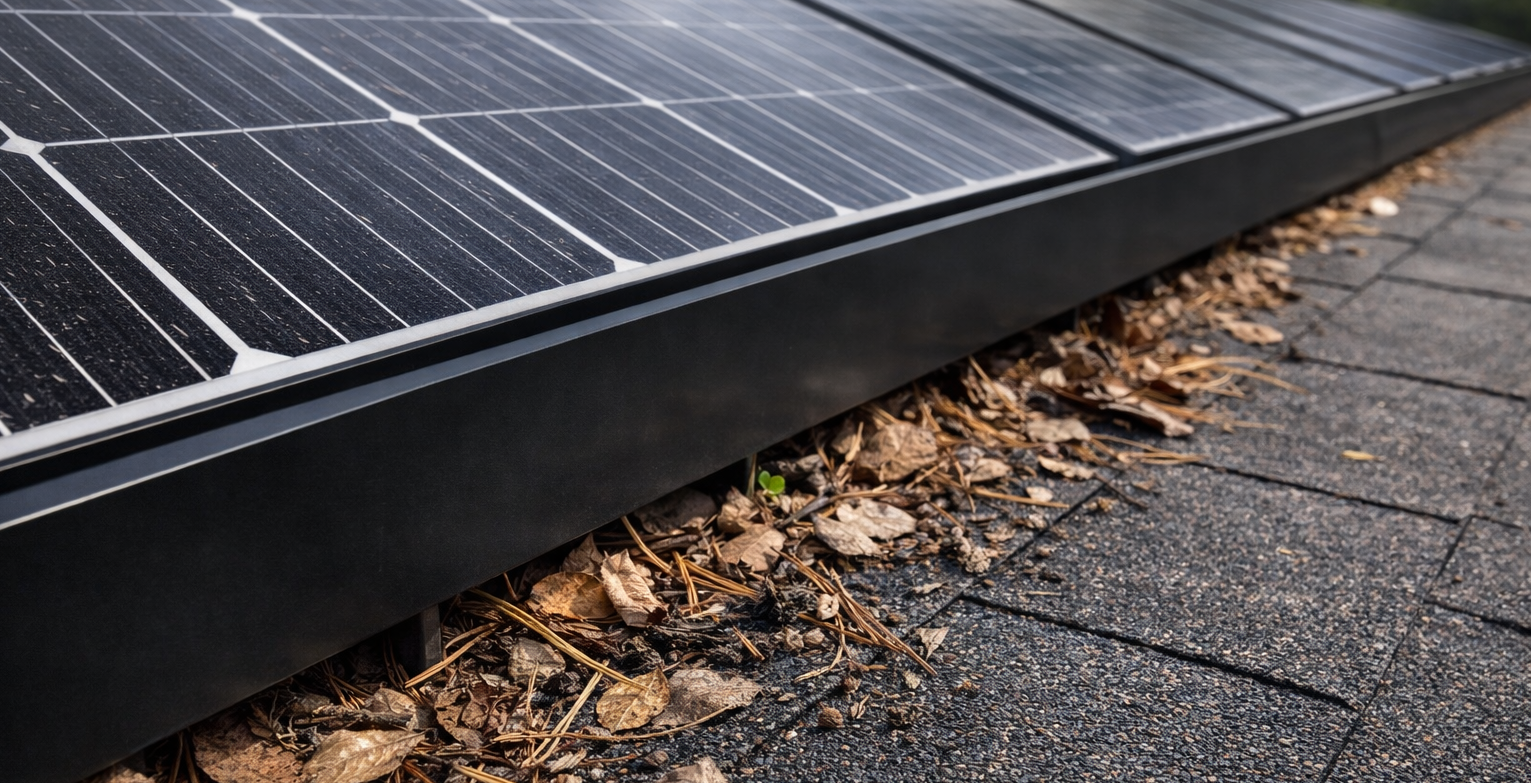
An open array allows wind to naturally move debris out. A skirt creates edges and corners where debris can accumulate and remain.
Debris retains water. Over time, that can contribute to mildew, corrosion, and general roof and hardware deterioration. While skirts are sometimes marketed as helping keep debris out, in practice, they create conditions where debris becomes trapped along the perimeter.
They do not meaningfully improve hurricane resilience
It is important to separate engineering from appearance. Real wind resilience comes from:
- Proper structural attachment framing
- Correct roof zone engineering
- Approved racking systems
- Adherence to manufacturer-recommended clamping zones
- Proper fastener torque
- Verified uplift calculations
- Quality installation workmanship
- Panels with good wind uplift test ratings
A cosmetic perimeter skirt does not provide meaningful structural benefit in a hurricane. Wind performance is determined by engineering and installation quality, not trim pieces. In fact, trim pieces can become windborne debris that damages the same panels they are supposedly protecting!
Serviceability becomes significantly worse
This is a big one. Modern solar systems commonly use Module Level Power Electronics (MLPE). That includes:
- Microinverters
- Optimizers
- Rapid shut down devices
These components occasionally require service or replacement. Accessing them requires removing modules.
Without skirts, removing the solar module is straightforward. With skirts, additional trim pieces and hardware must be removed first. That adds steps, labor time, and complexity.
What would otherwise be a routine service task becomes more involved. The end result is increased labor time, and it gets significantly more expensive.
Long-term serviceability should be a priority when designing any solar system expected to operate for decades. Creating a barrier to serviceability is foolish.
A less obvious “benefit”
Skirts also conceal what is underneath the array. That can sound appealing until you consider an uncomfortable reality: poor wire management is a persistent issue in this industry, with many (if not most) contractors taking shortcuts with wire management. Some contractors use plastic zip ties to secure wires, which degrade quickly and result in wires drooping down and touching the roof surface, creating a safety and performance issue.
When wiring is not properly secured or supported, a perimeter skirt hides those deficiencies. We prefer the opposite approach: proper wire management, clean installation practices, and nothing hidden from view.
If something needs to be concealed, it is worth asking why.
More components, more exposure points
Every additional component introduces:
- Another potential corrosion point in a humid, coastal environment
- Another part that can loosen over time
- Another surface that can trap moisture or debris
- Another obstacle during inspection or maintenance
Solar systems benefit from simplicity. Additional decorative hardware moves away from that principle.
A note on critter guards
Critter guards are mesh barriers installed around the perimeter of an array to prevent birds or rodents from nesting underneath. They are frequently presented as essential protection. These present similar downsides to solar panel skirts.
In most residential environments, they are unnecessary. Rodents can access extremely small openings anyway, including spaces between module frames. Mesh barriers are not a guaranteed solution. We don’t see widespread rodent or bird infestations with solar panels unless overall property maintenance is poor (for example, allowing tree branches to touch the roof).
What they consistently add is cost, labor, and perimeter material that can collect debris. In many cases, they function more as a solution looking for a problem, and a way for contractors to charge more for something most homes never needed in the first place.
Why some homeowners still choose skirts
The primary reason is aesthetics, paired with misinformation from salespeople.
That benefit is subjective. Objectively, it hurts production, reliability, and serviceability without any structural performance benefits.
Bottom line
Solar skirts:
- Restrict airflow and increases operating temperatures, reducing soalr production and increasing roof deterioration
- Create areas where debris can accumulate
- Complicate service and increase long-term maintenance cost
- Add hardware that provides no meaningful structural benefit
- Increase system cost, even if that cost is embedded in the overall price
You are paying for them, whether it is itemized or not.
We do not install these devices. We do not believe they serve our customers’ best interests in Florida’s climate. Our focus is performance, durability, serviceability, and long-term reliability.
Solar systems should be engineered to perform well for decades, not accessorized for curb appeal at the expense of practicality.


