

A customer sent me a solar panel comparison this week. He had built it using an AI chatbot as his research tool (it was pretty obvious). The chatbot named a premium brand as the only panel in his comparison set that met IEC 61701 Severity Level 6, which is the highest salt mist corrosion rating in the standard. That ranking felt decisive to him. He lives near the water and wanted the right panels for a coastal ground-mount system.
It was wrong. The panel I actually recommend most often for coastal Florida, the Aptos 460W bifacial, carries the same certification. It costs dramatically less. Before he could make an informed decision, I walked him back through the comparison and corrected three separate claims. The ranking changed. The leader became a runner-up. The value pick became a contender.
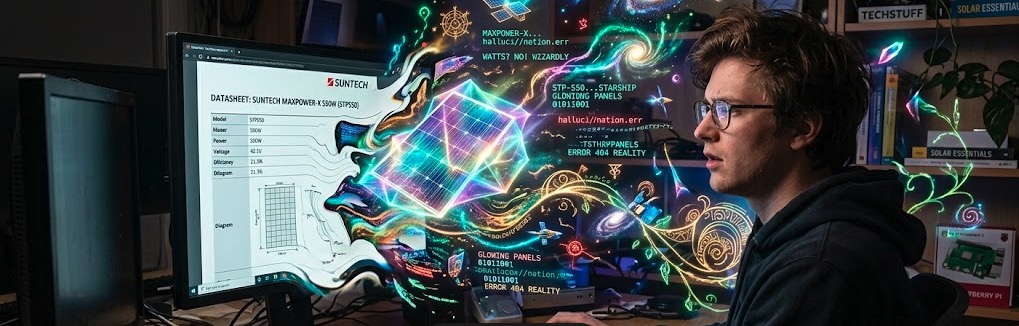
This is a weekly conversation now. A homeowner does what feels like responsible research using AI, lands on a confident-sounding recommendation, and ends up with a document full of stale specs, marketing filler, and skewed rankings. They bring it to me expecting confirmation. What they get is a correction.
AI is a powerful tool. I use it daily. In fact, I am quite enamored with it. If you cannot tell when the output is wrong, however, you are not doing research. You are outsourcing a major financial decision to a statistical model that rewards confident language over accurate information.
What AI Usually Gets Right in Solar Research
Let me be fair to the technology. AI chatbots are excellent at specific tasks.
They can summarize a spec sheet accurately if you paste the spec sheet in. They can pull product warranty terms from a PDF you provide. They can explain what a term like bifacial gain or temperature coefficient means in plain English. They can organize a table of features across a list of panels you specify. They can help you write better questions to ask your installer.
For these tasks, AI saves time. I use it this way constantly. When I prepared for my NABCEP recertification this year, I leaned on AI to work through code citations faster than pulling physical copies of the NEC and NFPA 855. It was a useful second set of eyes on material I already knew well. You can see examples of how I use AI in our design and service work in my earlier post on solving real solar energy problems with AI.
That is the key phrase. I already knew the material. I was using AI to accelerate research I was qualified to evaluate. When the AI hallucinated a citation, I caught it because I recognized that the section it quoted did not exist. When it missed a nuance, I filled in the nuance from memory.
Take that expertise away, and the same AI becomes dangerous.
What AI Usually Gets Wrong in Panel Research

Here is what I see almost every time a homeowner sends me an AI-generated solar panel comparison.
First, the rankings lean heavily toward premium legacy brands. SunPower and its spinoff Maxeon used to dominate the premium residential solar conversation. They flooded the internet with marketing content, affiliate articles, comparison blog posts, and consumer review guides. AI models trained on that content learned to associate those brands with the best quality. The actual panel market has shifted dramatically. SunPower went bankrupt. Maxeon is struggling. The premium mantle has shifted, and the current value leaders include panels that most AI models barely know about because there isn’t as much SEO-bait marketing content for them online.
Second, the specifications are often out of date. Panel models change fast. A 430W panel from two years ago has been replaced by a 460W model with different temperature coefficients, bifaciality factors, and certifications. AI pulls from whatever was indexed when the model was trained, which means the spec sheet it quotes may not match what is actually shipping today. You can verify current certifications for any serious panel directly from the manufacturer. For example, the Aptos Solar datasheet library lists its IEC 61701 Severity Level 6 rating right on the spec sheet. Confirming that takes two minutes and costs nothing.
Third, AI confidently declares a best choice without understanding context. The coastal ground-mount homeowner who triggered this article was given a top pick based on salt mist corrosion rating. That factor matters for his application. AI did not know that the recommended panel is significantly more expensive per watt than competitors with the same rating. It did not know that his installer might not have access to that brand in Florida. It did not know that the lead times for the premium option are currently six to eight weeks in our region versus next business day for the alternative. A good recommendation for a coastal ground mount is not just about corrosion rating. It is about whether the panel is actually available, reasonably priced, and supported by a distribution chain in your area.
Fourth, AI often misses warranty and company-stability factors entirely. When I evaluate a panel, I look at who the parent company is, whether they are publicly traded, what their financial position looks like, and whether they have a track record of honoring warranty claims in the US. AI will happily recommend a panel made by a company that filed for bankruptcy last quarter. If you want my honest take on how much weight any 25-year warranty really carries, read my piece on why solar panel warranties might not be as useful as you think.
Why AI Misses These Things
AI chatbots are trained on text. They are not out in the field. They do not know that our delivery truck pulled up to a warehouse last month and found three pallets configured differently than the spec sheet described. They do not know that a specific panel brand has been failing at an unusual rate in hot climates. They do not know that one manufacturer’s industry-leading warranty requires you to ship the failed panel back at your own expense to a lab in another country before they will pay the claim.
They also cannot weigh competing priorities the way a human expert does. Corrosion rating matters for a coastal install. So does efficiency, cost per watt, degradation curve, local availability, racking compatibility, and whether the panel is on the approved list for Florida’s high-velocity hurricane zone. AI does not naturally balance those factors. It latches onto whichever one was most emphasized in the prompt and ranks from there.
Finally, AI has no accountability. When I give you a recommendation, my license and my reputation are on the line. When a chatbot gives you a recommendation, it has no skin in the game. Nothing happens to the AI if your panels fail in year eight.
The Skill of Challenging an AI Answer
The customers who get useful results from AI research are the ones who already know something about what they are asking. They recognize when an answer smells wrong. They ask follow-up questions. They push back on confident claims and request sources. They treat the AI’s answer as a draft, not a verdict.
That is a skill. It is not complicated, but it is not automatic either.
If you are researching solar without that skill, you have three honest options. You can learn enough about the specific question to evaluate the answer yourself, which takes real time and access to good primary sources. You can ask a licensed contractor to evaluate the AI output and tell you what is right and what is wrong, which is exactly what my Naples customer did this week. Or you can decide that AI is a starting point for writing better questions, not a source of final answers.
Any of the three paths can work. The path that does not work is treating AI output as authoritative because it sounds authoritative.
How I Actually Use AI in My Work
I want to be fair about this. I use AI every day. I use it to analyze client production data when a homeowner is worried about output. I use it to draft technical responses and then edit them. I use it to help organize code research. I use it to translate manufacturer documentation into plain English. We use AI imagery and layout tools as part of our standard project workflow, and I have written about the specific places where AI is already part of our solar design work. And as you might imagine, I use AI to help me write these articles. The content is mine. AI amplifies my effectiveness and productivity, helping me get the message across cleanly and fixing all of my grammatical idiosyncrasies.
None of that requires the AI to be right the first time. All of it requires me to be able to tell when it is wrong.
That is the entire point of this post. AI is a tool. Tools require skill. If you would not hand a chainsaw to someone who had never used one and ask them to take down a tree, do not hand your $40,000 solar decision to a language model and ask it to pick the winner.
It Doesn’t Bother Me
When a client uses AI to learn about solar, that results in great questions. As I always say, an informed customer is always our best customer. It doesn’t bother me that clients use AI to research, and even when I get sent a bill of materials that was obviously pumped out by ChatGPT, Grok, Claude, Gemini, or one of the others.
I’m pretty good at spotting an AI cut-and-paste message. That’s fine, and I just might use AI in my response, but I promise that I will have read, vetted, edited, and confirmed all details. The response will be my voice, my knowledge, and my educated opinions.
What This Means if You Are Shopping for Solar in Southwest Florida
If you have been using AI to research solar panels, battery systems, or inverter brands, here is my suggestion.
Use the AI to frame better questions for your installer. Bring those questions to a licensed Florida solar contractor who actually installs the products in your region. Ask the contractor to respond to specific claims the AI made. A good contractor will tell you clearly when the AI was right, when it was out of date, and when it was just wrong. That conversation is worth more than any polished comparison document.
Be especially careful with rankings and best choice declarations. These are almost always where AI goes astray, because they require judgment calls that depend on price, availability, installer experience, and your specific site conditions. The AI has access to none of that.
If your installer cannot or will not engage with the details of your AI research, that is a separate red flag. A contractor worth hiring in Southwest Florida should welcome an informed customer, correct misconceptions politely, and explain the reasoning behind their own recommendations. A fair description of what that looks like is on our page about what it means to work with actual solar energy experts rather than a sales team reading from a script. If you bring homework and get dismissiveness or a sales pitch in return, keep looking.
The Bottom Line
AI is a great solar research tool, but only if you can tell when it is wrong. The confident tone of a chatbot is not the same thing as accuracy. The rankings it produces often reflect which brands have the most marketing content online, not which panels are the best value for your home.
If you are a Southwest Florida homeowner considering solar, use AI to learn the vocabulary and sharpen your questions. Then bring those questions to a licensed contractor who works in your region, stands behind their recommendations, and can explain in plain English why one panel is right for your roof and another is not. At Florida Solar Design Group, we will walk through any AI-generated research you bring to the table, tell you what holds up, show you what does not, and give you the reasoning behind every call. That is the conversation worth having.


