

You installed solar to gain energy independence. So why does your Enphase system shut down every time the grid goes out, just like every house on the block that never spent a dime on solar?
That is the frustrating reality for most microinverter owners in Southwest Florida. The grid goes down, and the panels on your roof go silent right along with it. The good news is that adding battery backup to an existing Enphase system has never been more practical, and the product options have matured to the point where there is a genuinely good solution for nearly every budget and backup need. This post covers three realistic paths from solar-only to solar-plus-storage, including the real trade-offs, who each option is best suited for, and the physical and electrical constraints that will shape the decision before you even choose a brand.
Why Your Solar System Goes Dark When the Grid Goes Out
Before getting into options, it helps to understand why this happens. Enphase microinverters are grid-tied devices. When utility power disappears, they are required by code to shut down. That is not a malfunction. It is an anti-islanding protection feature required under IEEE 1547 standards, and it exists to protect utility workers from being electrocuted by equipment feeding power into lines that are supposed to be dead.
To get backup capability, you need an inverter that can island from the grid and sustain power independently. That means adding hardware that was not part of your original installation. The three options below take three different approaches to solving this problem, and each comes with real trade-offs worth understanding before you commit to one.
Option 1: Enphase IQ Battery 5P (The Native Integration Path)
 For homeowners with IQ series microinverters, the cleanest integration is Enphase’s own IQ Battery 5P. If your system uses IQ6, IQ7, or IQ8 series microinverters, you are in the right generation for this to work well. Older M-series microinverters are also compatible, but they require an Envoy-S Metered gateway that IQ systems do not need. That adds both cost and installation complexity, so if you are on M series, factor that into the budget conversation before comparing this path to the other two options.
The 5P is a 5 kWh lithium iron phosphate battery that pairs with Enphase’s IQ System Controller to create a fully integrated backup solution. Everything stays in the same app, the same Enlighten monitoring platform, the same ecosystem. If you have spent years managing your system through Enlighten and your monitoring is dialed in exactly the way you want it, this path requires the least adjustment.
We specifically recommend the 5P over the IQ Battery 10C for existing Enphase owners. The 10C is a first-generation product still working through firmware development, and FPL has not approved the meter collar installation that is central to the 10C’s design. The 5P has years of real-world field data behind it. For a system your family is counting on during hurricane season, that track record matters more than spec sheet comparisons. Read our full breakdown of why we recommend the 5P over the 10C in Southwest Florida.
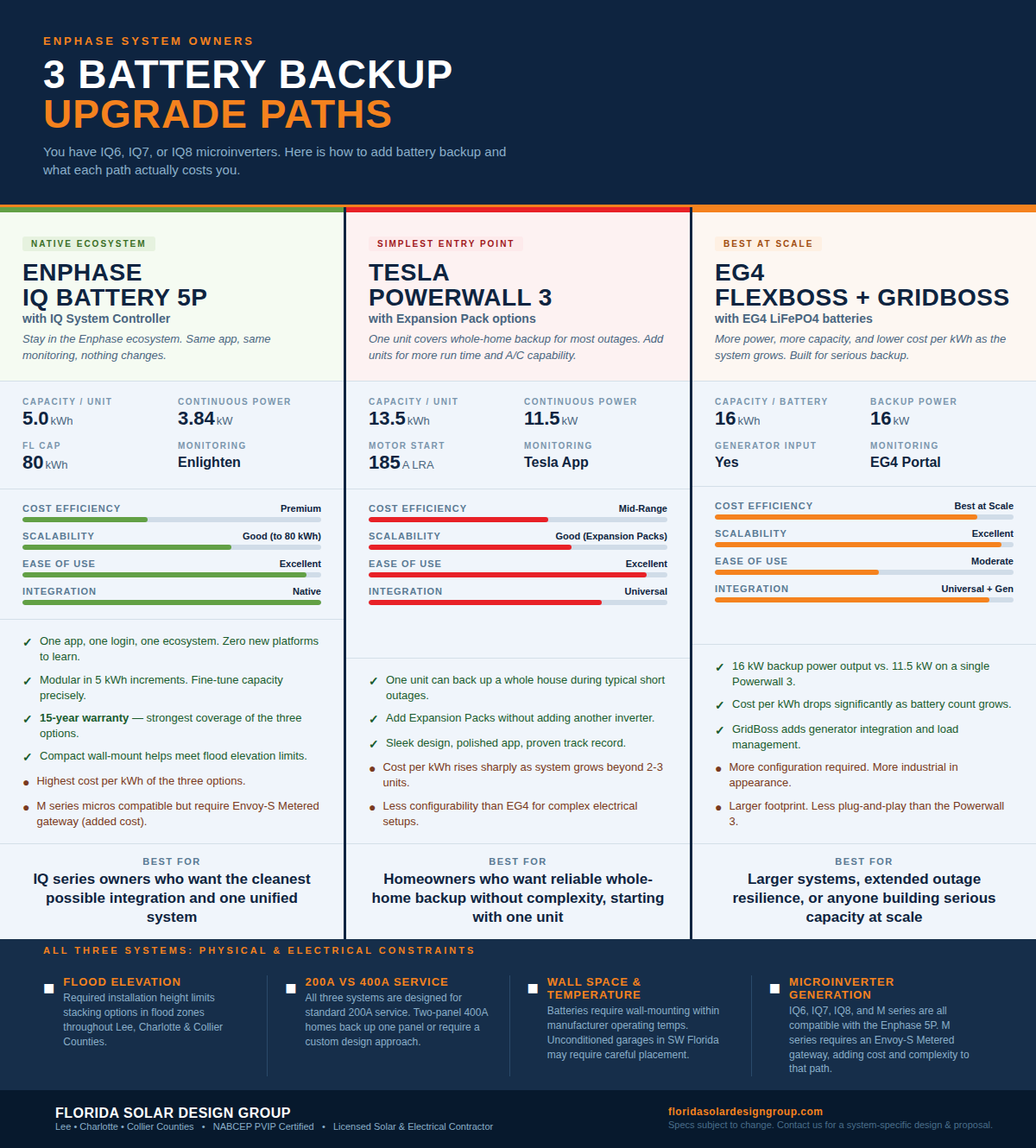
The trade-off is cost. The 5P is a premium product priced accordingly. You are paying for tight integration, a polished user experience, and the reliability of staying in one ecosystem. Worth noting: the 5P carries a 15-year warranty, which is the strongest coverage of the three options compared here. When you are pricing this out against the Powerwall or EG4, that warranty differential is a legitimate part of the value calculation. If budget is the primary driver, the next two options deserve a serious look.
That said, if a seamless single-ecosystem experience matters to you and you already have IQ series microinverters, the 5P earns its price. It is not the cheapest path. It is the path with the least friction.
Option 2: Tesla Powerwall 3 (The Straightforward Entry Point)
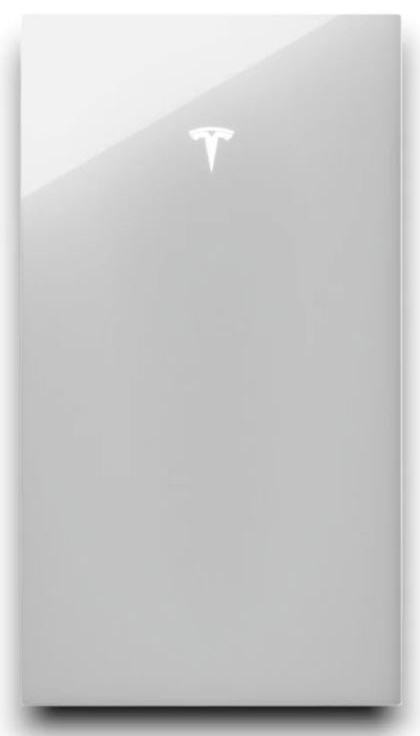 The Powerwall 3 is the most direct entry point into battery backup for a homeowner who wants solid performance without complexity. A single unit can handle whole-home backup during a typical short outage. Not for days, and not while running every load at full capacity, but for the kind of two-to-four-hour outages Southwest Florida sees regularly during storm season, it performs well.
The Powerwall 3 has a clean industrial design, a well-regarded app, and a strong installation track record. It handles the transition from grid power to battery power without interruption during an outage. For a homeowner whose primary concern is avoiding the inconvenience and potential losses that come with short outages, a single Powerwall 3 is often the most direct answer.
The picture changes when you start adding units. A second Powerwall opens the door to running limited air conditioning during an outage. In Southwest Florida, that is not a luxury in summer; it’s a necessity for most. Add a third unit, and you are running the house comfortably during a multi-day event. Additional Powerwall Expansion packs increase capacity without requiring another inverter, keeping the footprint manageable as the system grows.
Sizing matters here, and your existing microinverter capacity is a key variable. The number of panels you have, their combined output, and how that production aligns with your daily consumption all determine how aggressively the batteries can recharge during daylight hours when the grid is down. A system that cannot realistically recharge between outages leaves you with one shot at backup before the batteries are depleted. We work through this calculation on every battery retrofit design. See our battery backup sizing guide for Southwest Florida homes.
For existing Enphase owners in Lee, Charlotte, or Collier County, the Powerwall 3 is a strong starting point. It integrates cleanly with most existing solar systems without requiring any changes to what you already have.
Option 3: EG4 FlexBoss with GridBoss (The Scalable Platform)
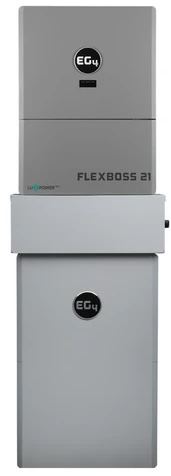 If you are thinking beyond one or two batteries, or if you want a system designed to handle extended off-grid operation, EG4’s FlexBoss platform is worth a serious look.
A single FlexBoss already outperforms a single Powerwall 3 on backup power output. The FlexBoss delivers 16 kW of backup power versus the Powerwall 3’s 11.5 kW. A single EG4 battery also delivers more usable capacity than a single Powerwall unit. Those numbers are useful, but the more compelling argument for EG4 is what happens when you start scaling.
The cost per kilowatt-hour drops significantly as you add batteries to an EG4 system. Adding a second, third, or fourth EG4 battery is considerably more affordable than stacking equivalent capacity in additional Powerwall units. If you are building a system designed for genuine multi-day resilience rather than outage convenience, EG4 becomes increasingly cost-competitive as the system grows. EG4 Electronics publishes full product specifications and documentation for homeowners who want to go deep on the numbers before a consultation.
Paired with a GridBoss, the system adds functionality the Powerwall does not offer out of the box: generator integration, expanded load management, and the configuration flexibility that matters for homes with non-standard electrical setups or higher capacity needs. The GridBoss is the control layer that takes EG4 from a capable battery platform to a fully configurable energy management system.
The Powerwall wins on physical footprint and aesthetics. It is compact, wall-mounted, and simple to operate. The EG4 solution is more industrial in appearance and requires more configuration. That is an honest trade-off, not a knock on EG4. For a larger system where battery capacity and cost efficiency at scale are the priorities, EG4 is our go-to. Learn more about how we design battery backup systems across Southwest Florida.
Physical and Electrical Constraints That Shape the Decision
Selecting a battery platform is only half the conversation. The other half is whether your home can physically and electrically accommodate the system you want, and in Southwest Florida, the answer is not always straightforward.
Physical space matters. All three platforms require wall-mounted installation in a conditioned or semi-conditioned environment. Battery operating temperatures in our climate demand that the installation location stay within manufacturer-specified ranges, which limits certain garage placements, and outdoor installations need to consider direct sunlight impacts.
Flood elevation requirements add another layer. A significant portion of homes in Lee, Charlotte, and Collier Counties have flood zone designations that require equipment to be installed above a specified base flood elevation. That ceiling on available wall height can limit stacking configurations or push the installation to a different location than what originally seemed obvious. We account for this on every job before we finalize a design.
Electrical service is the other major variable. All three of these systems are designed around standard 200-amp residential service. If your home has 200-amp service, your options are wide open with any of the three platforms.
A 400-amp service complicates things. A 400-amp home typically has two main panels. Backing up both panels fully through a single battery system is not always practical or cost-effective. In most cases, we recommend identifying the critical loads and consolidating them on the backed-up panel so the system can cover what matters most without being sized for the entire service. That said, we have design approaches that extend coverage more broadly across a 400-amp service for homeowners who need a more complete solution. It is worth discussing before you assume your options are limited.
The Bottom Line
If you have an Enphase solar system and no batteries, you have three solid options. The IQ Battery 5P is the right choice if you have IQ6, IQ7, IQ8, or M series microinverters and want to stay within the Enphase ecosystem. M series owners should factor in the additional Envoy-S Metered gateway cost before committing to this path. The Powerwall 3 is the cleanest entry point if you want short-term whole-home backup without complexity. EG4 with the FlexBoss and GridBoss is the platform to build on when you need real capacity, real scalability, or a system that can hold up during an extended multi-day outage.
The right answer depends on your budget, your existing system, your electrical service configuration, your physical installation constraints, and how much resilience you actually need. We design and install all three of these platforms regularly across Southwest Florida, and we are happy to walk through the specifics with you. Contact us for a battery backup consultation on your existing solar system.


