

If you own a Tesla Powerwall and your battery spends its nights discharging down to 20% while your solar panels spend their days refilling it, you are losing money. This happens quietly, every day, in the form of efficiency losses you never see, and battery capacity you are slowly burning through. In Florida, with full net metering in place, there is no rational argument for running your battery in daily cycling mode. I have had this conversation more times than I can count, and I want to put the explanation in writing for those asking the question.
What Full Net Metering Actually Means
Florida is a full net metering state (for most utility companies, including FPL and LCEC in Southwest Florida). When your solar panels produce more electricity than your home is consuming at any given moment, the excess flows out to the grid, and you receive a credit at the same retail rate you pay when you import power. A kilowatt-hour exported is worth the same as a kilowatt-hour imported. One for one.
Some people want to argue with me on this point. I’m right. They’re wrong. Period.
Full net metering is an extremely good deal. It means your solar system is effectively using the grid as a giant, lossless battery. When the sun is shining, and your panels are overproducing, your meter runs backward. When you need power at night or on a cloudy day, you draw it back. Net metering makes this exchange seamless and economically fair.
That context matters for everything that follows. Keep it in mind.
The Problem with Daily Battery Cycling
When a Powerwall is set to a 20% backup reserve, here is what actually happens. At night, the battery discharges from whatever state of charge it reached during the day down to 20%. When the sun comes up, the system recharges the battery using solar production. Only after the battery climbs back to 100% does it begin exporting excess solar energy to the grid.
This sounds fine on the surface. But there are two problems embedded in that cycle.
The first is efficiency loss. Lithium iron phosphate batteries are not perfect round-trip energy converters. Powerwall 3 has a round-trip efficiency of around 90%. That means that for every 10 kilowatt-hours you discharge from the battery and then recharge it, you lose roughly 1 kilowatt-hour to heat. In a full net metering environment, those efficiency losses are real money. The energy you lost in the cycle could have been exported to the grid for a full retail credit instead of disappearing as waste heat in your garage.
The second problem is battery degradation. Lithium batteries have a finite number of discharge cycles before their capacity begins to decline meaningfully. Tesla rates the Powerwall 3 for 4,000 cycles at 70% capacity retention. Every time you cycle the battery, you are spending one of those cycles. If your battery cycles once a day under a 20% reserve setting, you are burning through your rated lifespan in about 11 years. Keep it at 100% reserve, and the battery only cycles during actual outages, which in Southwest Florida might be a handful of times per year. The math is not complicated.
Where the 20% Default Comes From
Tesla’s default recommendation of a 20% backup reserve is not wrong everywhere. It exists for a reason. In states with time-of-use (TOU) rate plans, there is a real financial benefit to charging the battery from cheap overnight grid power and discharging it during expensive on-peak afternoon hours. The daily cycling is intentional and profitable in those markets.
Similarly, in states with reduced net metering compensation, or where utilities cap the amount of solar energy you can send to the grid, storing your excess production rather than exporting it makes sense. If you are only getting three cents per kilowatt-hour in credit for power you export but paying twelve cents when you import, you absolutely want to store that energy locally.
Florida Power and Light and LCEC do not operate that way. Residential customers on standard rate plans are not on time-of-use pricing, and full retail net metering credits apply to exported solar. The conditions that make Tesla’s default reserve setting rational simply do not exist here for most homeowners.
Tesla is a national product sold in dozens of markets with different utility structures. Their app defaults reflect a broad range of use cases. They are not optimized for the Southwest Florida solar customer on an FPL standard rate plan. That is not their fault. It is just a reality that your installer should be explaining when they commission your system. If yours did not, that is a gap worth addressing.
What You Should Actually Set It To
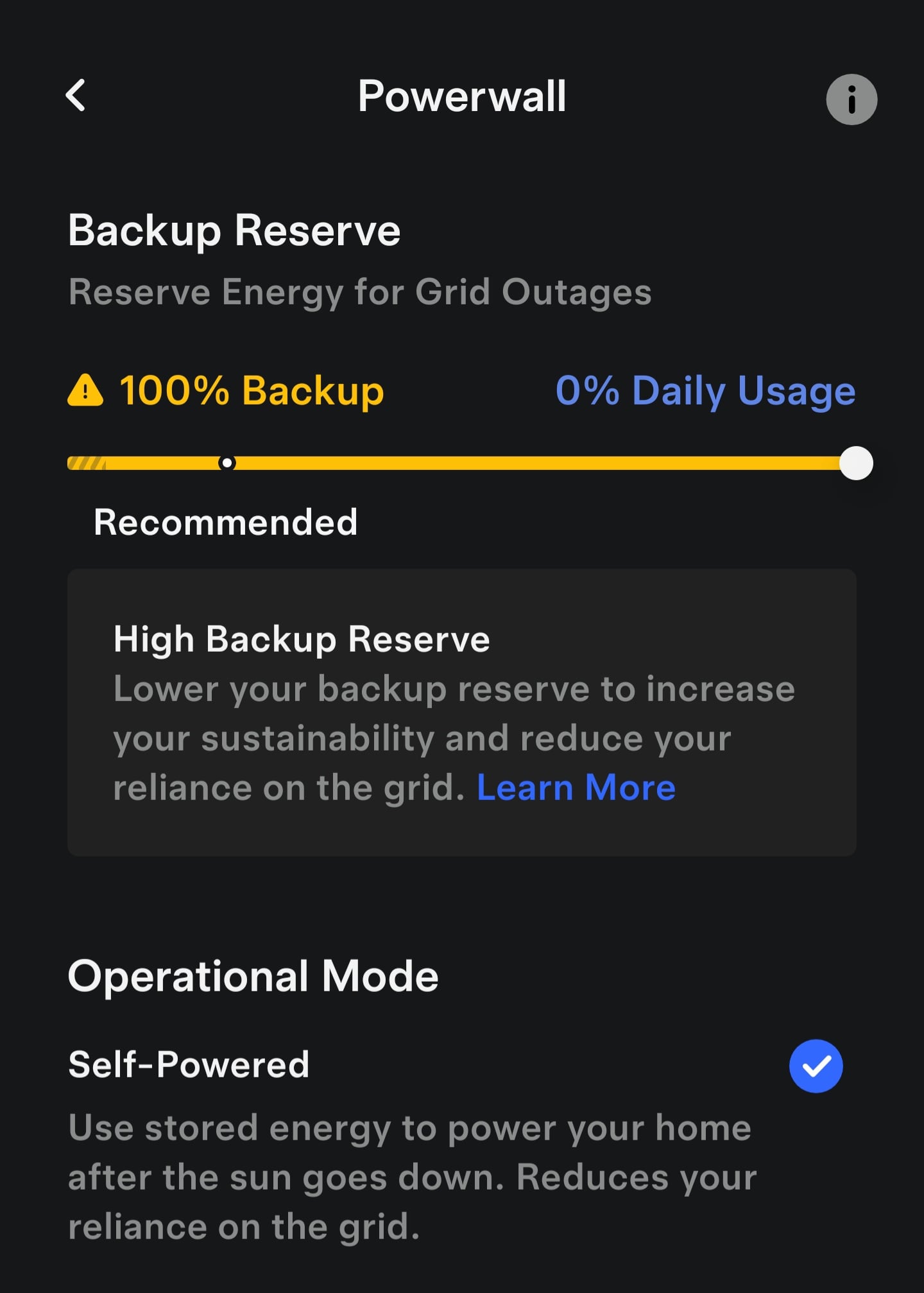
At an absolute minimum, set your backup reserve to 80%. At that level, your battery is sitting full almost all the time, and the only circumstance under which it discharges into the house is during a grid outage. You eliminate the big efficiency losses, you stop accelerating battery degradation, and you stop delaying solar export every morning while the battery recharges.
My actual recommendation is 100% backup reserve. Keep the battery full at all times under normal conditions. Here is why the extra 20% matters.
Power outages in Southwest Florida do not follow a schedule. They happen during hurricanes, yes, but they also happen on clear Tuesday afternoons when a squirrel gets into a transformer, or on a warm Thursday night when a car takes out a utility pole. Storm Watch mode on the Powerwall is a useful feature, and it will bring your battery to 100% when a significant weather event is detected. But Storm Watch does not cover every outage scenario, not even close.
Night is the worst time to have an outage with a partially charged battery. If your reserve is set to 20% and you lose power at 11 PM after the battery has been sitting at 20% all evening, you have very limited runtime. Your refrigerator, your security system, your medical devices, your lights, everything is competing for whatever is left in the tank. If the outage stretches overnight and into the next morning, you are in trouble before your panels ever see sunlight.
A battery that starts an outage at 100% gives you the maximum possible runtime. In a real emergency, that difference can be significant. There is simply no good reason to run your battery partially depleted every night in exchange for a theoretical economic benefit that does not exist under Florida net metering.
A Note on Battery Health and Cell Balancing
There is a counterargument worth addressing honestly. Some battery engineers and enthusiasts argue that keeping lithium iron phosphate cells at 100% state of charge continuously can lead to minor degradation over time, and that occasional discharge and charge cycles help keep cells balanced. There is some evidence behind this, and I am not going to dismiss it entirely.
What I will say is this: none of the major residential battery manufacturers I am aware of require periodic discharge and charge cycles as a condition of warranty coverage. Not Tesla, not Enphase, not EG4, not FranklinWH. If this were a serious operational concern, you would expect to see it addressed in warranty documentation. You do not.
The cell balancing argument also tends to get stretched well beyond what the data actually supports. The minor potential benefit of occasional cycling does not come close to outweighing the certain efficiency losses and documented degradation that comes from daily deep cycling in a full net metering environment. If you want to run a manual discharge cycle once or twice a year, that is a defensible choice. Setting your battery to 20% reserve and letting it grind through a cycle every single day is not.
The Bottom Line
If you are in Florida on a full net metering rate plan, the right backup reserve setting for your Tesla Powerwall is 100%. The second-best setting is 80%. The worst setting is what Tesla’s app recommends: 20%.
Daily battery cycling under full net metering costs you money through efficiency losses, reduces your battery capacity over time through accelerated degradation, and leaves you with less backup energy when you actually need it. None of the conditions that make cycling economically rational in other markets apply here.
Open your Tesla app right now and check your backup reserve setting. If it is set to anything below 80%, change it. If you are not sure how your system is configured or you want someone to walk through your setup and make sure it is optimized for the Florida market, call us. This is what we do.


