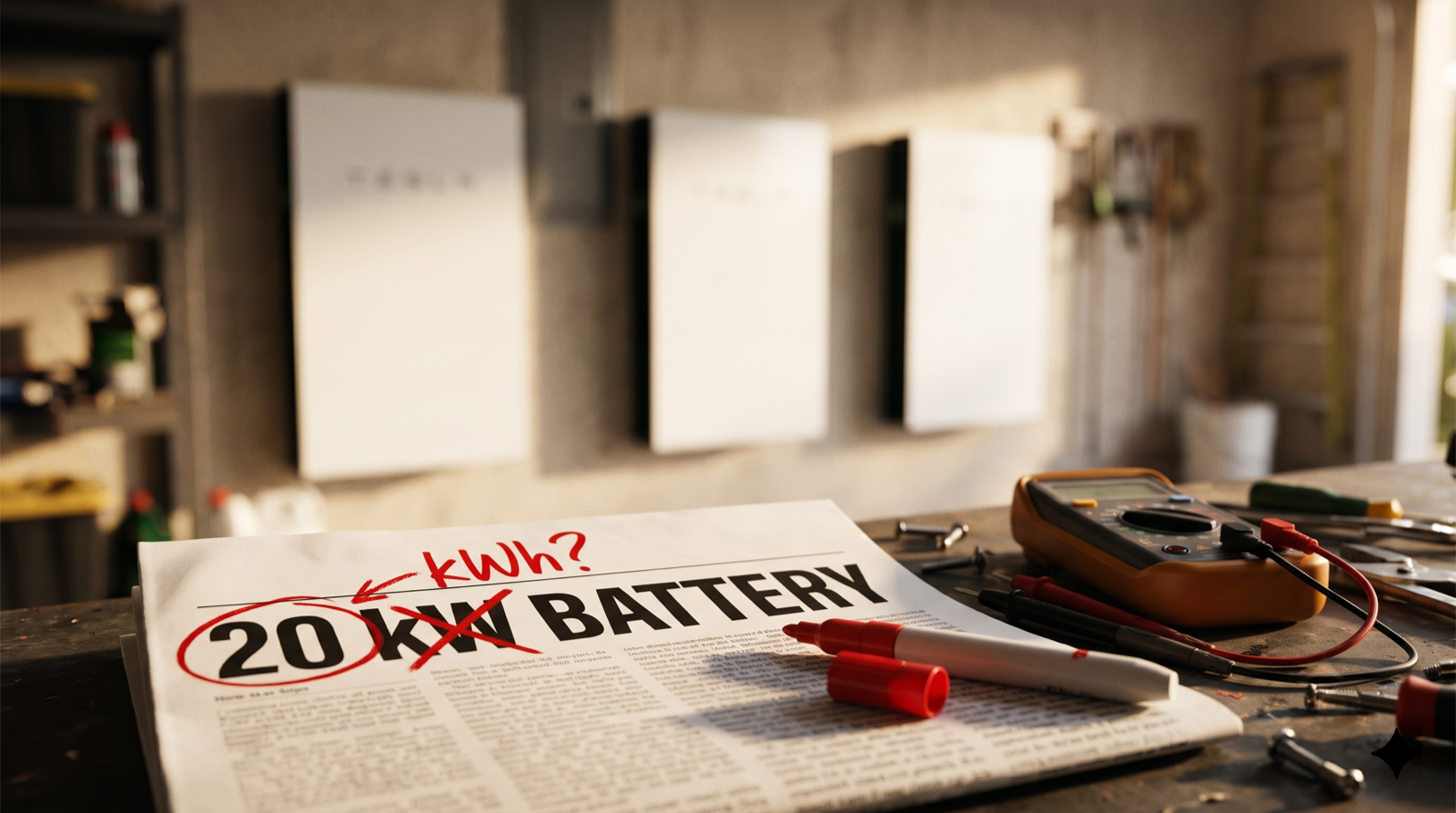
Electrek ran a headline this week announcing that Huawei is set to challenge the Tesla Powerwall with a “new 20 kW home battery.” The product is real. The headline is wrong, because a battery is not rated in kilowatts. It is rated in kilowatt-hours, and confusing the two is the most common mistake in home battery backup shopping.
The 20 kW number is the maximum output of the inverter in Huawei’s new all-in-one system, the Luterra S2. It tells you nothing about how much energy the system stores. Calling it a 20 kW battery is like describing the size of a truck’s fuel tank in horsepower.
I am not trying to pile on one writer. I see this mistake constantly, in news coverage, in sales pitches, and from contractors who should know better. It matters because kW and kWh answer two completely different questions about your system. Mix them up, and you can easily buy the wrong one.
Power vs. Energy in Plain English
Power, measured in kilowatts (kW), is how much your system can run at the same time. Your air conditioner, pool pump, refrigerator, well pump, and dryer all pull power at once. If the combined load exceeds what the inverter can deliver, the system overloads and shuts down. It does not matter how full the battery is.
Energy, measured in kilowatt-hours (kWh), is how long your system can keep running. This is the size of the tank. A battery with more kWh carries you further into the night.
Here is a typical Florida example. A 4-ton central air conditioner might draw around 4 kW while it runs. That is a power number. If it runs half the time over a ten-hour night, it uses roughly 20 kWh. That is an energy number. On top of that, the compressor pulls a big surge for a split second every time it starts, which is why we talk so much about starting current and whether you still need a soft starter.
A system with a big inverter and a small battery runs everything, but not for long. A system with a huge battery and a small inverter runs a few things for days. Southwest Florida homes need enough of both, especially when the outage follows a hurricane, and the house is hot and humid before the sun is even up.
What Huawei Actually Announced
Strip away the headline, and the Luterra S2 is an interesting product. It combines a hybrid inverter and modular LFP battery storage in a stackable unit. The base configuration is 5 kWh, and you expand with 7 kWh battery packs. Huawei claims passive cooling with no fans, an IP66 enclosure, and high corrosion resistance. Those last two features would be very welcome in a salt-air, high-humidity market like ours.
Now the important part. The single-phase versions are rated from 3 kW to 10 kW of output. The 20 kW figure only applies to the three-phase version.
American homes run on split-phase 120/240 volt service, which is single-phase. Three-phase service at a single-family home in Lee, Collier, or Charlotte County is about as common as a snow day. So the version of this product that would actually apply to your house tops out at 10 kW, not 20.
And according to Electrek, it probably is not coming to the US anytime soon anyway. For the record, it is not something FSDG sells or recommends. I am writing about it because the headline is a perfect teaching moment.
Comparing the Right Things
To be fair, 20 kW of continuous output from a single unit would be great. A large Florida home with two air conditioning systems and a pool can put real demand on an inverter. I would never complain about more power.
But if we are going to compare this to the Tesla Powerwall 3, let’s compare the right specs. A Powerwall 3 delivers 11.5 kW of continuous output and stores 13.5 kWh. The single-phase Luterra S2, the one that could actually serve an American home, delivers up to 10 kW. On power, the “challenger” is behind the product it is supposedly challenging.
On energy, Huawei starts at 5 kWh and adds 7 kWh at a time. Tesla adds 13.5 kWh at a time, either with another Powerwall 3 or an expansion unit. Neither one wins on headline numbers. The comparison that actually matters to a Florida homeowner is how those building blocks add up, and how they fit within the code.
That is where this story gets interesting. Not because of Huawei. Because of Tesla.
The Code Limits That Decide Battery Size
NFPA 855 and Section R328 of the Florida Building Code limit residential battery installations in two ways. No single battery unit can exceed 20 kWh. And the total capacity in any one location is capped. Utility closets and interior storage spaces get 40 kWh. Garages, exterior walls, and outdoor ground locations each get 80 kWh.
Those limits apply per location, not per dwelling, which is a point a lot of people in this industry still get wrong. But within any single location, the number is a hard ceiling. 80 kWh passes. 81 kWh does not. Lee and Collier County inspectors know these limits well, and they enforce them.
So the real question is not how many kilowatts a battery can push. It is how cleanly its building blocks divide into 40 and 80.
The Math on Battery Increments
Here is how the common unit sizes play out against the two limits.
5 kWh units: Eight fit in a 40 kWh space. Sixteen fit in an 80 kWh space. Zero waste in either location.
10 kWh units: Four fit in 40 kWh. Eight fit in 80 kWh. Zero waste in either location.
16 kWh units: Five fit in a garage for exactly 80 kWh, which is perfect. But 16 does not divide into 40. Only two fit in a utility space, giving you 32 kWh and leaving 8 kWh on the table.
20 kWh units: Two and four, both clean. But 20 kWh is the maximum allowed unit size, so you are stuck with big steps and very little flexibility in sizing.
13.5 kWh units: Two fit in a utility space for 27 kWh. A third unit brings you to 40.5 kWh, which is over. Five fit in a garage for 67.5 kWh. A sixth brings you to 81 kWh, which is also over.
Look at that last line again. Tesla misses the 40 kWh limit by half a kilowatt-hour and the 80 kWh limit by one kilowatt-hour. That is 13 kWh stranded in a utility space and 12.5 kWh stranded in a garage. I covered the garage side of this in detail in The Tesla Powerwall Math Problem No One Talks About, but the 40 kWh side is just as awkward.
And here is the irony. Huawei’s 5 kWh base plus five 7 kWh packs lands on exactly 40 kWh. The product in the bad headline does the code math better than the product it is being compared to, at least in one location.
Why Hasn’t Tesla Fixed This?
Honestly, I do not know. I have asked. Earlier this year I took the question to Tesla’s regulatory compliance team, and the answer was essentially that unit capacity is a product design decision, not a code approval issue. More recently, I asked my Tesla rep whether anything is in the works. I did not get a real answer.
To be fair, there may be good engineering or manufacturing reasons for 13.5 kWh. It is also a number Tesla has used across multiple Powerwall generations, and there is brand value in consistency. But the code limits are not a secret. They have been in NFPA 855 for years, and every installer who designs large systems in a code-enforcing state runs into them.
A modest change in unit capacity, or a smaller expansion module, would solve the problem in both locations. Until that happens, the workaround is splitting the installation across locations, such as five units in the garage and the rest on an exterior wall. That works, but it adds cost, complexity, and wall space that many clients would rather not give up.
What the Ideal Building Block Looks Like
If I were designing a residential battery for code-enforcing markets, I would build it in 5 kWh or 10 kWh increments. Both divide cleanly into 40 and 80. Both let you size a system to the actual need instead of the nearest awkward multiple. And both let you fill any location to the last kilowatt-hour the code allows.
I would also scale power and energy separately. That is one thing the Luterra S2 gets conceptually right: add inverter capacity when you need more power, add battery packs when you need more runtime. Powerwall 3 expansion units do something similar on the energy side, adding storage without adding another inverter.
The 16 kWh units that several manufacturers now offer are a good choice for garages, where five units hit 80 kWh exactly. They just do not fit as cleanly in interior utility spaces. In Southwest Florida, that is less of a concern, since most of our battery installs go in garages or on exterior walls, and flood elevation often shapes where batteries can go more than anything else (and sometimes which batteries are even an option).
What to Ask When You Shop for Battery Backup
If a quote or an article describes a battery only in kW, or only in kWh, you are missing half the picture. Ask these questions instead.
How many kW of continuous output does the system deliver, and can it start my air conditioner? This determines what you can run at the same time.
How many usable kWh does it store? This determines how long you can run it.
Where will the batteries be installed, and how does the total fit the code limit for that location? If the answer involves more than 80 kWh in a garage, ask how they plan to get it permitted.
For perspective, most homes do not come anywhere near these limits. Two Powerwall 3 units will run everything on a typical 200 amp panel that needs to run at the same time. The increment problem shows up when someone wants maximum capacity in a single location, which is more common in our market than most, thanks to hurricane season and long outages. If you are not sure what whole home battery backup actually means for your house, start there.
The Bottom Line
Batteries are rated in kWh. Inverters are rated in kW. A “20 kW battery” headline mixes the two, and in this case the 20 kW figure applies to a three-phase version that doesn’t apply to American homes anyway. The single-phase version tops out at 10 kW, which is less than a Powerwall 3.
The better story is battery increments. Under NFPA 855 and the Florida Building Code, 5 kWh and 10 kWh building blocks divide cleanly into both the 40 kWh and 80 kWh location limits. Tesla’s 13.5 kWh units miss both by a kilowatt-hour or less, stranding usable capacity in every maxed-out location.
If you are planning battery backup in Lee, Collier, or Charlotte County and want a system sized to what you actually need, and to what the code actually allows, contact Florida Solar Design Group. We will give you both numbers, kW and kWh, and explain what each one means for your home.