The solar industry loves to frame AC coupling and DC coupling as a battle, with one winner and one loser. That framing misses the point entirely. Both architectures exist because they solve different problems, and the “better” choice depends almost entirely on what your system spends most of its time doing.
If your home is connected to the utility grid, which describes the vast majority of homes in Lee, Charlotte, and Collier Counties, your solar system operates in grid-interactive mode for roughly 99% of the year. The grid is up. The lights are on. Net metering is doing its thing. The other 1% is the handful of hours or days per year when the grid goes down and your batteries take over. That ratio matters a lot when you start thinking about where efficiency losses actually occur.
A Quick Refresher on the Two Architectures
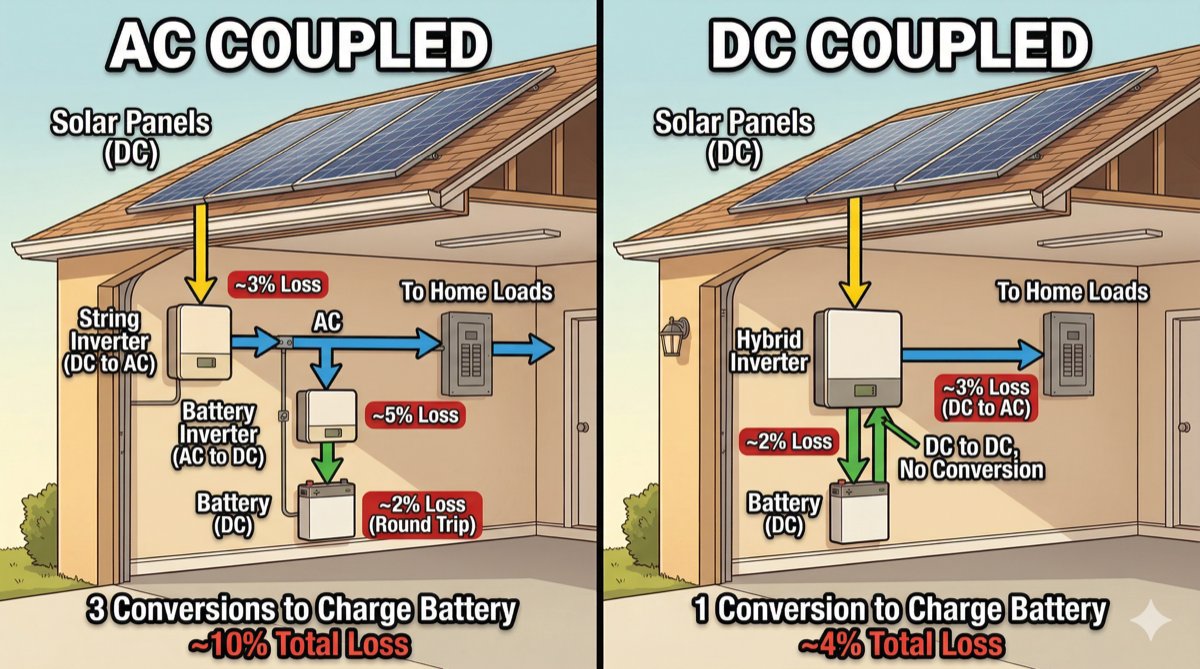
In a DC-coupled system, solar panels feed DC electricity directly into a hybrid inverter that manages everything: solar charging, battery charging, and AC output to your home. The solar energy stays in DC form until the very last step when it is converted to AC for your home’s circuits. If the energy is headed for the battery, it never converts to AC at all. It goes from the panels through a charge controller to the battery as DC the entire way. One conversion to power the home. Zero conversions to charge the battery.
In an AC-coupled system, the solar panels have their own inverter (microinverters or a string inverter) that converts DC to AC right at the source. That AC power flows into your home and either powers your loads, exports to the grid, or gets converted back to DC by a separate battery inverter for storage. To charge the battery, the energy converts from DC to AC at the solar inverter, then from AC back to DC at the battery inverter. Two conversions instead of zero. Each conversion introduces a small loss, typically 2 to 5 percent per step.
If you want a deeper look at how AC-coupled systems are wired and managed, I wrote a detailed post on microgrid interconnect devices and AC coupling architecture.
Why AC Coupling Wins on the Grid
Here is the part that gets lost in the efficiency debate. When your home is grid-connected and the sun is shining, an AC-coupled system does not suffer meaningful conversion losses at all for the energy you consume in your home.
Think about what happens on a normal sunny afternoon. Your solar panels produce DC. Your microinverters or string inverter converts that to AC. That AC flows directly to your home’s loads. One conversion. Done. The energy that powers your air conditioner, your refrigerator, and your lights never touches the battery. It goes straight from the panels through a single inverter stage to your appliances. A DC-coupled system does the same thing with one conversion through its hybrid inverter. At this stage, the efficiency difference between the two is negligible.
The excess energy that you do not consume goes to the grid through net metering. It does not go to the battery. There is no round-trip battery loss. There is no second conversion. Your utility credits you for that exported energy at the full retail rate (or whatever your net metering agreement specifies), and you use those credits later. The grid acts as your storage, and it has zero conversion loss.
This is why AC coupling has dominated the residential grid-interactive market for years. When the grid is your primary “battery,” the extra conversion step to charge a physical battery barely matters because it barely happens during normal operation. Enphase microinverters, the most widely installed residential solar inverter platform in the country, are AC-coupled by design. So is any system that pairs a SolarEdge or other string inverter with an add-on battery like the Tesla Powerwall 3. We install both configurations regularly. I covered the AC coupling limits for Enphase and Powerwall 3 in a recent post with an interactive calculator.
Where DC Coupling Pulls Ahead
DC coupling earns its advantage when the battery is no longer a backup device and becomes the primary energy pathway. This happens in two scenarios: extended grid outages and off-grid living.
When the grid goes down and your home is running on battery and solar, every kilowatt-hour matters. Your battery has a finite capacity, and the sun only shines for part of the day. In this mode, every percentage point of efficiency you lose in conversion is a percentage point of runtime you lose at night. DC-coupled systems charge the battery directly from the solar panels without any intermediate AC conversion. That savings of 4 to 8 percent in round-trip efficiency translates to real hours of additional runtime when you are counting kilowatt-hours in a hurricane.
For off-grid homes, like the island properties we service on Cayo Costa and Keewaydin Island, this math compounds. There is no grid to export to. Every kilowatt-hour your panels produce either powers the home, charges the battery, or gets wasted. The battery charges and discharges every single day, not just during the rare outage. Conversion losses that seem trivial on a grid-connected home accumulate meaningfully when the battery cycles daily. A 5 to 8 percent round-trip advantage over thousands of cycles per year adds up to a lot of energy. If you are curious about how we approach off-grid system design for island properties, I wrote about it in detail.
DC-coupled hybrid inverters like the Sol-Ark 15K/18K, EG4 FlexBOSS18/FlexBOSS21, and Sol-Max AIO (formerly Midnite AIO) are the workhorses of these off-grid installations for exactly this reason. They handle solar input, battery management, and AC output in a single integrated unit. Fewer components, fewer conversion stages, and maximum energy retention. Our battery options guide breaks down the tradeoffs between AC-coupled, DC-coupled, hybrid, and all-in-one systems in more detail.
The Lines Are Blurring
Here is where the conversation gets more interesting. AC-coupled systems are increasingly being used for battery backup and even off-grid applications, despite the theoretical efficiency disadvantage. There are a few reasons for this.
First, battery costs have come down dramatically. When batteries were expensive, squeezing every last percentage point of efficiency out of the charge cycle was critical because every kilowatt-hour of wasted energy represented real dollars. As battery (and solar) prices drop, it becomes more cost-effective to simply install slightly more capacity than to architect the entire system around minimizing conversion losses. If an extra 5 kWh of battery costs less than the premium for a DC-coupled hybrid inverter, the math favors AC coupling with a bigger battery.
Second, AC-coupled systems are more flexible. If you already have a functioning solar array with microinverters, adding a battery does not require ripping out your existing equipment. You add a battery system alongside your existing inverters, and everything connects on the AC side. This is a massive practical advantage for retrofit installations, which make up a growing share of our business. Homeowners who installed solar three or five years ago without batteries are now adding them, and AC coupling lets them do it without starting over.
Third, and this is the point that deserves more attention, AC-coupled off-grid systems do not actually suffer conversion losses when delivering solar power directly to loads. Think about it. The solar panels produce DC. The microinverters convert to AC. That AC powers the home. One conversion, same as DC coupling. The additional losses only show up when the system is charging or discharging the battery, because that is the only time the extra AC-to-DC and DC-to-AC conversion steps occur. During the middle of a sunny day, when an off-grid home is running directly on solar, the AC-coupled system is operating at essentially the same efficiency as a DC-coupled one.
This realization changes the calculation for some off-grid designs. If the home’s occupants are active during the day and can shift heavy loads to daytime hours when solar is producing, the battery cycling is reduced and the efficiency gap narrows significantly. An AC-coupled off-grid system with smart load management may only cycle the battery for nighttime loads and morning startup, which limits the conversion loss penalty to a smaller portion of the daily energy budget.
What We Actually Recommend
For a new grid-interactive installation with battery backup in Southwest Florida, either architecture works well. AC coupling is our default for homes with Enphase microinverters or any system where the homeowner may want to add batteries later without replacing existing equipment. DC coupling is our default for whole-home backup systems designed from scratch where maximum efficiency during extended outages is a priority, and for off-grid island properties where every kilowatt-hour counts.
The wrong answer is choosing an architecture based on a theoretical efficiency chart without considering how the system will actually be used 99% of the time. If your home is on the grid and your batteries exist primarily for hurricane backup, the few percentage points of conversion loss during those rare events are not worth redesigning your entire solar system around. If your home has no grid connection and your batteries cycle every single day, those percentage points matter, and DC coupling is the stronger choice.
The Bottom Line
AC coupling and DC coupling are not competing technologies. They are tools designed for different jobs. AC coupling is the practical, flexible, and cost-effective choice for grid-connected homes that want battery backup. DC coupling is the efficiency champion for off-grid properties and systems where maximizing battery performance is the top design priority. The industry is trending toward more AC coupling even in backup and off-grid applications as battery costs fall and the efficiency gap becomes less financially significant. But for island homes and truly grid-independent designs, DC coupling still has a meaningful edge.
If you are in Lee, Charlotte, or Collier County and trying to figure out which architecture makes sense for your home, give us a call. The answer depends on your existing equipment, your backup goals, and how you actually use energy. We will help you sort it out.