

I’m proud to announce that I have officially completed my NABCEP PV Installation Professional (PVIP) recertification, extending my credential through January 26, 2029.
If you’ve already seen our NABCEP certification overview page, you know this credential represents the highest level of technical competence in the solar industry. What many people don’t realize is that maintaining this certification is arguably harder than earning it in the first place.
This recertification confirms that I continue to meet the rigorous technical, educational, and ethical requirements established by the North American Board of Certified Energy Practitioners (NABCEP), the gold standard organization for solar professionals. The industry is evolving, and the knowledge and experience required to maintain certification becomes harder every year.
NABCEP Certification Expires — Unless You Earn It Again
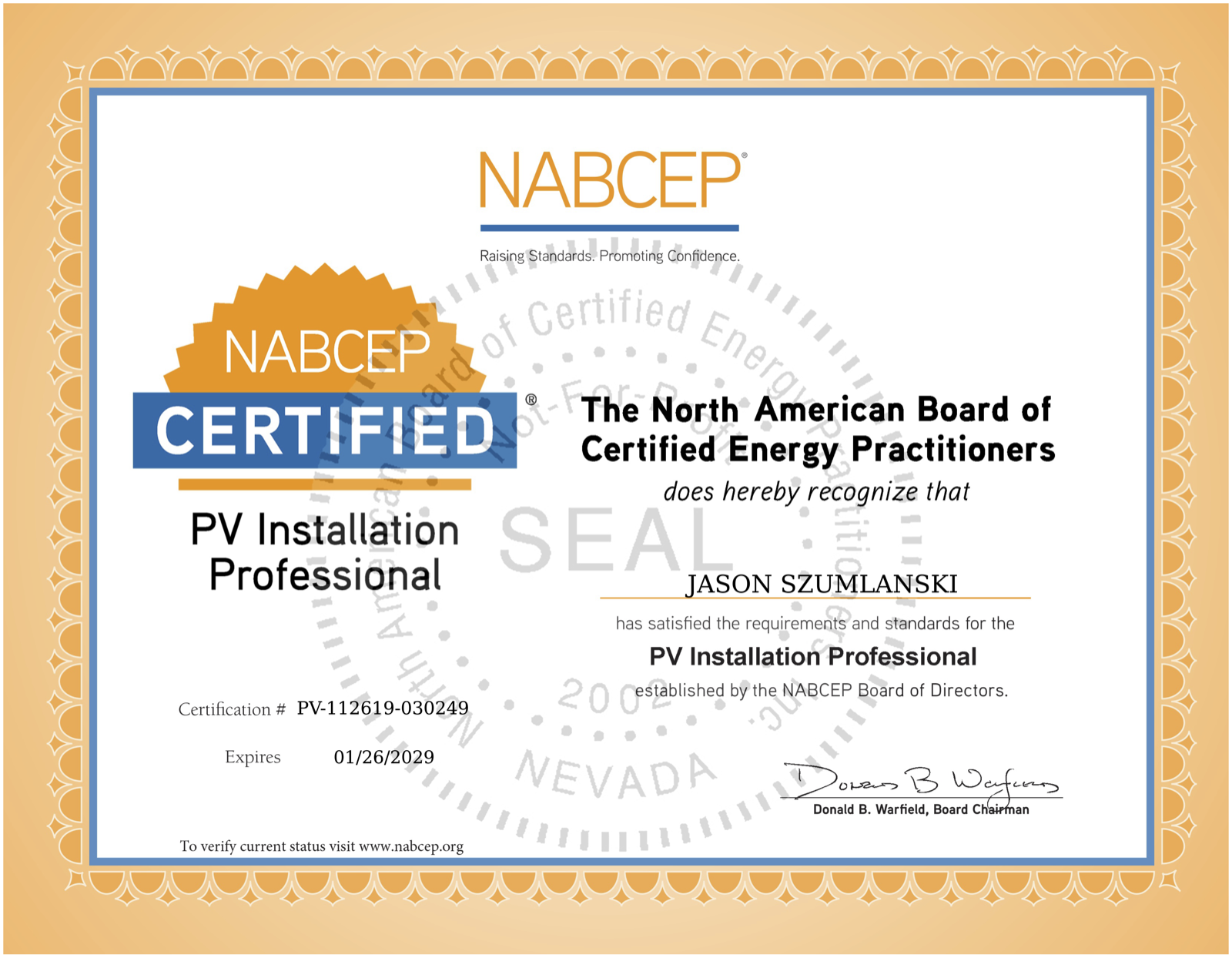 NABCEP PVIP certification is not permanent. Every three years, certified professionals must demonstrate continued competence and active involvement in the industry.
This process requires:
- Completion of extensive continuing education in solar design, electrical code, energy storage, and building/fire code.
- Documentation of ongoing work designing and installing solar energy systems
- Verification of compliance with current NEC electrical code standards
- Formal application review and approval by NABCEP
- Strict adherence to NABCEP’s professional and ethical standards
If these requirements are not met, certification expires. There are no shortcuts. The continuing education requirements are onerous.
Why Recertification Matters to Homeowners
Solar technology evolves rapidly. In the past few years alone, we’ve seen major changes in:
- Battery backup systems and whole-home energy storage
- Advanced inverter capabilities
- Movement toward All-in-one system architecture for off-grid installations
- Rapid shutdown and safety requirements
- Electrical code updates affecting solar installation
- Power control systems and load management
- Grid integration and backup system design
- EV integration and charging control
Recertification ensures that your solar system is designed by someone who understands these changes—not someone relying on outdated knowledge.
This directly impacts system safety, reliability, and long-term performance.
The Difference Between Certified and Recertified
Anyone can claim experience. NABCEP certification proves it. Recertification proves it continuously.
This means your system is designed by a professional who:
- Stays current with NEC code and industry standards
- Actively designs and implements solar and battery systems
- Understands modern equipment and evolving technology
- Maintains verified professional competence
NABCEP certification is not just a credential—it is part of our operational standard.
Why This Matters in Southwest Florida
Southwest Florida presents unique challenges for solar installations, including hurricane exposure, high heat, salt air corrosion, and complex electrical integration requirements.
Proper system design is critical.
Maintaining NABCEP PVIP certification ensures that our clients receive systems designed for safety, performance, and durability under real Florida conditions.
A Continued Commitment to Excellence
Maintaining NABCEP PVIP certification through 2029 reflects an ongoing commitment to technical excellence and professional accountability.
This ensures our clients receive solar and battery systems designed to the highest industry standards.
If you are considering solar or battery backup, working with a NABCEP-certified and actively recertified professional is one of the most important decisions you can make.
If you’d like to learn more, visit our NABCEP certification page or contact Florida Solar Design Group for a consultation.


