The marketing says otherwise. The box says otherwise. The slick app and the smart transfer switch and the YouTube influencer reviews say otherwise. But the electrical code, the fire code, the Florida Building Code, and basic math say the same thing I say to homeowners every week: a portable power station is not a whole-home battery backup system.
This is not a knock on EcoFlow, Jackery, Anker, or Bluetti. Those are legitimate products built for legitimate purposes. The problem is not the equipment. The problem is what people are being led to believe they can do with it.
How This Conversation Keeps Happening
I get inquiries regularly from homeowners who want to add solar panels to their portable power station setup. The request usually goes something like this: they bought a 5 kWh to 10 kWh portable unit, plugged it into a smart transfer switch, and now they want rooftop solar to charge it and sell power back to the grid.
What they have built feels like a real battery backup system. It turns on automatically when the power goes out. It runs the refrigerator and some lights. The app shows them how much power they are using. It seems like the real thing.
It is not the real thing. And the gap between what it seems to be and what it actually is matters in ways that go beyond inconvenience.
The Safety Certification Problem
When a professional solar and battery system is installed in Florida, every major component carries specific safety certifications that apply to how that component is being used. A Tesla Powerwall 3, an EG4 FlexBoss, or an Enphase system installed in a home is certified to UL 9540, the system-level safety standard for stationary energy storage systems. That certification means the complete integrated system, battery, inverter, controls, and all, was tested together by a nationally recognized testing laboratory for exactly the way it is being installed.
Most portable power stations carry a different certification: UL 2743, the standard for portable power packs. That standard covers camping power, jobsite charging, and emergency backup use through extension cords. It does not cover stationary residential installation. It was never tested for that application. When you plug a UL 2743 listed portable power station into a permanently wired transfer switch and use it as a fixed home backup system, you have created a configuration that no testing laboratory has ever evaluated for safety.
Florida Building Code Section R328, which adopts NFPA 855, is explicit: any energy storage system installed in a stationary residential application must be listed and labeled in accordance with UL 9540. The scope of NFPA 855 specifically addresses mobile and portable energy storage systems installed in a stationary situation. The portability of the product does not exempt it from the requirement.
There is one notable exception worth mentioning. EcoFlow’s Delta Pro 3 does carry a system-level UL 9540 listing. That puts it in a different category than most competing portable units. But even that product must be installed in a manner consistent with its listing documentation, which means the installation still needs to comply with code-required separation distances, aggregate capacity limits, smoke detection requirements, and more. The listing alone does not make any installation automatically code-compliant.
Jackery, to be specific about the brand I hear about often, holds UL 1973 certification on its battery packs (a component-level standard) and UL 2743 on its main power station units. The Smart Transfer Switch carries UL 916 and UL 67 listings. None of that adds up to a UL 9540 system listing.
The Solar Integration Problem
Even if the safety certification issue did not exist, the technical reality of integrating rooftop solar with a portable power station is a problem that cannot be solved with a clever adapter or a longer cable.
Rooftop solar in Florida requires rapid shutdown capability. This is a National Electrical Code requirement (NEC Article 690.12) that exists so firefighters can de-energize a solar array when responding to an emergency. Rapid shutdown requires specific equipment integrated into the solar system that communicates with the array to shut it down module by module when triggered. Portable power stations do not have this. There is no way to get a permit for a rooftop solar installation without it, and there is no legal way to install rooftop solar without a permit in Florida.
There also needs to be a system of proper disconnects for both code compliance and utility company rules. These portable systems do not address that.
To permanently install solar panels, you have to use proper wiring methods for safety and code compliance. Take a look at this example from EcoFlow’s Delta Pro X manual:
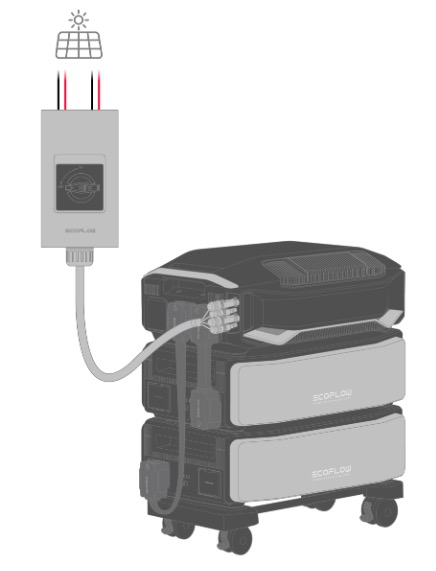
What is depicted is high-voltage strings of DC power from solar panels coming into the battery system using proprietary flexible cords. That is not allowed. High-voltage DC circuits are extremely dangerous and must be contained in metallic conduits when run inside buildings per the National Electrical Code. This example of how to connect solar panels to one of these systems doesn’t meet the requirements, and there is no way to change that. This limitation alone precludes connecting permanently mounted solar panels to EcoFlow’s “whole home backup” system.
Beyond the code issue, the solar input capacity on portable units is severely limited relative to their battery capacity. A system marketed as having 30 kWh of storage, which you might assemble by stacking several units and expansion batteries, might accept two to four kilowatts of solar input at best. At that charge rate, a fully depleted 30 kWh system would take seven to ten hours of peak solar production to fully recharge, assuming your house was drawing zero power during that time. In Southwest Florida, where a summer afternoon can demand five kilowatts or more just for air conditioning, you would be drawing down the batteries faster than the solar can replenish them during an extended outage.
A properly designed system sized for 30 kWh of storage would pair with a solar array large enough to actually recover that energy within a day or two, with enough headroom to run the house simultaneously. That takes a real grid-interactive inverter with proper charge control, MPPT sizing, and net metering capability. Portable power stations are not built for that architecture.
On the flip side, we see systems with paltry battery storage capacities, such as 12 kWh, paired with oversized solar arrays in the 10kW range. That’s way too much solar power for a small backup system, especially ones that can’t sell excess capacity back to the grid.
You Cannot Sell Power Back to the Grid?!
FPL’s net metering interconnection program requires equipment that meets specific technical standards for grid-interactive systems. A portable power station connected to home circuits through a transfer switch is not a grid-interactive system. It cannot export power to the grid. It cannot participate in net metering. The energy it stores can only be used on your side of the meter, which means any solar charging you do goes into the battery and stops there. You give up the economics of net metering entirely. This is the best reason to get solar panels, and you’re leaving that on the table with portable battery systems!
For a homeowner trying to offset a significant portion of their electric bill and build meaningful resilience, that matters. A properly installed grid-tied solar-plus-storage system with Tesla Powerwall 3 , Enphase 5P Batteries, or EG4 FlexBoss units can charge from solar, power your home, export excess to the grid when the grid is present, and switch to island mode during outages. That full cycle of energy management is what a real system does. A portable power station does only one of those things.
A Word About Permits and Insurance
Building departments in Lee and Collier County vary in how closely they scrutinize energy storage equipment. Some inspectors are well-versed in UL 9540 and NFPA 855. Others are not. You might get a permit pulled for rooftop solar with a portable battery sitting in your garage on a transfer switch, and the inspector might never ask about the certification chain on the battery system.
That is not the same as the installation being code-compliant. Code compliance is not determined by whether an inspector caught the issue. It is determined by whether the installation meets the adopted codes.
The reason this matters beyond principle is your homeowner’s insurance. If a fire starts in your home and investigators determine it originated with an energy storage system that was not listed for stationary residential use, your insurer has grounds to scrutinize the claim carefully. Florida’s property insurance market does not need another complicating factor. Installing an unlisted system in a permanent wired configuration is exactly the kind of thing that turns a covered loss into a prolonged dispute.
What a Real Whole Home Battery System Looks Like
If you want genuine whole home battery backup with solar charging in Southwest Florida, the path is straightforward even if the price is higher than a stack of portable units from a big box store.
FSDG installs Tesla Powerwall 3, EG4 FlexBoss, FranklinWH, and similar systems that are fully certified for stationary residential installation, properly permitted, interconnected with FPL or LCEC where applicable, and installed by licensed electrical and solar contractors. These systems integrate directly with rooftop solar, manage grid interaction, provide automatic backup transfer, and are built to operate as permanent infrastructure.
You might be surprised how affordable a professionally installed system is compared to a DIY portable battery. Portable battery systems are actually very expensive, especially with scale and when features are considered.
The Bottom Line
Portable power stations like Jackery, Bluetti, and most EcoFlow units are useful products for what they are designed to do: portable power, camping, emergency plug-in backup through extension cords, and off-grid cabin use. They are not designed, certified, or appropriate for permanent whole home solar power with battery backup in Florida when connected to your electrical panel through a transfer switch. The marketing says you can do it. The Florida Building Code, NFPA 855, and the UL listing on the product itself say otherwise.
If you have already purchased one of these systems and connected it to your panel, it is worth understanding what you have and what its limitations are. If you are planning a real solar-plus-battery system that handles extended outages, integrates with rooftop solar, and participates in net metering, call us. We will design something that actually does the job.