

Editor’s note: This is an opinion piece. Every factual statement about what county staff, commissioners, or the developer said is drawn from written correspondence in my possession, Charlotte County’s own published permit requirements, or the text of the county code and Florida Statutes. The opinions are mine.
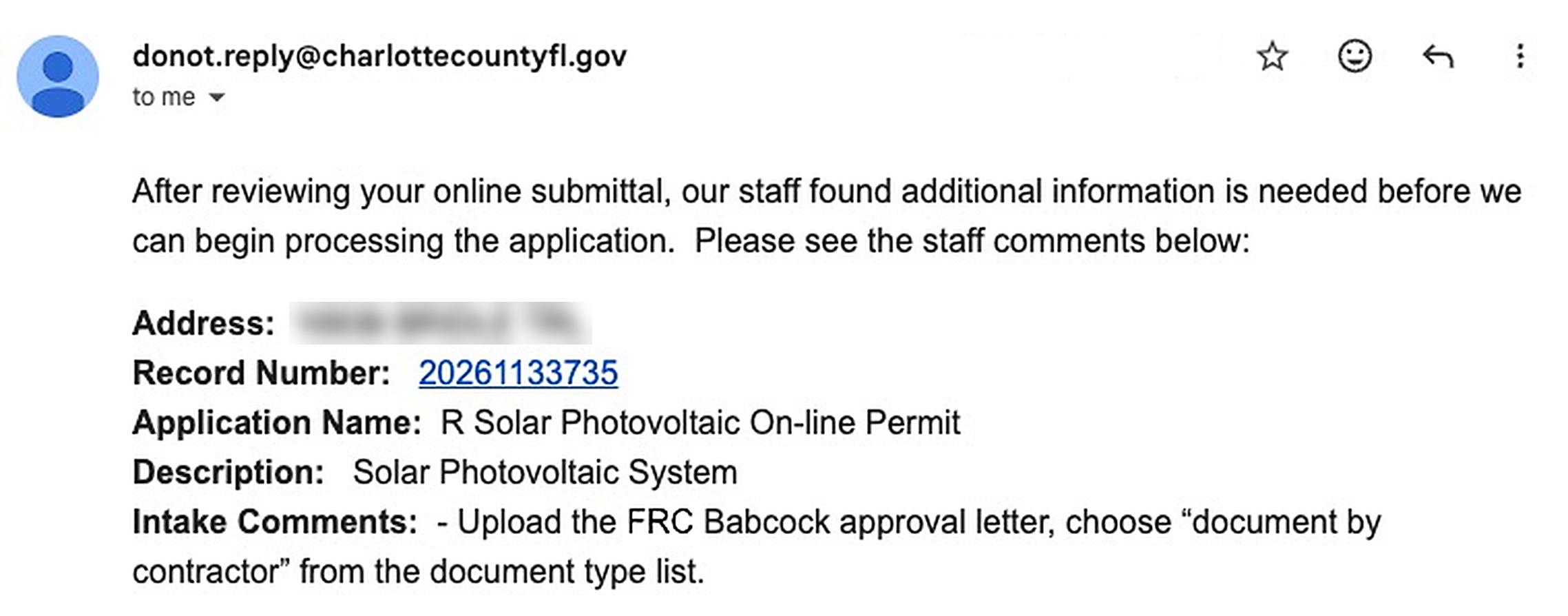
This morning, Charlotte County refused to begin processing a solar permit application we submitted for a home on Bridle Trail in Babcock Ranch. The reason, in its entirety: “Upload the FRC Babcock approval letter.” No plan review. No code issue. Just a missing letter from a private homeowners’ architectural committee.
Babcock Ranch sells itself as America’s first solar-powered town. Since March, it has also been the only place in Charlotte County where the county will not even accept a solar permit application until the homeowners’ association signs off first. Seven months of emails, a letter to every county commissioner, and a promise from county staff to “review our internal processes” have changed nothing.
How the Babcock Ranch FRC Requirement Started
We have been installing solar in Babcock Ranch since the early days of the community, and we have always gone through the Founders Review Committee (FRC), the community’s architectural review body. That was never the issue. The FRC review and the county permit simply ran on their own tracks.
That ended in late March. Our office manager submitted an FRC application for a Palmetto Pass job on March 24. On March 31, the county told us it would not accept the permit without the FRC letter. When she asked why, a senior permit technician answered that it “will be a requirement for all outside structures from here on out,” and that it was “a requirement from the Founders Review Committee of Babcock,” so we should take it up with them if we disagreed.
Read that again. A county employee told a licensed contractor that a county permit requirement came from a private committee.
Community Development Director Ben Bailey later explained that a permit technician had questioned whether FRC approval was needed and “reached out to Babcock Ranch for confirmation.” Solar permits do not normally route through zoning review, he wrote, so the requirement “was not identified or applied,” and he called eleven years of non-enforcement an “oversight in our internal process.”
What the Code Actually Says
The county relies on one sentence of the Babcock Overlay Zoning District, Charlotte County Code Section 3-9-51(e)(2), adopted in 2014:
“Any application for county development permit within the district must be accompanied by documentation of approval by the master developer, or its successor or assign, in order for the application to be accepted by the county.”
Read that: “Any application.” Not exterior applications. Not visible applications. Not solar applications. Any.
The same ordinance defines “development” for its own purposes, and the definition is anything but narrow. It says the term “shall be construed liberally” and includes any plat, site plan approval, building or sign permit, or “any other official action of Charlotte County.”
So the text leaves exactly two honest readings. The first is that this provision governs the large-scale buildout of a master-planned community: plats, site plans, new phases, and new homes, where the master developer’s sign-off actually matters. Individual homeowner trade permits on finished houses were never in scope, which is exactly how the county treated it for eleven years.
The second is that “any” means any. Water heaters, panel changes, EV chargers, kitchen remodels, re-roofs, pool heaters. Every one of them would need a letter from the developer before the county could accept the application.
The county has chosen neither.
One Sentence, Three Different Rules
Watch how the rule has shifted, all without a single word of the ordinance changing:
On April 1, it applied to “all outside structures.” On April 6, Mr. Bailey cited the Comprehensive Plan’s definition of development, not the overlay district’s own broader definition, to explain why interior work is exempt. On April 20, it applied to permits that affect “the exterior appearance of the building.” On May 14, writing to Commissioner Joseph Tiseo, he said the county would “continue requiring the FRC approval for solar.”
Outside structures, exterior appearance, or solar. Those are three different rules, and none of them appears in the code. When the people enforcing a regulation keep restating what it covers, that tells you the boundary is being drawn at the permit counter, not in the ordinance.
In April, I asked in writing for a list of every type of permit the county requires FRC approval for at intake. The county answered my related public records request, but it never provided that list.
The County’s Best Argument, and Why It Falls Short
I want to give the county’s position a fair hearing, because it is not crazy. In that May 14 email, Mr. Bailey wrote that he had discussed the matter with staff and with Kitson and Partners, the developer. His reasoning: the FRC only reviews changes that are visible from the outside, so it would be “pointless” to hold an interior permit for an FRC approval the homeowner could never obtain.
As a practical matter, that is sensible. As a matter of law, it proves my point. If applying the code as written produces a pointless result, the fix is to amend the code. That is the Board of County Commissioners’ job, done in public, with notice and a vote. It is not the job of staff to quietly redraw the ordinance’s boundaries to match the developer’s review practices.
The same email says Kitson “is working on a revised pattern book to clarify the language and intent so there is no confusion.” Two problems. A pattern book is the developer’s private design document. Revising it cannot change what a county ordinance says. And if the language needs clarifying, then by the county’s own account it is not clear today. Yet it is being enforced today, against solar, as if it were.
The Promise That Went Nowhere
Even if you accept the county’s reading of the ordinance, the way it is being enforced makes no sense. This is a zoning condition. Zoning conditions do not belong at the front door.
Building departments place holds on permits all the time. A missing recorded Notice of Commencement, a flood elevation certificate, a zoning sign-off: any of them can stop a permit from being issued or an inspection from being scheduled, while plan review and everything else keeps moving. When the missing document arrives, the hold comes off. That is ordinary, routine permitting, and Charlotte County does it every day.
Applied here, the county could accept a Babcock Ranch solar application, review the plans, and place a zoning hold on issuance until the FRC letter is uploaded. The FRC and the county would work at the same time. Nobody’s oversight would be weakened, and nobody would wait for one review to finish before the other begins.
Mr. Bailey proposed almost exactly that. On April 3, he wrote that the county would review whether to require FRC documentation before permit issuance rather than at intake, with any FRC-driven design changes at the contractor’s risk. That is a fair trade, and I would take it. He repeated it on April 6 and said he would follow up if anything changed.
That was seven and a half months ago. This morning’s rejection was at intake.
The difference matters. Babcock Ranch’s own solar page says homes in a sub-HOA neighborhood need the sub-HOA’s approval first, then the FRC’s. In our experience, the FRC alone can take a month. Under the county’s current approach, plan review does not even start until all of that is done. Running the steps one after another instead of side by side turns a few weeks into a couple of months before a homeowner even gets to the FPL interconnection and permission to operate stage. A hold at issuance would cost the county nothing. A hold at intake costs the homeowner weeks.
The County’s Own Checklist Does Not List It
Here is the part I find hardest to square. Charlotte County publishes a page listing what it requires at application submittal for a residential solar permit. As of today, that list includes the application package, roof layout, engineering, Notice of Commencement, and several other items. It does not mention an FRC letter, HOA approval, master developer approval, or Babcock Ranch anywhere.
The same page, as of today, says which reviews a solar permit goes through. Ground-mounted systems need zoning, electrical, and building review. Rooftop systems need only electrical and building review. Zoning is not on the list. That matches what Mr. Bailey told me in April: solar permits do not normally route through zoning, which is why the FRC requirement went unnoticed for eleven years. So a requirement the county itself calls a zoning matter is being enforced at intake, on a permit type the county’s own website says skips zoning review.
Florida law requires each local building department to post every type of building permit application along with its required attachments, and a separate statute measures whether an application is complete against the filing requirements the local government has published. I am not a lawyer, and I am not claiming the county has broken either law. But I would like someone to explain how an application can be deemed incomplete for lacking a document that appears nowhere in the county’s published requirements for that permit.
What About Florida’s Solar Rights Act?
Florida Statute 163.04 says an HOA cannot prohibit solar or deny a homeowner permission to install it, though it can steer panel placement within limits that do not hurt performance. The county’s position is that requiring FRC documentation simply respects that placement authority and prohibits nothing.
I see it differently. The FRC already has every tool the statute gives it, through its own covenants, with no help from the county. Turning a private review into a gate for a public permit adds delay that falls on solar and, as far as I can tell, not on most other trades. Whether that crosses the statute’s line is ultimately a question for a court. My objection does not depend on it. The code argument stands by itself.
Where the Commissioners Stand
On April 23, I wrote to all five county commissioners. Four of them, Ken Doherty, Chris Constance, Bill Truex, and Stephen Deutsch, were on the Board when this ordinance was adopted. They are the people best positioned to say what it was meant to do.
To be accurate about the responses: Commissioner Tiseo replied, forwarded my letter to county administration and the legal department, and shared Mr. Bailey’s explanation with me. Commissioner Truex replied on May 6, after I followed up, to say staff was looking into it. I have not received a reply from the other three.
Six months later, the answer from the county is the one staff gave in May. As far as I know, the Board has not clarified the ordinance or put the question on an agenda. The Board wrote this sentence. Staff is now telling the public what the Board meant by it, and the Board has let that stand.
The Irony Writes Itself
Babcock Ranch markets solar on every brochure and billboard. The FPL solar plant next door is the centerpiece of the brand. I have written about Babcock Ranch’s solar culture for years, and plenty of buyers take that pitch at face value.
Then one of those homeowners wants solar on their own roof, and the developer’s committee needs the county’s permit counter to hold the paperwork until it says yes. The community-scale solar serves the brand. The homeowner who wants to own their generation gets a longer line than anyone else in the county.
America’s first solar-powered town is now the least solar-friendly place in Southwest Florida to put solar on your own roof. Not because of the sun, the roofs, or the utility. Because of a permit process that makes no sense.
What This Means If You Live in Babcock Ranch
Until something changes, plan for it. Start your sub-HOA application, if you have one, and your FRC application before anything else. Expect the approval process to take weeks. Nothing moves at the county until the FRC letter is in hand.
As of today, we are one of two solar vendors listed on Babcock Ranch’s own solar page as having completed its certification and training. We handle the FRC submission for our clients, and we will keep doing it. If you are building new in Babcock Ranch, getting solar into the plans early is still the smartest way to avoid the delay altogether.
If you want this changed, the people who can change it are listed below. Be polite, be specific, and ask one question: does Section 3-9-51(e)(2) apply to every permit in the district, or not?
Charlotte County Board of County Commissioners: Ken Doherty (Ken.Doherty@charlottecountyfl.gov), Chris Constance (Chris.Constance@charlottecountyfl.gov), Bill Truex (Bill.Truex@charlottecountyfl.gov), Stephen R. Deutsch (StephenR.Deutsch@charlottecountyfl.gov), and Joseph Tiseo (Joseph.Tiseo@charlottecountyfl.gov).
Charlotte County Community Development Director Ben Bailey: Ben.Bailey@charlottecountyfl.gov, 941.743.1211.
The Bottom Line on Babcock Ranch Solar Permits
This permit application we submitted is not in jeopardy of a long delay. We know the routine. The FRC is expected to sign off on it shortly. But this kind of delay, however brief, should not happen.
Charlotte County’s code says “any application.” County staff has enforced it as “outside structures,” then “exterior appearance,” then “solar.” The developer is rewriting a private pattern book to clarify a public ordinance. A promised fix to stop stacking the approvals never arrived. The county’s published solar checklist still does not mention the letter it rejected my application for this morning. And the commissioners who adopted the ordinance have let staff answer for them.
Either this provision covers every permit in the district, or it was never meant for homeowner trade permits at all. The version Babcock Ranch residents are living with, where solar additions wait in line for HOA approval, and almost nothing else does, is not in the code. If you are in Babcock Ranch and want solar, call us. We know the FRC process, and we will get you through it. Just know that the delay is not our doing, and it is not the law’s either.


