

A client called me last week, and somewhere in the middle of our conversation, he dropped Will Prowse’s name like he was referencing a mutual friend. “Will Prowse reviewed that battery, and he really liked it, so it must be good.” He said it in the same breath as admitting he doesn’t know much about solar. And I thought to myself: yeah, you’re no Will Prowse, sir.
That’s not an insult. It’s actually the whole point of this post.
Will Prowse is genuinely good at what he does. He has built one of the most respected channels in the solar and off-grid space, and for good reason. In fact, he’s kind of a YouTube sensation in the DIY solar energy realm. But what he does and what you need from a solar installation are two very different things. Understanding that gap may be the most useful thing you take away from reading this.
Will Prowse Does What Most Professionals Won’t
Let me be upfront: I watch just about everything Will Prowse puts out. I am a licensed solar contractor with more than 25 years of solar experience, a NABCEP-certified PV installation professional, and I have been doing this long enough to remember when YouTube did not exist. And I still watch his channel regularly.
That should tell you something about the quality of his work.
Prowse does teardowns. He opens up inverters and batteries that I would never crack open, because the warranty would be void before the lid hit the floor. He runs load tests, discharge curves, and capacity measurements against manufacturer claims. He documents failures honestly. He compares real-world performance against spec sheets in a way that is methodical, useful, and, frankly, entertaining. He does expensive and time-consuming work that almost no professional installer is set up to do, and he does it consistently across a wide range of products.
That is a genuine service to the industry and to consumers. When a product comes through his channel and takes a thorough beating, I pay attention. His reviews are one of the data points I use when forming opinions on equipment I am considering recommending to clients. He does much of the dirty work, so I don’t have to.
So when I say “you’re no Will Prowse,” I mean it as a compliment to him and as a practical observation about the client sitting across from me.
The Difference Between a Tinkerer and a Homeowner
Will Prowse is a knowledgeable tinkerer. I use that term with genuine respect (as I am one myself at times). He builds systems, learns them inside and out, modifies them, sometimes pushes them past their limits, and documents all of it. He is comfortable working at a component level that most homeowners are not and, honestly, that most solar installers don’t bother with.
Most of my clients are not tinkerers. They are homeowners, business owners, and property owners who want their power to stay on when FPL goes down. They want a system that works reliably for the next 25 years without requiring them to pull out a manual, or call a contractor every six months. They want peace of mind, not a project.
That is a completely different set of requirements than what Will Prowse is optimizing for when he reviews a product.
When Prowse evaluates a battery, he is speaking to a technically sophisticated audience that is comfortable with inverters, charge controllers, bus bars, and firmware updates. He is benchmarking a product against other products on specs, performance metrics, and value per dollar. He is not designing a whole-home backup system for a 2,800-square-foot house in Fort Myers with a 200-amp main panel, an FPL interconnection agreement, and three hurricane seasons of wear ahead of it.
Those are two different jobs entirely.
This video has 3.7 million views as of the time of this article! He gets eyeballs on his work!
YouTube Doesn’t Cover What Code Requires
Here is where things get more serious.
Will Prowse works primarily in off-grid and DIY environments, where the main constraints are physics, budget, and personal preference. He is not designing systems that need to comply with the Florida Building Code, NFPA 855 (the standard governing battery energy storage systems in occupied buildings), or the National Electrical Code as enforced by your local authority having jurisdiction. He is not pulling permits, submitting single-line diagrams for engineering review, or navigating an FPL interconnection process.
I am not criticizing him for that. It is not his job.
But when a product he recommends gets specified for a permitted residential installation in Southwest Florida, the rules change completely. Under NFPA 855, battery systems in occupied dwellings face strict limits on how much stored energy is allowed in a single room, where units can be placed, what ventilation is required, and what protection systems must be in place. Those constraints shape which products I can recommend and how they can legally be installed, regardless of what any review says.
Product reviews are not supposed to cover this. But that gap is exactly why you need a licensed professional on your project.
Individual Products vs. Cohesive System Design
This is the part that YouTube genuinely cannot provide, no matter how good the creator.
A solar and battery system is not a shopping list. It is an integrated system. The inverter, the batteries, the solar array, the critical load panel, the transfer switching, and the main service equipment all have to work together. They have to be sized for your load profile, your roof geometry, your budget, your utility tariff, and your energy goals. In Florida, they also have to survive a hurricane season and meet the requirements of your local permitting office.
A product review tells you whether that product performs as advertised in the conditions the reviewer tested. It does not tell you whether that product is the right fit for your system architecture. It does not tell you whether your existing equipment can communicate with it. It does not tell you whether the capacity is appropriate for what you are trying to back up, or whether the battery chemistry is the right choice given how you actually use power in your home.
I have sat down with clients who arrived having watched 20 hours of YouTube content and had strong opinions on every component. In most cases, their individual product choices were reasonable. The problem was that none of those choices had been considered together, with that specific home, those specific loads, and those specific site constraints in mind. Understanding what you actually need from a battery backup system starts with understanding your loads, not with finding the product with the highest review score.
System design is integration work. It is the service that YouTube cannot perform for you.
Everyone Has Something to Teach You
I want to be careful not to turn this into an anti-YouTube argument, because that is not the point I am making. I watch a ridiculous amount of YouTube.
I have been in solar for a long time. I hold a NABCEP PV Installation Professional certification, a Florida Certified Solar Contractor license, and a Florida Certified Electrical Contractor license. I have installed systems across Lee, Charlotte, and Collier Counties for more than a decade with Florida Solar Design Group. And I still picked up useful information from Will Prowse’s channel this year.
He tests products at a level I do not have time to. His battery teardowns have occasionally changed my thinking on a product I was considering. His audience is well-informed, and that makes him worth watching even for seasoned professionals. Everyone has something they can teach you, and pretending otherwise is arrogance, not experience.
The good content creators in this space produce a more informed buyer, and that makes my job better. When a client already understands the basics of battery chemistry, or why inverter efficiency under partial load matters, we can skip the introductory chapter and get directly into the system design conversation.
The issue is not the content. The issue is what it can and cannot replace.
What YouTube Can and Cannot Do For Your Project
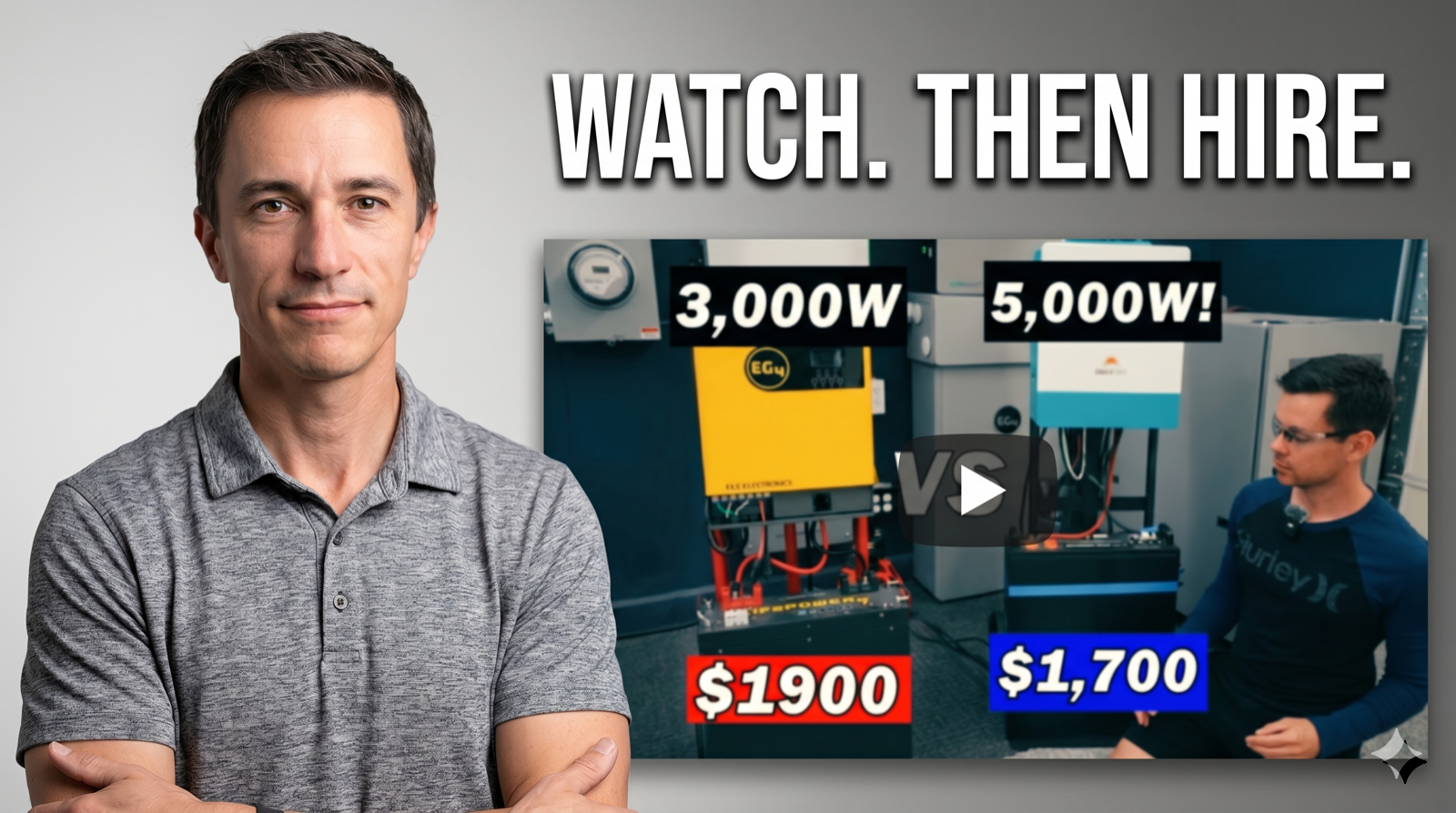 A YouTube video can educate you on a product. It cannot design your system. It cannot pull your permit. It cannot sign off on the single-line diagram. It cannot commission your installation to the manufacturer’s specifications. It cannot show up when something trips offline before a storm and you need someone who knows your specific equipment, your specific panel configuration, and your specific utility account.
A licensed local installer brings something that no content creator can replicate: accountability to your specific site, your specific code requirements, and you as a client. That relationship does not end when the video stops playing.
When clients arrive having done their research, including watching Will Prowse, I appreciate it. It tells me they are taking this seriously. A $25,000 to $40,000 solar and battery investment deserves serious due diligence.
But the homework that actually prepares you for a productive system design conversation is different from what YouTube assigns. Think about what you need the system to do. Which loads matter most when the power is out? How long do you need to sustain them? Are you trying to offset your FPL bill, protect against outages, or both? What does your average monthly bill look like? Is your roof in good shape?
Those questions shape a real system design. “Which battery did Will Prowse give five stars?” does not.
Will Prowse is good at his job. Make sure you hire someone who is good at theirs.
The Bottom Line
Will Prowse has done more than almost anyone to make solar and battery storage understandable to a general audience. I respect the work. I watch the channel. He covers products at a depth that benefits both consumers and professionals, and he does it with honesty and consistency that is rare in any media format.
But watching his reviews is not a substitute for hiring a licensed, experienced solar professional to design and install your system. The products he covers may or may not be right for your home. That determination requires someone who knows your site, your utility account, your local code requirements, and your specific needs. The code compliance, the permitting, the system integration, the long-term serviceability, and the accountability after installation all require a professional, not a playlist.
YouTube gets you interested and informed. A professional gets it done right and keeps it running.
If you are ready to move from research to a real system design for your Southwest Florida home, contact Florida Solar Design Group. We serve Lee, Charlotte, and Collier Counties, and we have been doing this work since 2015.


