I have written thousands of words about net metering on this site. Detailed breakdowns of how to read your FPL bill, deep dives into Florida’s net metering law changes, and explanations of why your monitoring app and your utility bill never seem to agree. All of those posts are still there, and they go deep. But I realized something recently. I never wrote the simple version. The “explain it to me like I just heard the term for the first time” version. This is that post.
The Core Concept
Net metering is a billing arrangement between you and your electric utility. When you install solar panels, your home becomes a small power plant. Sometimes you produce more electricity than you use. Sometimes you use more than you produce. Net metering is the system that keeps score.
Your utility replaces your standard electric meter with a bi-directional meter. This meter can measure electricity flowing in both directions: power delivered to your home from the grid, and power sent from your home back to the grid. If you want to understand exactly what that meter displays and how to read it, I wrote a detailed guide on reading bi-directional meters.
Three Scenarios, All Day Long
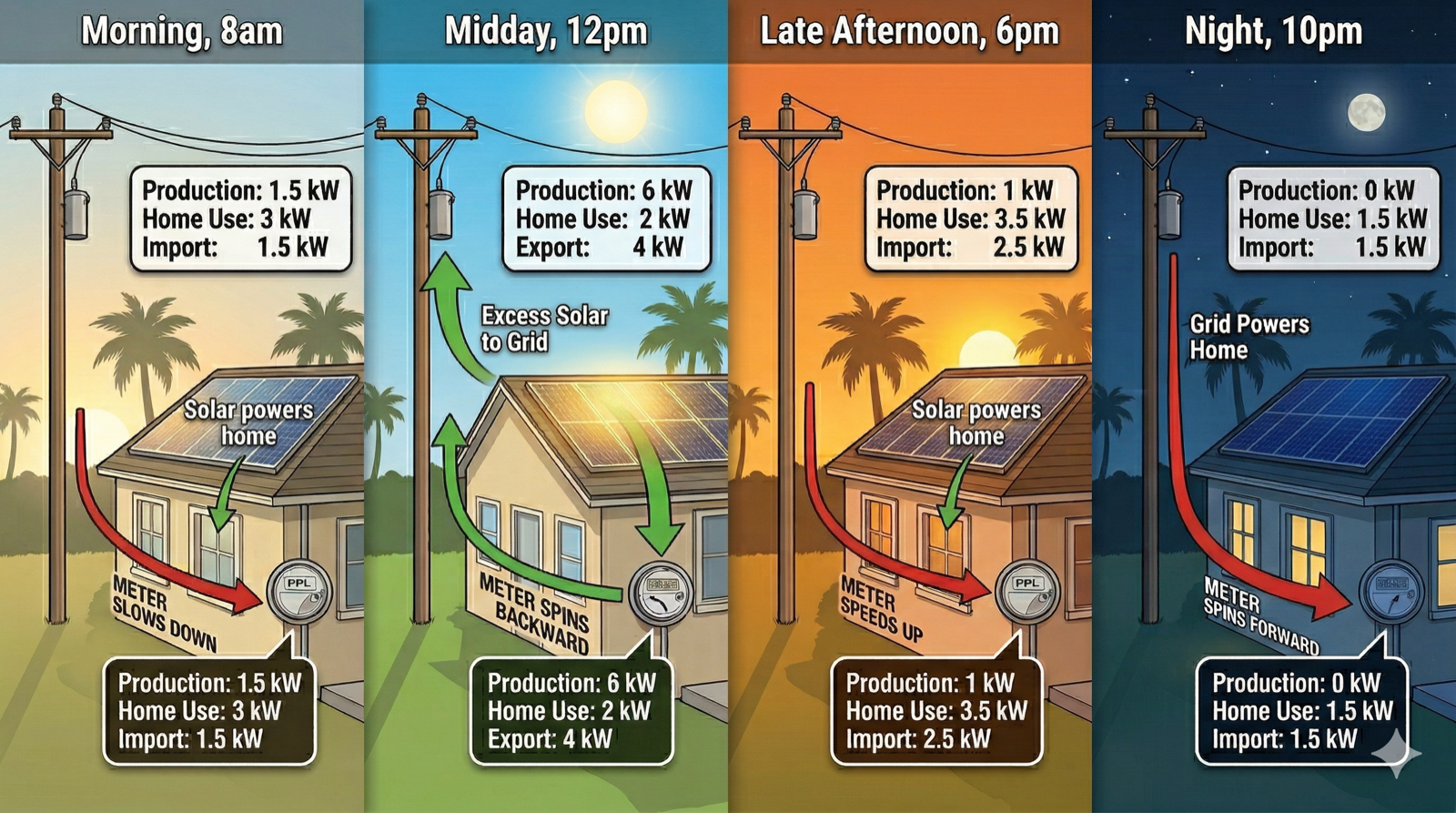
Every moment of every day, your home falls into one of three situations.
Scenario 1: Solar production exceeds your usage. This happens most often during the middle of a sunny day. Your air conditioning might be pulling 4 kilowatts, but your panels are cranking out 10 kilowatts. The extra 6kilowatts flow out through your meter to the grid. Your meter records this as energy received from you. Your neighbors use that power, and you get credit for it.
Scenario 2: Your usage exceeds solar production. This is your mornings, your evenings, and your cloudy stretches. The panels are producing something, but not enough. Your home pulls the difference from the grid, and the meter records it as energy delivered to you.
Scenario 3: No solar production at all. Nighttime. Your panels are off. Everything comes from the grid, just like it did before you had solar.
These three scenarios cycle throughout the day, every day. The meter tracks it all.
How the Math Works
At the end of each billing period, your utility looks at two numbers: how much energy they delivered to you, and how much energy they received from you. Your bill is based on the difference. That is the “net” in net metering.
If your utility delivered 900 kilowatt-hours and received 600, you get billed for 300. If they delivered 500 and received 700, you produced more than you used, and the excess carries forward as a credit toward future billing periods. It really is that simple.
In Florida, those credits accumulate throughout the calendar year. At the end of December, the utility resets your balance. Any remaining excess is paid out at a wholesale rate, which is significantly lower than the retail credit you received during the year. This is why we design systems to match your annual usage as closely as possible rather than wildly overshoot it. I explained this annual credit cycle in detail here, and if you have ever been surprised by a January electric bill despite having solar, that post explains why.
What Net Metering Is Not
Net metering is not a subsidy. Nobody is handing you money. You are producing electricity, sending it to the grid, and getting credit for it. Your neighbors use that power. The utility resells it. You are not getting a free ride. You are a small power producer participating in a billing arrangement that accounts for two-way energy flow.
Net metering also does not mean you are “off the grid.” You are very much connected to the grid, and you rely on it every night and during periods of low production. The grid acts as your battery, storing your excess production as credits rather than as electrons. If you want actual independence from the grid during outages, you need a battery backup system. That is a different conversation entirely.
One Important Thing Your Utility Cannot See
Your utility has no idea how much total energy your solar system produces. They can only see what crosses the meter. When your panels produce 5 kilowatts and your home is using 3 kilowatts at the same moment, only the excess 2 kilowatts flow to the grid and get recorded. The other 3 kilowatts were consumed inside your home and never touched the meter. This is why the “generated” number on your FPL bill is always lower than what your monitoring app reports. Both numbers are correct. They are just measuring different things. I wrote a whole post explaining this disconnect because it confuses nearly every solar homeowner at some point.
The Bottom Line
Net metering is the accounting system that makes grid-connected solar work financially. Your meter tracks energy in both directions. You get credited for what you send out. You get billed for what you pull in. The difference is what you pay. That is it.
If you want the deeper details, I have written extensively about the full mechanics of net metering, interconnection tiers and requirements, and how the Florida legislature changed the rules. But if all you needed was the basic picture of how your solar panels and your electric bill actually interact, now you have it.
If you are in Lee, Charlotte, or Collier County and want to talk about what a solar system would look like for your home, give us a call. We will walk you through your specific numbers.