

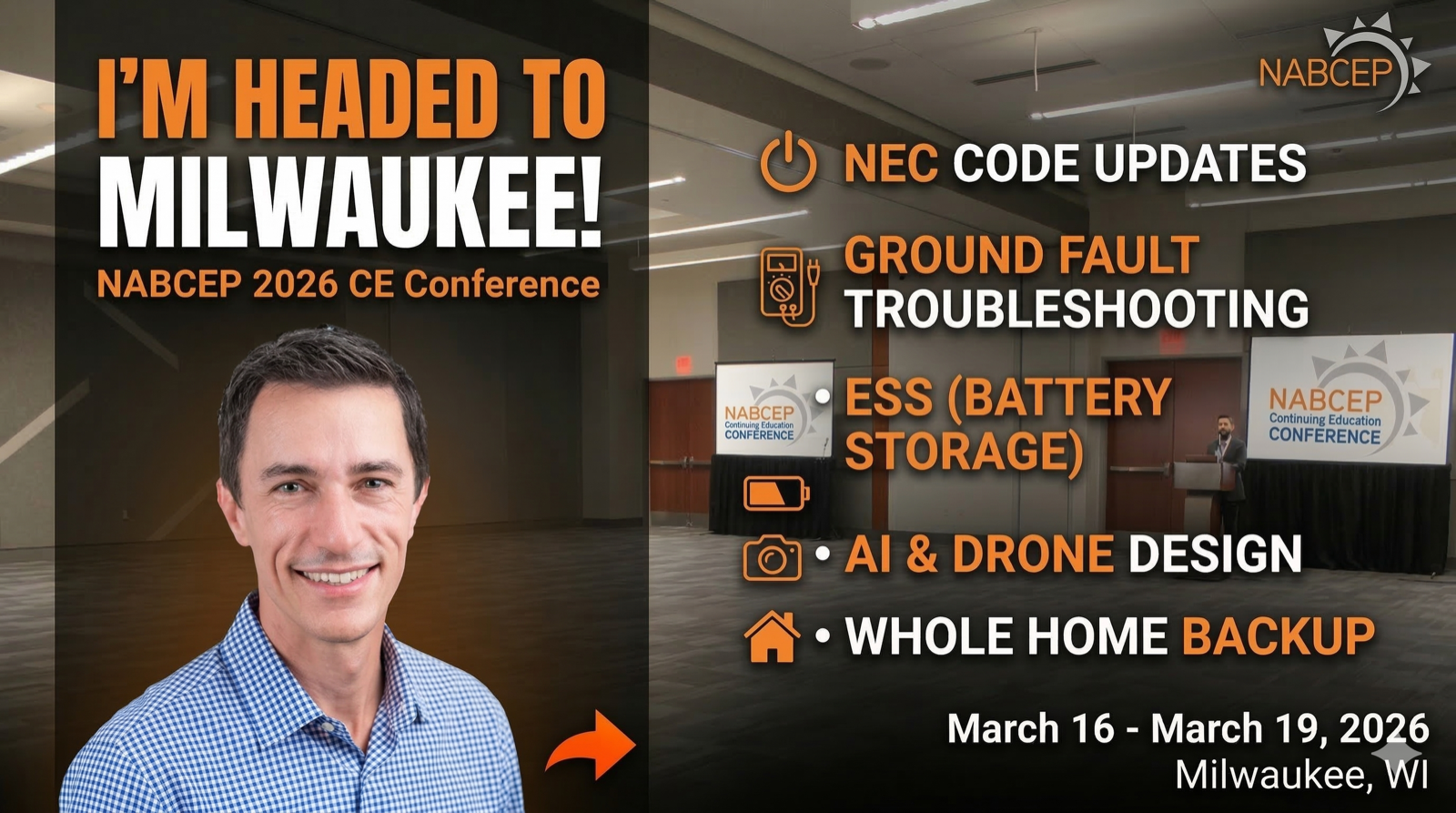
I fly out tomorrow for Milwaukee. Four days at the NABCEP CE Conference, one of the most technically dense continuing education events in the solar industry. I’ve been doing this long enough to know that what gets taught in rooms like this eventually shows up in code changes, equipment decisions, and the conversations I have with homeowners in Southwest Florida.
This isn’t a trade show, although manufacturers will be there with free stuff and pitching their wares. It’s technical sessions, code deep-dives, and a few hundred of the most credentialed solar and storage professionals in the country sitting in the same rooms trying to get sharper at their craft.
I’ll be posting a daily recap here each evening. If you’ve ever wondered what it looks like when your solar designer actually stays current, this is it.
Why NABCEP, and Why It Matters to You
 NABCEP stands for the North American Board of Certified Energy Practitioners. It’s the gold standard certification body for solar professionals in the United States. Maintaining certification requires ongoing continuing education, and the CE Conference is one of the best places to earn it because the content is genuinely advanced.
This isn’t a beginner’s course on how solar panels work. The sessions I’m attending cover DC disconnects and isolator placement, advanced ground fault troubleshooting, NEC code updates for PV and storage systems, safety standards across multiple building codes, and how AI and drone photogrammetry are changing the way designers approach rooftop layouts.
That last one is relevant to what I do every day. The others are relevant to what I do every day, too.
The Full Agenda
Here’s what the four days look like:
Monday, March 16 (Day 1) The conference opens with pre-conference sessions in the afternoon. I’ll be attending:
- No More Free Fixes: Tips on How Installers Save Time, Money, and Headaches
- True Whole Home Back-Up with the EG4 GridBOSS
- Ignite Sessions in the afternoon
- Keynote speaker in the evening followed by the opening reception
Tuesday, March 17 (Day 2) A full day of technical sessions:
- DC Disconnects and Isolators: Where to Use Them
- Advanced Techniques for Troubleshooting Ground Faults
- The State of PV and ESS Codes and Standards
- Know Your Code: Solar Roofing Codes and Best Practices
Wednesday, March 18 (Day 3) Another full day, with some of the sessions I’m most looking forward to:
- How Have Cheap Solar Panels, Lithium Batteries, and All-in-One Inverters Changed Off-Grid System Design?
- NEC All-in-One Line Diagram Review: Sol-Ark 18K Inverter Interconnection Strategy
- Navigating IRC, IBC, IFC, and NFPA 855: Advanced Safety Standards for PV and ESS
- PV Design Precision: AI, Drones, and Photogrammetry
Thursday, March 19 (Day 4) The conference wraps up with what looks like an intense full-day deep dive:
- The Ever-Evolving National Electrical Code: Focus on PV, Storage, Interconnection, and EVs

What I’ll Be Writing About
Each evening, I’ll post a recap of what I sat through, what actually surprised me, and what it means for the kind of work I do in Fort Myers and Southwest Florida. Some of it will be technical. Some of it will be me telling you which conventional wisdom in this industry is holding up and which isn’t.
If a code change is coming that affects how battery systems get permitted, you’ll know about it. If there’s a new design approach that’s worth paying attention to, I’ll tell you that too. If something I heard contradicts what I’ve been doing, I’ll tell you that as well.
Follow along using the links below as they go live:
- Day 1 Recap: Monday, March 16
- Day 2 Recap: Tuesday, March 17
- Day 3 Recap: Wednesday, March 18 (coming Wednesday evening)
- Day 4 Recap: Thursday, March 19 (coming Thursday evening)
The Bottom Line
Most solar contractors aren’t at this conference. Most aren’t NABCEP certified. Most aren’t spending four days in Milwaukee in March voluntarily learning about ground fault troubleshooting and building code intersections.
I am, because that’s what it takes to actually know what you’re doing in this industry. Check back here each day this week and see what I’m learning.


