

Part of the NABCEP CE Conference 2026 Series. See the full agenda and series overview here.
Day one did not go as planned. My morning flight out of Fort Myers was canceled. By the time I got rerouted through Baltimore and finally touched down in Milwaukee, we came in hard enough that the flight attendant got a round of applause from a nervous cabin. It was that kind of landing. And then I stepped outside to find out a blizzard is bearing down on the city.

Turns out I was not alone. Several of the Ignite session presenters didn’t make it in time either. Four presentations were no-shows, which means the afternoon ran well ahead of schedule and the moderator opened the floor for Q&A with the presenters who did show up. Between the travel chaos and the missing speakers, the vibe in the room was somewhere between “we’re all in this together” and “how bad is this storm going to get.”
Despite all of that, I caught some genuinely good content this afternoon. Here’s what stuck.
From Parallax to Photogrammetry: Scanifly’s Presentation Was the Highlight
I’ll be honest: this was the session I was most looking forward to, and it delivered.
 Scanifly opened with a story about Giovanni Cassini and Jean Richer in the 1600s, two astronomers who coordinated from opposite sides of the world using telescopes and pendulum clocks to measure the distance from Earth to Mars using parallax. The parallax principle is simple: look at the same object from two different positions, measure the angular difference, do the math. Cassini and Richer pulled it off within a seven percent margin of error using instruments they had to haul to South America on a ship. Jean Richer drew the short straw on that one.
The reason Scanifly started there is that photogrammetry uses the exact same mathematical principle. A drone captures overlapping images from multiple angles, and the software compares common points across those images to construct a precise three-dimensional model of the structure. Instead of two telescopes pointed at Mars, you have millions of pixels compared across dozens of image frames, each one a data point in a triangulation calculation that’s been refined for 400 years.
I actually connected with this on a personal level. I was one of the first solar professionals in Southwest Florida to get my FAA Part 107 drone license. I was doing aerial site assessments and early photogrammetry before it became a standard tool in this industry. Scanifly has taken that same concept and built it into a polished design platform with shade analysis, production modeling, and a full field app workflow. It’s the direction I was heading with a drone and a laptop. They built the destination.
One thing that surprised me was the honest take on LiDAR. There’s a tendency in this industry to treat LiDAR as the gold standard, and Scanifly pushed back on that. The problem with LiDAR for residential rooftop solar assessment is occlusion: the laser fires from a fixed position, so anything behind an obstacle doesn’t get captured. Trees, dormers, chimneys, neighboring structures — they all create dead zones. The data is also largely sourced from USGS flights at thousands of feet in the air, which means it’s not current, not dense enough for precise measurements, and doesn’t account for structures built after the last flight.
A drone flying forty feet above a rooftop with a high-resolution camera produces data that is more accurate, more current, and more complete. When I watched their Scanifly presentation, it clicked in a way that reminded me of a StarTalk video I’d watched recently with Neil deGrasse Tyson explaining how astronomers calculate distances to galaxies using parallax. Same principle, wildly different scale. Cassini measured the solar system. Scanifly measures your roof. Both use triangulation.
I’m looking forward to their full technical session later this week on AI, drones, and photogrammetry. There’s more to dig into there.
Sungrow: Inverters That Work When the Sun Doesn’t
Sungrow’s application engineer Madeline Amfrey walked through a concept that doesn’t get nearly enough attention in residential solar: reactive power.
Most people think of an inverter as a box that converts DC power from solar panels into AC power for the home. That’s the primary job, yes. But the grid doesn’t just need active power (watts). It also needs reactive power (measured in VARs, volt-amperes reactive) to maintain voltage stability, compensate for harmonic distortion from nonlinear loads like LED drivers and variable frequency drives, and handle voltage sags caused by large motors starting up.
The analogy Madeline used that I liked: reactive power is the lift that gets an airplane to cruising altitude. Active power is what moves it forward. You need both to get where you’re going.
What Sungrow is doing that’s worth paying attention to is their Q at Night mode. Their string inverters can supply reactive power to the grid even when there’s no solar production. Once DC voltage drops below a threshold and the inverter recognizes nighttime conditions, it opens the DC breaker to isolate the PV array and closes the AC relay to operate purely on the grid side, injecting or absorbing reactive current as needed.
This is relevant to utilities and commercial applications more than residential right now, but it signals where inverter technology is heading. Inverters are no longer just DC-to-AC converters. They’re becoming active grid participants.
Yaskawa Solectria: American Manufacturing and DC Coupling
Hatem Alawani from Yaskawa Solectria Solar covered their product line and gave a preview of tomorrow’s technical session on DC-coupled versus AC-coupled storage systems.
The American manufacturing angle was notable given the current environment around tariffs and domestic content requirements. Yaskawa is investing $180 million in a consolidated campus in Franklin, Wisconsin, combining their manufacturing facilities for drives, robotics, and solar inverters. They’re not just maintaining domestic capacity — they’re expanding it.
On the technical side, Yaskawa has inverter models with reactive power overhead, meaning the inverter can supply reactive power beyond its nameplate rating without reducing active power output. For utility-scale applications where the grid operator needs reactive power support, that matters because you’re not sacrificing revenue-generating kilowatt-hours to stabilize the grid.
They also mentioned a collaboration with First Solar’s thin-film modules where their grounded DC inverter topology reduces module degradation from 0.6 percent per year to 0.3 percent. Over a 30-year system lifespan on a 2 MW project, they calculated roughly $1 million in savings. That’s not a residential play, but it illustrates how inverter design decisions have long-term financial consequences that often get ignored at the point of sale.
The Session That Hit Closest to Home: Solar Insure on the Service Era
I’ll be direct: I’m not a fan of insurance products as a rule. But the Solar Insure presentation from this afternoon gave me something real to think about.
The presenter’s core argument was that the solar industry has spent the last decade optimizing for volume: installs per week, states covered, kilowatts bragged about. That model has produced a lot of orphaned systems — solar arrays sitting on rooftops with nobody to call when something goes wrong because the installer is out of business, overwhelmed, or simply not picking up the phone.
The data point that landed: the average time to first failure in a solar system is 14 to 26 months. Not year ten. Not year twenty. Somewhere between your first and third anniversary, something in your system is going to need attention. And at that point, you either build trust with your customer or you lose it permanently.
The framing I kept coming back to: service is the new sales. The companies that will define the next decade of this industry aren’t going to be the ones who install the most systems. They’ll be the ones who are still answering the phone when something breaks two years later.
This is something I think about seriously at Florida Solar Design Group. We are not a volume shop. We don’t install in fifteen states. We focus on Southwest Florida because we can actually show up when you need us. The orphaned system problem is real, and it’s getting worse. When a major national installer exits a market or shuts down, their customers become someone else’s problem — or nobody’s problem.
The shift from installer to energy service provider isn’t just a business model conversation. It’s about what this industry needs to be if it wants long-term credibility with homeowners.
The Keynote: Politics, Policy, and the Case for Solar Without Apology
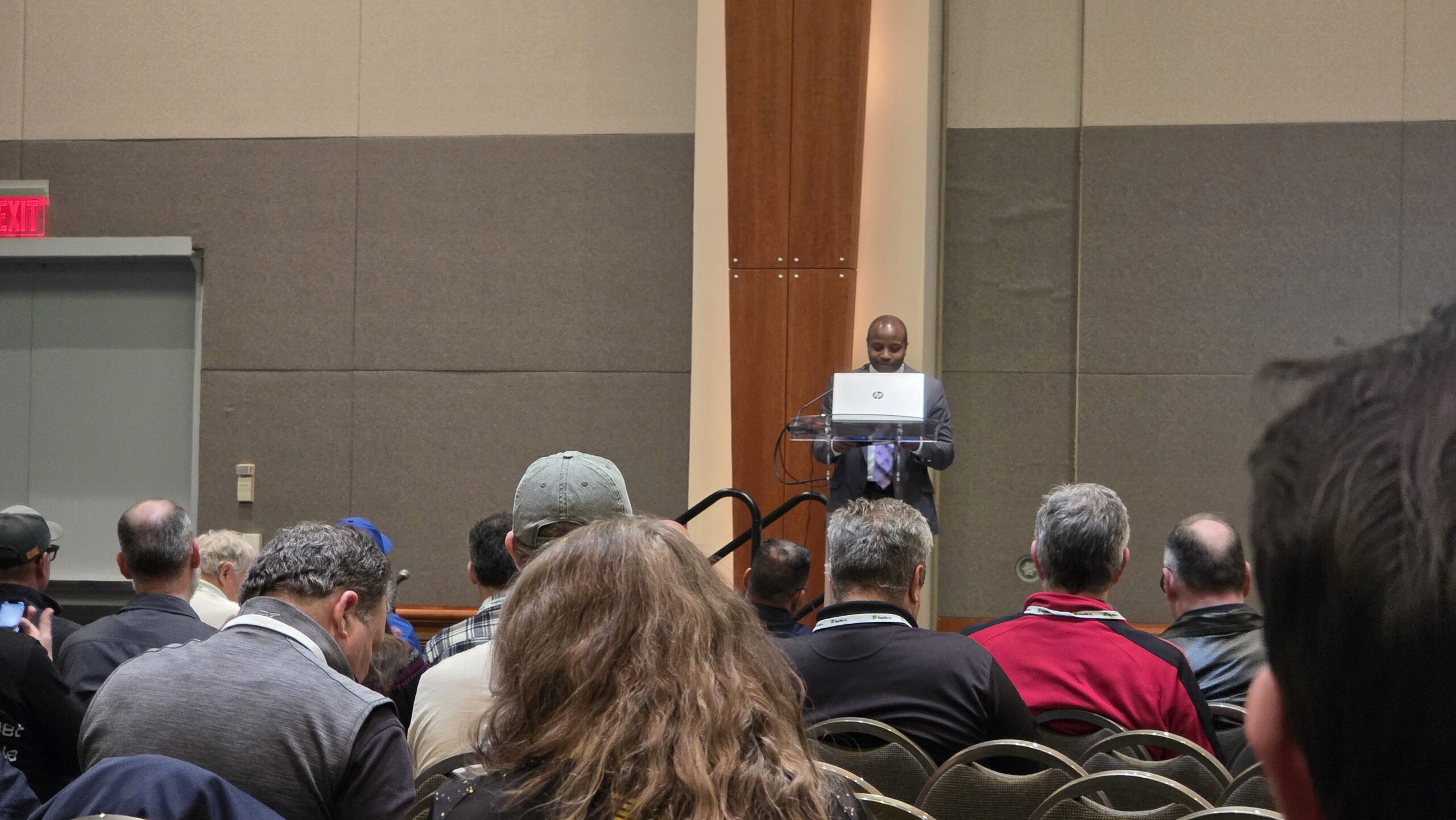
The evening keynote featured remarks from Milwaukee’s Mayor Cavalier Johnson and Eric Schoenberg, the city’s Director of Environmental Sustainability and head of the Environmental Collaboration Office. It was a different kind of content than the technical sessions, but it was worth staying for.
Mayor Johnson made a point that stuck with me: it’s the men and women in rooms like this one who are doing the actual work, not the politicians. Mayors can set goals. Elected officials can make speeches. But the people designing, selling, and installing these systems are the ones who actually determine whether solar becomes mainstream or stays a niche product for early adopters.
Schoenberg runs Milwaukee’s Environmental Collaboration Office, and he’s been pushing solar into city operations through libraries, police data centers, fire stations, and a landfill solar project near General Mitchell Airport. He was direct about the current federal environment in a way that some people in the room probably found uncomfortable. The residential solar tax credit is gone. He said it plainly, without softening it. His message to the industry: we still have until the end of 2027 to complete commercial projects under the remaining credits, and there’s no excuse not to go get that done.
The part of his presentation that I thought was most strategically useful had nothing to do with tax credits. It was this: Milwaukee’s group solar buy program requires participating contractors to be NABCEP certified. Not preferred. Required. That’s a city government saying that certification is a baseline standard for doing business, not a nice-to-have credential on a business card. That matters.
He also pushed back on the false choice between energy efficiency and solar that apparently comes up at too many industry conferences. His framing was simple: solar generates clean power, and energy efficiency reduces how much power you need. They work together. Solar contractors who build relationships with HVAC contractors and energy efficiency professionals are going to capture more of the market than those who treat those industries as separate or competing.
The political tone of the evening was unapologetically pro-solar and blunt about the current federal posture toward the industry. I’ll leave the politics where they belong. What I took away was practical: the local policy environment matters enormously, NABCEP certification is increasingly being treated as a professional baseline by municipalities that take this seriously, and the industry has to make a clear, simple case to homeowners and businesses regardless of what Washington is doing.
Control what you can control. That’s not a bad takeaway for day one.
The Bottom Line
I got here late, through Baltimore, in a blizzard. Four Ignite presenters didn’t make it at all. And it was still a genuinely good first day.
The Scanifly photogrammetry session was the technical highlight. The Solar Insure framing on service as the new sales model is something every contractor in this industry needs to sit with. And the keynote reinforced something I already believe: NABCEP certification isn’t a piece of paper. It’s increasingly the standard that serious municipalities and buyers are using to separate real solar professionals from the volume installers who disappear after the install truck pulls away.
Tomorrow is a full day of technical sessions: DC disconnects and isolators, advanced ground fault troubleshooting, PV and ESS codes and standards, and roofing codes. I’ll have a full recap up tomorrow evening.
Read the full series:


