

A Live Rescue, Off-Grid Roots, and the Photogrammetry Reality Check
Part of the NABCEP CE Conference 2026 Series. See the full agenda and series overview here. Read the Day 1 Recap here and the Day 2 Recap here.
Day three started with something that had nothing to do with the conference schedule.
The Best Reason to Be in the Room: A Live System Rescue
About thirty minutes into the first morning session, my phone started lighting up. A client was texting in a panic. His Sol-Max AIO (formerly Midnite AIO) system was completely down. He’s off-grid. No power, no backup, no idea what to do. I spent the next stretch of the session texting him through a complete restart procedure, trying everything I could think of remotely. Nothing worked. The system wouldn’t even turn on with a generator running.
I knew the Sol-Max brain trust was here at the conference. I had already sent them a heads-up before the session ended. The moment it wrapped up, I ran straight to their booth in the expo hall.
Within one minute they had the answer. There was a PV insulation resistance alarm on one of the three inverters at the site. Because the inverters are running in parallel, one unit with an active fault alarm prevents all of them from starting. I had been troubleshooting remotely by checking logs on one inverter and missing the alarm on another. Easy to miss. Hard to diagnose from Fort Myers.
With the Sol-Max engineer standing next to me, we called the homeowner on speakerphone. He turned off the PV disconnect on the affected inverter. The system came back to life immediately.
This site has a history. It was badly damaged during Hurricane Ian and we rebuilt it, but intermittent issues have persisted. An insulation resistance fault on a hurricane-damaged array that shows up intermittently is exactly the kind of problem that’s nearly impossible to chase remotely. I’ll be heading out to do a full on-site diagnostic, and we may end up replacing that array entirely given the level of damage the panels sustained.
Here’s the connection that hit me immediately: yesterday’s ground fault session covered exactly this failure mode. High-resistance intermittent faults are the hardest to find because they don’t show up consistently in the logs and they can hide across multiple circuits. I spent an hour yesterday learning about that problem in a classroom. Twenty-four hours later I was dealing with a live version of it on a real system. The conference content paid for itself before lunch on day three.
And the only reason I could resolve it quickly was because the people who built the equipment were thirty feet away from me. That’s worth something.
Off-Grid Design: A Walk Down Memory Lane
The morning session was presented by Briggs and Stratton Energy Solutions, covering off-grid system design with their SimpliPhi LFP batteries. The technical content was solid, but what I got out of it was more personal than technical.
The presenter opened by honoring Johnny Weiss, one of the founders of Solar Energy International, who passed away recently. Johnny was a foundational figure in this industry, one of the people who built the education infrastructure that most of us learned from directly or indirectly. Worth pausing for.
From there the session walked through the full history and evolution of off-grid solar: Home Power magazine, Sunfrost DC refrigerators, 60-watt panels at $4.70 a watt, trace inverters, the whole timeline. For anyone who’s been in this industry long enough, it was a genuine walk down memory lane.
What struck me most was the contrast between how we used to design off-grid systems and how we do it now. In the early days, every single load mattered. You added up every watt-hour with a calculator because panels were expensive and inverters were primitive. Oversizing wasn’t an option. You designed tight or you designed wrong.
Today panels are fifty cents a watt. The calculus has completely changed. A macro view of whole-home loads is acceptable now because you can simply add more solar to cover your margin of error. The precision load accounting that used to be the core skill of an off-grid designer is still useful, but it’s no longer the survival skill it once was.
The session also reinforced the inverter standby power point from a slightly different angle. An inverter sitting idle drawing 60 to 100 watts continuous adds up to 1.4 to 2.4 kilowatt-hours per day that you didn’t account for in your load calculation. On a small off-grid system, that’s a meaningful percentage of your daily budget. Choosing a low-standby inverter isn’t a luxury in that context.
Sol-Ark 18K: Sticking to Its Roots While the Market Moves On
The Sol-Ark session covered their 18K line diagram and the newly redesigned 12K. Sol-Ark deserves real credit here: they invented the all-in-one residential inverter category and the 15K has genuinely become an industry benchmark.
The 18K wiring diagram was essentially what I expected. If you’ve installed the 15K before, the 18K is familiar territory. No surprises, which is both a feature and a data point.
The new 12K is a different story. It’s been redesigned as a lower-cost unit with the internal AC disconnects removed. Stripping safety and service components to hit a price point is a direction that gives me pause, especially in a market where serviceability is already a concern.
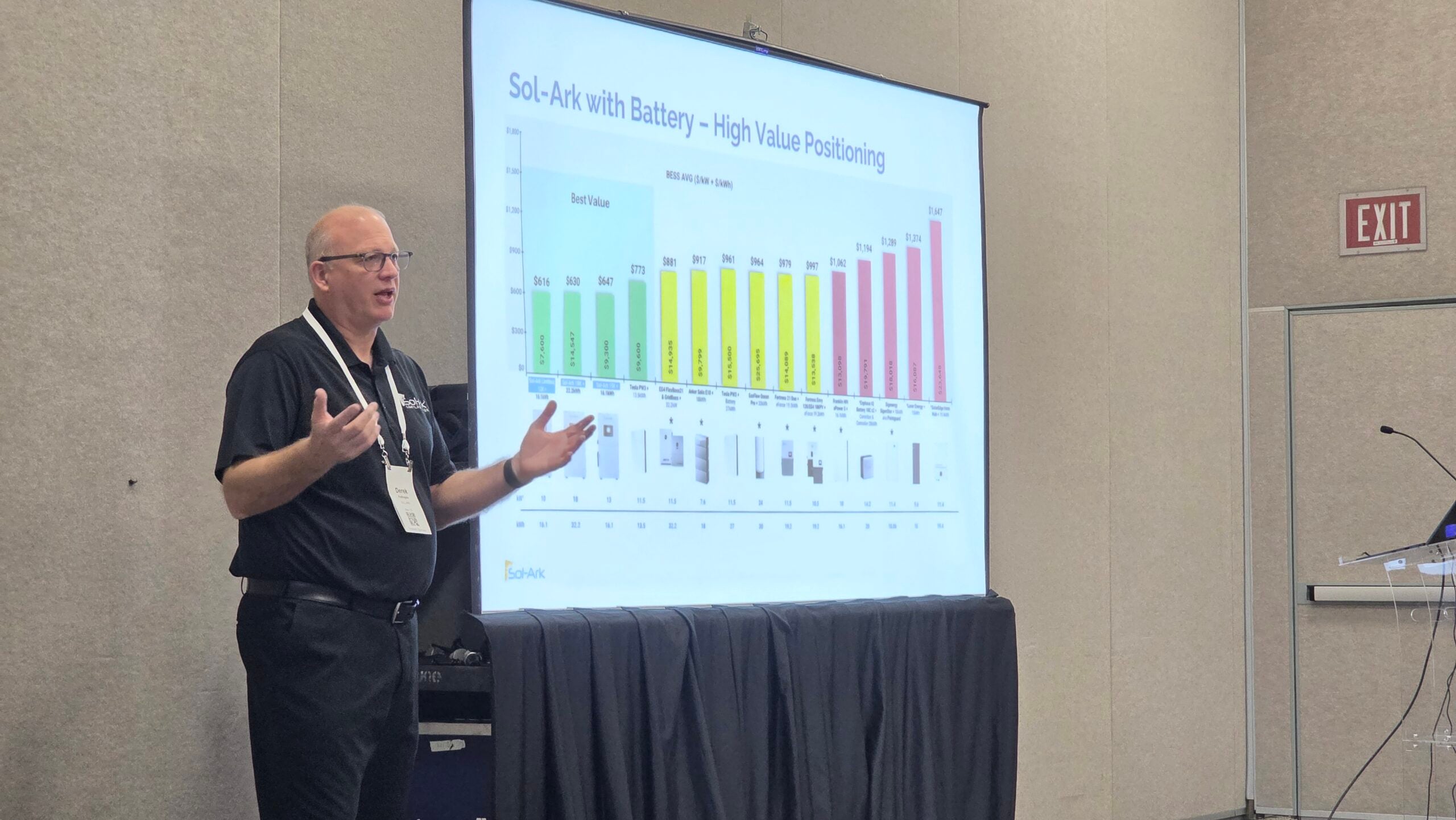
The session also included a cost comparison table positioning Sol-Ark against EG4, Tesla, and others, arguing that their no-MID architecture beats the competition on total system cost. The table was selectively constructed. It works at a certain system size and falls apart as you scale up. The EG4 GridBOSS MID is a one-time purchase that handles multiple inverters without the large wire runs and subcombining gear that a comparable Sol-Ark multi-inverter setup requires. The math doesn’t hold at scale, and the presenter didn’t address that.
Sol-Ark’s position is clear: 200-amp passthrough, no MID required, proven architecture. That’s a defensible choice for certain applications. But the rest of the market is moving toward MID-based systems, and their cost argument cherry-picks the scenario where their approach wins. You do the math on your actual project.
Safety Standards, Structural Codes, and a Hurricane Reality Check
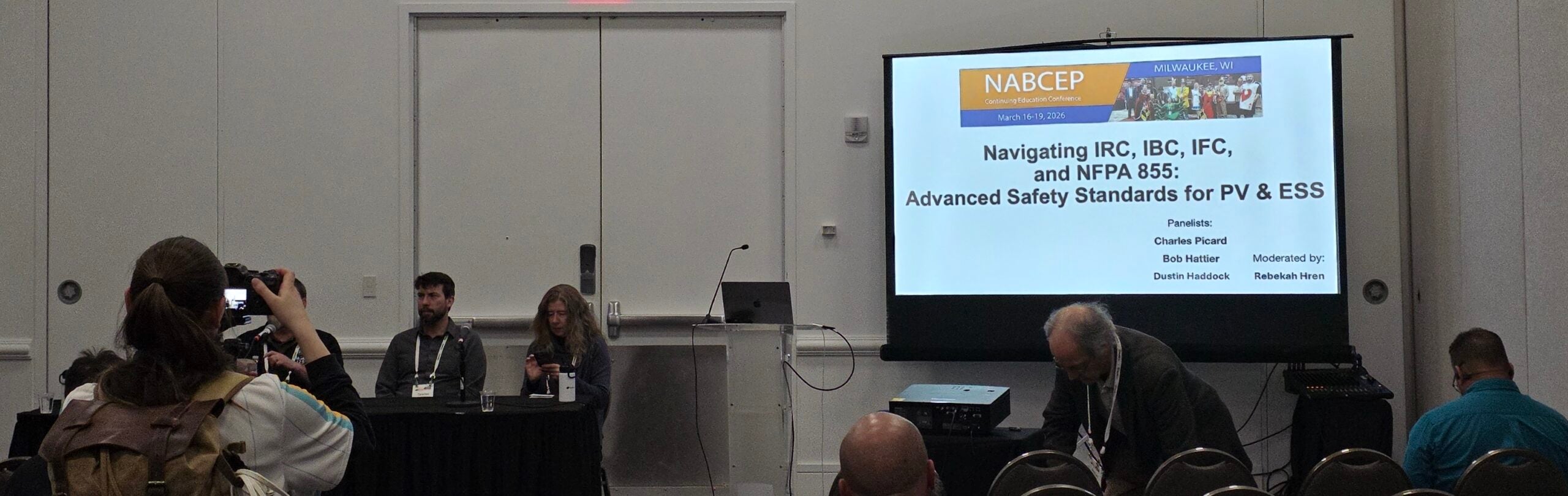
The codes and standards session covered the ICC building code family, NFPA 855 for energy storage systems, UL 9540 and 9540A, and structural requirements for PV racking and mounting. Three presenters, dense material, and some genuinely useful real-world context.
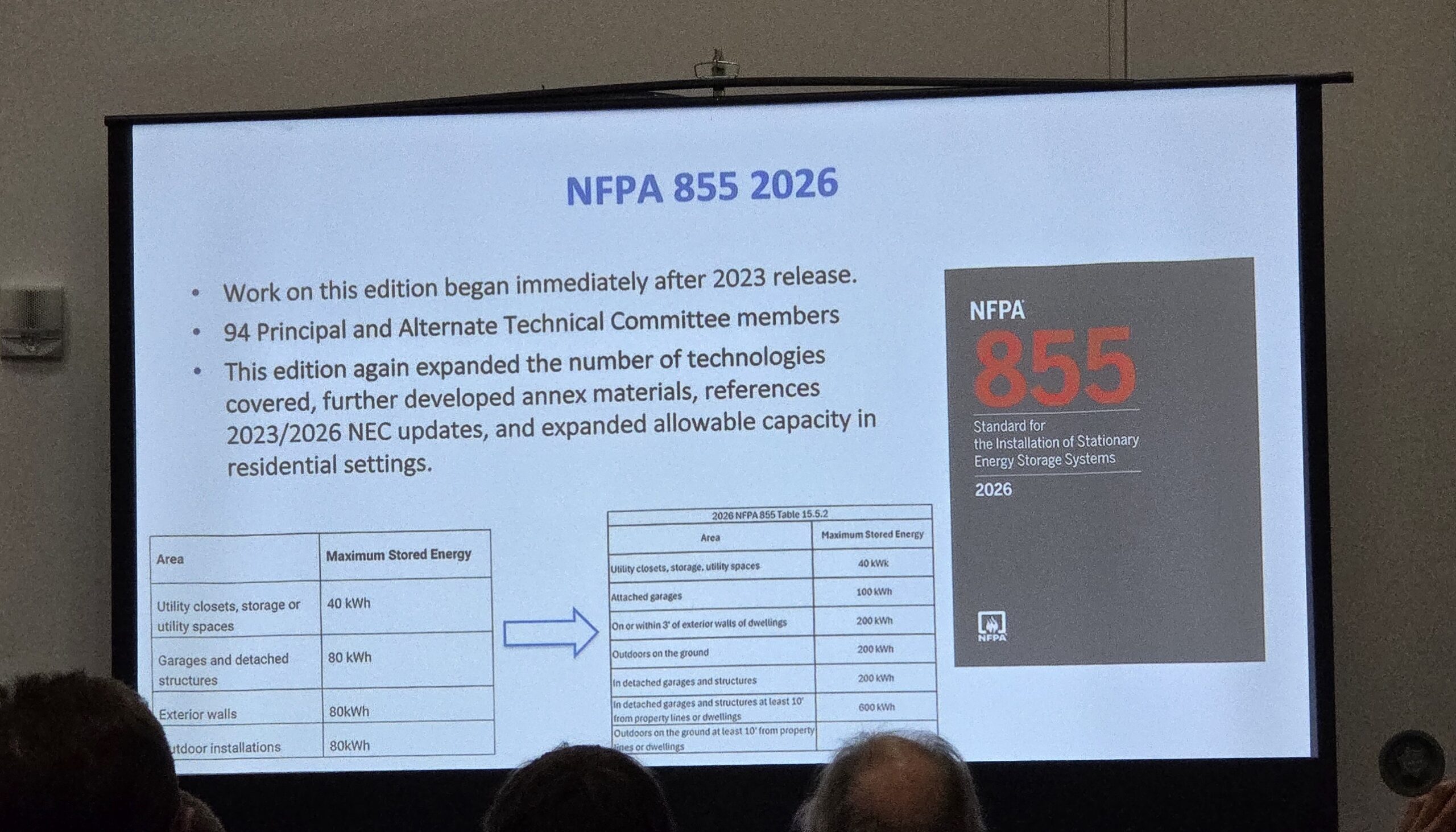
The ESS section covered the evolving battery storage limits under NFPA 855, which are changing in ways that will affect how large residential battery systems can be installed. The short version: the limits are moving and getting more defined, but Florida’s building code adoption cycle means we won’t see these changes reflected in local permit requirements for some time. Worth knowing what’s coming even if it’s not here yet.
The structural section produced the most interesting moment of the session for me. The presenter, Dustin, made the point that the weakest link in a rooftop PV assembly is the rack-to-roof attachment: the lag bolts, the flashings, the connection between the racking system and the roof structure. His argument was that this is the failure point that the standards haven’t fully addressed yet.
I have some anecdotal evidence that complicates that claim. Having been through Hurricane Ian, Helene, and Milton in Southwest Florida, what I’ve seen in the field is that modules come off the rail before the rail comes off the roof. The attachment to the roof structure generally holds. What fails is the module-to-rail connection, which is partly a function of the “big floppy module” problem the presenter himself described: modern large-format panels have significantly thinner frames than the older 60-cell modules, which means the module frame itself is more susceptible to deformation and separation under extreme wind loads.
The code writers are working from test data and modeling. We have hurricane data. Both perspectives are useful, and the honest answer is probably that both connection points are failure modes depending on the specific installation, the racking system, and the storm characteristics. The conversation around mounting zones and load ratings for large-format modules is one the industry needs to keep having.
Photogrammetry Revisited: The Full Technical Session
Day one’s Scanifly presentation got me genuinely excited. The full technical session today gave me a more grounded read.
The core technology hasn’t changed fundamentally since I was doing early photogrammetry work with my Part 107 drone license years ago. The principle is the same: overlapping images, triangulation, 3D model construction. What Scanifly has built is a polished end-to-end platform around that core: integrated proposal software, panel layout tools, shade analysis, production modeling, and a field app workflow that connects the site assessment to the design to the customer deliverable.
That’s genuinely useful, and for the right project it’s a strong tool. But the price point still doesn’t pencil out for a standard Southwest Florida residential job. The typical rooftop assessment I do on a Fort Myers or Cape Coral home doesn’t require the level of precision that photogrammetry delivers. Satellite imagery, a good site visit, and experience with local roof types gets me where I need to be at a fraction of the cost.
Where it earns its keep: complex commercial rooftops, heavily shaded sites where shade analysis needs to be precise, large ground mounts, or any project where the design complexity justifies the time and tool cost. There are real applications here. It’s just not a one-size-fits-all workflow for residential installers.
The Bottom Line
Day three gave me more than any single session could have. The live system rescue at the Sol-Max booth was a reminder that the value of being in the same room as the people who build this equipment is hard to quantify until you actually need it. The off-grid session was a useful professional reflection. The Sol-Ark and structural sessions reinforced existing views with new detail. And the photogrammetry session landed where good continuing education should: not where I started, but somewhere more precise.
Tomorrow is the final day: a full-day NEC deep dive covering PV, storage, interconnection, and EVs. Recap up tomorrow evening.
Read the full series:


