

Residential energy storage systems (ESS) are increasingly placed in locations where vehicles operate—especially garages and driveways. The Florida Building Code, 8th‑edition tells us to protect ESS “subject to vehicle damage,” but it didn’t initially define those zones clearly. Fortunately, an approved modification was made to the draft 9th Edition FBC that clarifies where protection is required and what protection looks like. The modifications were approved in Modification 11487 Text RB161-22.
AHJs can use this framework to evaluate current installations consistently and fairly.
Let’s face it – what isn’t subject to vehicle damage? People do crazy things with their cars. They end up in canals, ravines, and inside convenience stores. But the intent of the code is not to protect ESS from all calamities. It is to protect against damaging ESS placed in the normal path of driving.
The modification mirrors the text and schematic previously established in the International Fire Code in Section 1207.11.7.1. The IFC is used in many jurisdictions and has already been widely adopted. Many jurisdictions in California have also published the schematic directly into their local codes.
The modification summary states: “The intent is to provide clear methods for providing vehicle impact protection.” That’s exactly what we solar installers and AHJs need!

What the FBC Draft Adds (Plain‑English Summary)
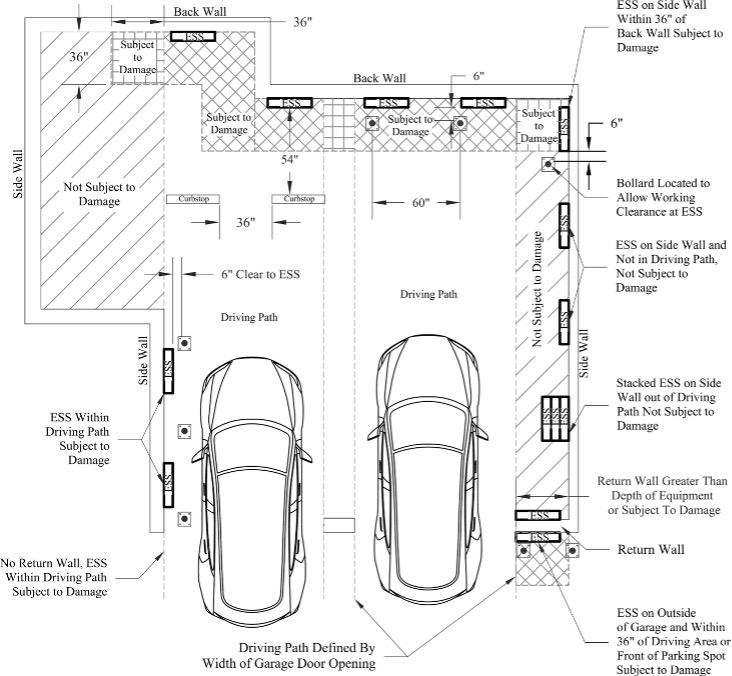
- Normal driving path (garages): From the garage door opening to the back wall up to 48 in. above the floor, as wide as the door opening.
- Back‑wall risk zone: ESS on the back wall within 36 in. left or right of the normal driving path requires impact protection.
- Side‑wall corner risk: ESS on a side wall within 24 in. of the back wall and within 36 in. of the normal driving path requires protection.
- Other locations: Outside of garages (e.g., carports, driveway edges) still need protection if vehicle contact is reasonably foreseeable.
- Protection methods: Bollards (embedded/surface‑mounted or listed pre‑manufactured) or wheel‑barrier/curb‑stop devices installed to specified dimensions and anchorage.
- Practical exception: In low headroom garages (≤ 7 ft 6 in clear opening), mounting the ESS ≥ 36 in. above the floor can eliminate the need for impact protection.
AHJ Evaluation Framework (Use This Today)
Because a framework for protection from vehicle damage is absent in the 8th edition of FBC, there are a wide range of interpretations out there from AHJs who are left to come up with a plan for approval and inspection of systems. Often, there is no policy in place, and inspectors are left to interpret the code on the spot and err on the side of caution. That is understandable, but there is a reasonable way for jurisdictions to approach this problem.
Since the IFC has already addressed this and adopted clear guidelines, and the FBC is poised to adopt the same framework, there is a clear intent to limit protection measures to places where vehicles are likely to travel in the normal course of driving.

Diagram/Schematic of ESS Protection from Vehicle Traffic
This schematic shows the normal driving path (dashed), the back‑wall risk zones (shaded corners), and a sample ESS location. This is the same schematic used in the IFC (Figure 1207.11.7.1, ESS Vehicle Impact Protection) and the draft version of the Florida Building Code.
Practical Application of ESS Protection
Solar installers will generally want to install batteries on the side wall of garages, ideally near the garage door opening, and not in the back corner of the garage. Most garage return walls are deeper than wall-mounted ESS.
For example, the Tesla Powerwall 3 is only 7.6 inches deep and the Enphase IQ Battery 5P is 7.4 inches. Most garage return walls are at least 8 inches, but we are seeing some that are less than that as garage real estate gets tighter in new home construction.
It’s interesting to note that the newest generation Enphase Battery 10C is 14.4 inches deep, which is one of the reasons we don’t recommend it, among others.
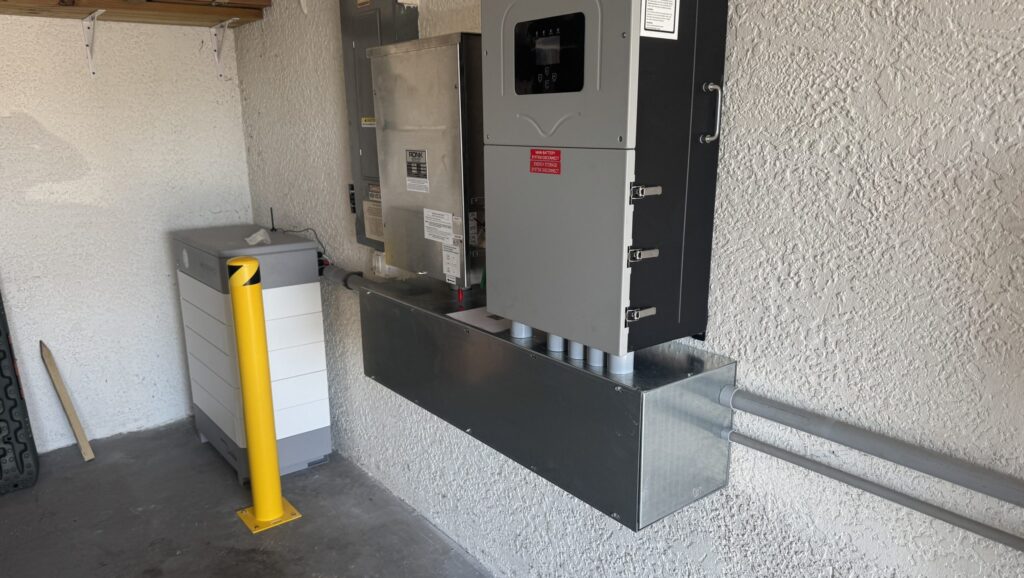
Stackable and server-rack batteries are typically deeper, extending 18 to 24 inches from a wall, which often requires protective measures.
Nobody wants bollards or parking lot style wheel barriers in their garage. They are unsightly and pose tripping hazards and obstacles on walking paths. Most solar installers are going to avoid these requirements wherever possible. In many cases, the garage might not be the best place for batteries, so exterior walls might be used (where sufficiently protected from intense sunlight).
The side wall of the garage is typically the best place to avoid additional protective measures. The back wall may be used if the battery is mounted at least 48 inches from the floor.
Interesting side note: The Tesla Powerwall 3 may only be installed 45 inches from the ground per the manufacturer’s instructions. This excludes the option of mounting 48 inches along the garage back wall. Several other wall mounted batteries do not have this restriction.
Bottom Line
Even before the 9th‑edition text is officially adopted, this framework lets AHJs—and designers—apply a clear, repeatable test: identify the normal driving path, check the back‑wall and side‑corner zones, and require bollards or wheel barriers where a vehicle could reasonably strike the ESS. The result is easy to understand rules and consistent enforcement across jurisdictions.
To find the modification from the official source, navigate to the FBC Website, then choose:
- Code Version: 2026
- Code Change Cycle: 2026 ICC Code Change Original Modification 02/13/2024 – 05/17/2024
- Section: 328
- Click [Search]
- From the list, select Modification # F11487


