

A Client Asked Us About Solar Fences. Here Is Why We Said No.
A client recently asked if we install solar fences. It is one of those ideas that sounds brilliant for about ten seconds. A fence that generates electricity? A property boundary that pays for itself? Sign me up. But as soon as you start thinking through the engineering, the code compliance, the wind loads, and the practicalities of living in Southwest Florida, the concept falls apart quickly. We gave the client a polite but firm no, and I want to explain why.
Solar fencing is a real product category now. Companies like Next2Sun in Germany and SOL Fence in the U.S. are actively marketing bifacial solar panels integrated into fence structures. The pitch is compelling: vertically mounted bifacial panels capture sunlight on both sides, produce energy during morning and evening hours when traditional rooftop panels underperform, and do double duty as a privacy fence. Some manufacturers claim up to 10% higher energy yield per installed kilowatt compared to conventional ground-mounted systems. On paper, it sounds like the future.
On paper is where it should stay, at least in our market.
This Is Still a Ground-Mounted Solar System
Let’s start with the most important technical reality that solar fence marketers conveniently ignore. A solar fence is, by definition, a ground-mounted solar energy system. It sits at grade level. The panels are readily accessible to anyone who walks up to them. That means every code requirement that applies to ground-mounted solar arrays applies here too.
NEC 690.31(A) requires that PV system DC circuit conductors operating above certain voltage thresholds be guarded or made not readily accessible to unqualified persons when installed in locations where people can reach them. On a rooftop system, the panels are eight feet or more above grade, so this is rarely an issue. On a ground-mounted array, the standard solution is to build a fence around the array to restrict access to exposed wiring. See the irony? The typical method for guarding the backside of a ground-mounted solar array is fencing. When the solar panels ARE the fence, you have a problem.
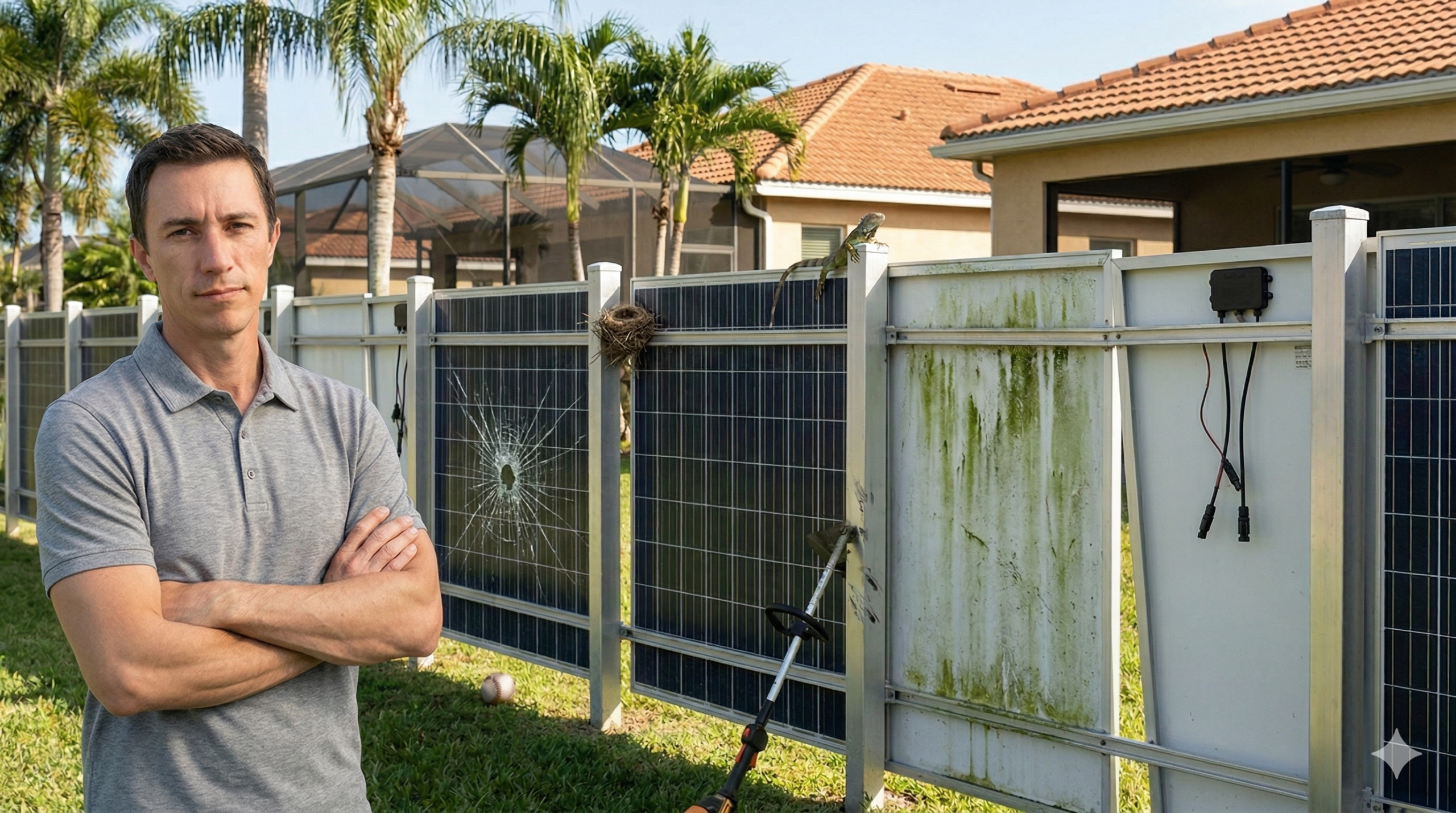
Modern solar panels have exposed wiring on the back. Junction boxes, MC4 connectors, and conductor leads are all visible and accessible. On a traditional ground mount, you guard this wiring by surrounding the array with a physical barrier. On a solar fence, the wiring faces one side of the property line. That side is fully exposed to anyone standing there, including neighbors, children, landscapers, and anyone else who happens to be nearby.
Bifacial Panels and the Guarding Paradox
One of the biggest selling points of solar fencing is the use of bifacial panels. These panels collect sunlight from both the front and back surfaces, boosting total energy production. Manufacturers use this as a major differentiator over rooftop systems that only collect light from one direction.
Here is the problem. If you need to guard the backside wiring with screening material, wire mesh, or any physical barrier, you block the light reaching the back of those bifacial panels. You negate the very feature that is supposed to make solar fencing superior. Screening material is ugly in a fencing application, and it defeats the purpose of using bifacial technology in the first place.
You could theoretically sandwich two monofacial panels back to back on a post-and-rail system, hiding all the wiring between them. That would address the guarding requirement and give you solar production on both sides. But now you have introduced a gap between two panels that will collect leaves, dirt, pollen, and moisture. In Southwest Florida, that gap becomes a haven for birds, lizards, rodents, and insects looking for a cozy nesting spot. Debris buildup between panels will degrade performance and create maintenance headaches that no homeowner wants to deal with.
You would also need the property owner on the other side of the fence to be comfortable with this unconventional arrangement. Good luck with that conversation.
Wind Loads Are More Complicated Than You Think
You might assume that a vertical surface catches more wind than a roof. It is a reasonable intuition, but the actual engineering is more nuanced. Under ASCE 7 (the standard used for structural wind load calculations in the United States), low-slope roofs actually experience some of the most severe wind pressures of any building surface. Wind flowing over a nearly flat roof creates intense suction through the Bernoulli effect. The external pressure coefficients (GCp) in roof corner and edge zones can be brutally high, often exceeding what you would calculate for a vertical wall. As roof slope increases, that uplift suction decreases because the windward roof surface starts behaving more like a wall, receiving positive (inward) pressure instead of suction. By the time you reach a truly vertical surface, the net pressure per unit area can actually be lower than the worst-case low-slope roof zones.
So does that mean a solar fence gets a pass on wind loads? Not even close.
A solar fence would not be analyzed as a building wall. It would fall under ASCE 7 Section 29.3, which covers solid freestanding walls and solid signs. The formula is straightforward: F = qh x G x Cf x As, where Cf is a net force coefficient from Figure 29.3-1. For a typical long fence (high B/s ratio, where B is the horizontal length and s is the panel height), the Cf for Case A is around 1.3. That is the net coefficient combining both faces, and it is comparable to or even lower than the worst-case C&C roof zone pressures. So far, the fence is not looking terrible on paper.
But there are two problems that the raw coefficients do not reveal.
First, the end-of-wall coefficients are severe. ASCE 7 Case C applies to any freestanding wall where the length-to-height ratio is 2 or greater, which is virtually every fence. The Cf at the first segment near a wall end or corner can exceed 4.0, with the adjacent segments still well above 2.0. That means the posts and footings at fence ends and corners need to be dramatically overbuilt compared to the middle of the run. In our wind environment, with design speeds of 150 to 170 mph depending on the county, those localized forces are enormous.
Second, and this is the critical issue, the structural challenge is fundamentally different from a rooftop installation. On a roof, the building structure already exists. The roof deck, trusses, and walls form an engineered system that transfers wind loads to the foundation. Solar panels on that roof are adding a relatively modest load to an existing structure. A freestanding fence has no such advantage. Every pound of lateral force from wind has to be resisted by posts set in concrete footings, and the overturning moment on those posts at hurricane wind speeds is substantial. The fence structure itself has to do all the work from scratch.
Panel Pressure Ratings and the Real Concern
Modern solar panels are tougher than most people realize. We do not use bargain-bin panels with low pressure ratings. Most quality panels are rated at a minimum of 2,400 pascals on both the front and back, and many carry ratings of 4,000 or even 5,600 pascals. Those ratings are tested as a uniform load perpendicular to the panel face, so the orientation of the panel (horizontal or vertical) does not change the test geometry. A vertical panel hit by horizontal wind is still being loaded perpendicular to its face, which is exactly what the pressure test measures.
The concern is not that panels are inherently too weak for vertical mounting. The concern is that the design wind pressures in our area, particularly in higher exposure categories and near the ends of a freestanding wall, can exceed even the higher panel ratings. When you run the ASCE 7 numbers for a solid freestanding wall in Exposure C or D at 160 mph design speed, the pressures at end zones and corners push into territory where a 4,000 Pa panel is marginal and a 2,400 Pa panel is clearly insufficient. And those are the pressures on the panel itself, before you even consider what the posts and footings need to handle.
Anyone who saw the aftermath of Hurricane Ian does not need a calculator to understand this. The volume of vinyl fencing that was shredded, snapped, and scattered across Southwest Florida tells you everything about what sustained hurricane winds do to fence-height vertical surfaces. A solar panel in that position faces the same forces, with the added consequence of shattering tempered glass and scattering live electrical components across the neighborhood.
Mouse over or tap the circles on the mind map to learn more.
Breakage, Maintenance, and Real Life
Fences live a hard life. They get hit by lawn mowers and weed trimmers. They catch stray baseballs, soccer balls, and flying pool toys. Landscaping crews bump them with equipment. Kids climb them. Dogs dig under them. Trees fall on them. This is the reality of a residential fence in Florida.
Solar panels are durable, but they are made of tempered glass. A direct impact from a rock launched by a mower or a wayward baseball will crack or shatter a panel. Replacing a broken fence board is a $20 fix. Replacing a broken solar panel in the middle of a fence run requires an electrician and a panel, and it costs hundreds of dollars. The economics of using solar panels as fence material start to look very different when you factor in the real-world abuse that fences endure.
Cleaning is another consideration. In our humid, subtropical climate, algae and mold growth on south-facing surfaces is aggressive. Maintaining clean panel surfaces on a fence line would be a constant chore.
The Structure Still Needs to Be a Fence
Solar fence manufacturers sometimes imply that you are getting two things for the price of one: a fence and a solar array. The reality is less exciting. The solar panel still needs to be mounted on a structural frame. Posts need to be set in concrete footings. Rails or brackets need to connect the posts. The panel itself replaces the fence boards or pickets, but the underlying structure is still a fence.
In Southwest Florida, that fence structure needs to be engineered for our wind loads. That means heavier posts, deeper footings, and more concrete than a standard fence would require. The cost of the structural frame alone will rival or exceed the cost of a conventional fence. Then you add the cost of the solar panels, the inverter system, the electrical wiring, permitting, and interconnection. You are not saving money. You are spending significantly more for a fence that also happens to make some electricity.
For context, a ground-mounted solar array in our area already costs 50% to 75% more than a comparable roof-mounted system for arrays under 20 kilowatts. A solar fence would likely cost even more than a conventional ground mount because of the vertical orientation, the custom structural engineering, and the specialized mounting hardware.
Why People Want Solar Fences (And What They Should Do Instead)
When I dug into this, the underlying motivation became clear. Most people who are drawn to solar fencing do not actually want a solar fence. They want solar energy without putting panels on their roof. Maybe they think roof-mounted panels are ugly. Maybe they heard a horror story about roof leaks. Maybe a neighbor told them ground-mounted panels are better. Whatever the reason, the solar fence is an attempt to solve a problem that does not actually exist.
Roof-mounted solar panels are the best option for the vast majority of homeowners in Southwest Florida. Modern attachment methods are robust, well-tested, and effectively leak-proof when installed correctly. We use engineered mounting hardware that bolts into roof rafters with lag screws and is sealed with proven flashing systems. These systems have survived every hurricane that has come through our area, including Charley, Irma, Ian, and Milton.
Roof-mounted panels sit several inches above the roof surface, which means they benefit from airflow for cooling and are elevated well above floodwater and ground-level debris during storms. They are not readily accessible to unqualified persons, which simplifies code compliance. They do not take up yard space. They do not interfere with landscaping, play areas, or outdoor living. And because the roof is already there providing the structural support, the installation cost is dramatically lower than any ground-based alternative.
Ground-mounted systems, including solar fences, are far more exposed to windborne debris, storm surge, and flooding. We have seen ground-mounted systems suffer significant damage during storms that left roof-mounted systems completely intact. The panels on your roof actually help protect the roofing material beneath them from UV exposure, hail, and falling debris.
Fencing Is a Separate Trade
There is one more practical reason we are not pursuing solar fencing, and it has nothing to do with engineering or code. Fencing is a skilled trade. Fence contractors have specialized tools, techniques, and experience that solar contractors do not. Setting posts, pulling string lines, mixing and pouring footings, cutting and fitting fence sections to uneven terrain: these are skills that take years to develop.
We are solar designers and electrical contractors. We are not fence builders. Trying to bolt a solar business onto a fencing business (or vice versa) would dilute our expertise and drive up costs for the customer. The market for solar fencing in Southwest Florida is too small and too niche to justify the investment in training, tooling, and insurance that would be required to do it properly. It would be ridiculously expensive for the handful of customers who might want it.
The Bottom Line
Solar fencing is a clever concept that works better in marketing materials than in the real world, especially in a hurricane-prone market like Southwest Florida. The code compliance challenges with exposed wiring, the paradox of guarding bifacial panels, the wind load engineering on freestanding structures, the breakage risks, the structural costs, and the impracticality of combining two separate trades all point to the same conclusion: this is not a viable product for our area.
If you want solar energy, put it on your roof. It is cheaper, more durable, better protected from storms, easier to maintain, and proven by decades of installations in our market. If you also want a new fence, hire a fence contractor. Trying to combine the two into one product creates more problems than it solves.
If you are considering solar for your home in Lee, Charlotte, or Collier County, contact us and we will help you design a system that actually makes sense for Southwest Florida.


