I got a call this morning from a loyal customer who told me his 82-year-old friend had just signed a solar lease. The salesperson didn’t leave a single piece of paper behind. No contract. No proposal. No written notice of his right to cancel. Nothing.
The man lives in a 1,600-square-foot house. He just moved in. His FPL bill was $250 a month, but it’s not clear where that is going since he has no history there. He told my customer he’d been promised he would “never have to pay FPL again” for about $139 a month.
I got him on the phone and helped him cancel.
Here’s the thing: even setting aside how the sale was conducted, this man was not a good solar candidate. A modest house, a new resident still figuring out his energy habits, $250 a month in bills that may well increase in the summer. Solar might make sense for him eventually, with a real proposal and real numbers. But a 25-year lease signed at a kitchen table after a hard sell, with no paperwork? That’s not solar. That’s predatory sales targeting someone who doesn’t know what he signed.
The vultures are still out there. This post is for anyone who needs to deal with them.
The Pitch Is Always the Same
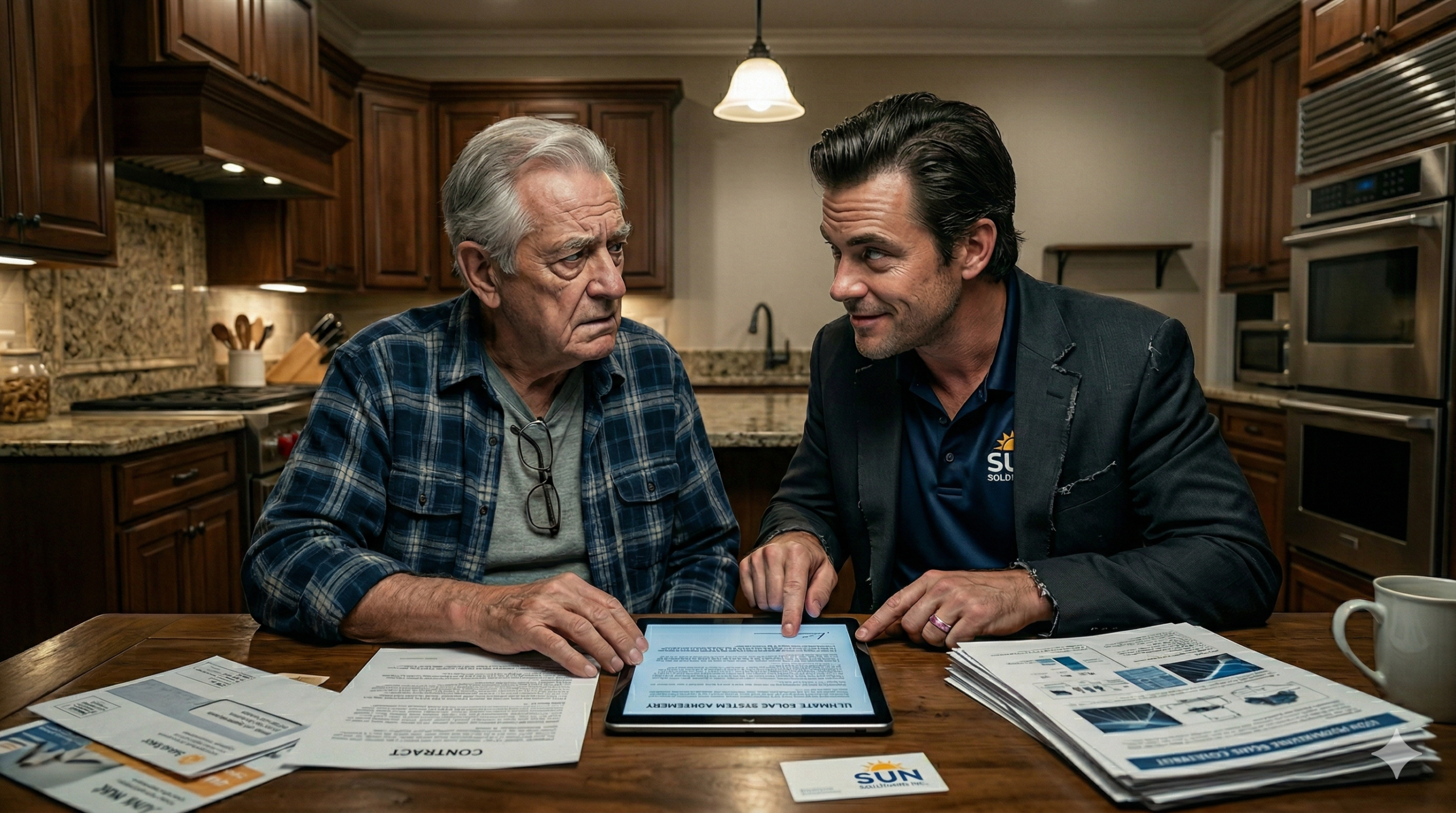
The salesperson shows up at the door. Sometimes they claim a neighbor just got solar, and it’s “going around the neighborhood.” Sometimes they drop a utility program name to sound official. They get inside fast, build rapport fast, and create urgency: this offer is only available today, prices are going up, your neighbor locked in last week.
Then comes the pitch. Something like: for about $150 a month, you’ll never have to pay FPL again.
That’s it. No written proposal. No system design. No explanation of what you’re actually signing. Just a tablet and a finger pointing at the signature line.
What you’re actually signing is a 20 to 25-year solar lease. The equipment never belongs to you. The monthly payment typically escalates by about 3 percent every year. The system is usually sized to offset only a portion of your usage, so you will still receive FPL bills. And if you try to sell your home, the lease is attached to the property. Either the buyer assumes it or you pay to buy it out, which can cost tens of thousands of dollars at mid-contract.
The “never pay FPL again” line is not a misunderstanding. It is a lie with a purpose.
Why No Paperwork Is Not an Oversight
Under Florida Statute 501.021, a home solicitation seller is required to provide you with written notice of your right to cancel at the time of the sale. If they don’t, the three-day cancellation window never officially opens.
Leaving no paperwork behind is not a clerical error. It is a calculated move. These companies know the law. They are betting that elderly homeowners targeted by high-pressure door-to-door pitches won’t know the law. In most cases, they’re right, because they’ve run this play a hundred times.
If a salesperson came to your home uninvited, you signed something, and they left with no paperwork, the clock on your right to cancel may never have started. That right may still be available to you.
Why Leases Are the Worst Way to Go Solar
Let me be direct about this, because the pitch is designed to make a lease sound like the smart choice.
When you own a solar system, it adds measurable value to your home. Florida exempts that added value from property taxes, which is a significant benefit. When you lease, the system is the company’s asset, not yours. You get nothing when you sell.
When you own, you control every decision: the equipment, the installer, the warranty terms. When you lease, the company controls all of that for the life of the contract.
When you own your solar panels, your home title is clean. A lease is a financial encumbrance on your property. It shows up in title searches and can complicate or kill a home sale.
There is no scenario where a 25-year escalating-payment lease is the financial equivalent of ownership for a homeowner who can qualify for financing or pay cash. The zero upfront cost is real. The long-term cost is higher, and the long-term flexibility is gone.
Legitimate solar companies will tell you this honestly and let you decide. Lease-only door-to-door sales teams have a different objective.
Why Lease Companies Are Everywhere Right Now
For years, cash buyers had access to a federal residential solar tax credit that covered 26 to 30 percent of the cost of a system. That credit made the upfront math compelling for a wide range of homeowners and kept a healthy volume of legitimate solar business moving.
That residential tax credit is now gone.
Solar still makes excellent financial sense in Southwest Florida. Our sun exposure, FPL’s rate structure, and the very real risk of extended grid outages after major storms keep the payback math solidly in the right direction. But the incentive that softened the upfront cost for moderate-income buyers no longer exists.
Lease companies identified that gap immediately. They rushed in with door-to-door sales teams pushing zero upfront cost as the solution. The pitch lands because the problem it addresses is real. The product it delivers is not.
When the One Big Beautiful Bill Act was signed, it had a convenient 2-year carve-out for business-owned solar, at the expense of residential customers. Leasing companies are exploiting that by selling solar, maintaining ownership, and taking the tax credit for themselves. It’s a nifty trick to sidestep the loss of tax credits, but guess who benefits? The leasing company! Not you!
Not Every House Is a Good Solar Candidate
This point matters, and it almost never gets made in solar marketing: some homes and some homeowners are not good candidates for solar right now.
The man in my story had a $250 monthly FPL bill and had just moved into a 1,600-square-foot home. He didn’t know yet what his energy habits in the new house would look like. His bill might drop significantly once he settled in, since we are beyoud the winter saving months where energy use is low. Before solar makes financial sense, it makes sense to understand your actual load and to look at ways to reduce consumption first. An efficient air conditioner, a variable-speed pool pump, LED lighting, a smart thermostat, and other energy saving appliances might be a better investment. These have lower costs and faster paybacks than a solar system.
A legitimate solar company assesses your situation honestly and tells you if solar isn’t the right call yet. A door-to-door lease sales team doesn’t care whether solar is right for you. They care whether you’ll sign.
I told the man exactly that. He will possibly never recover the cost of solar panels if he buys them outright, and it would be a risky proposition. A lease is doubly risky. He would still be paying monthly at age 107, and the bills would be nearly double with the escalation clause. Of course, what would more likely happen is that his heirs would be burdened with sorting out the mess he left behind.
What to Do If You or Someone You Know Signed a Lease
Act immediately. Here is the full list of available tools.
Send a cancellation letter right now. Write a clear written notice that you are canceling the agreement and invoking your rights under Florida Statute 501.021. Send it via certified mail, return receipt requested, to every address you can find for the company. Do not wait to consult an attorney first. Get the letter in the mail today. The record it creates matters.
Identify the company if you don’t know who they are. Check email for any confirmation message. Check bank or credit card statements for any charge. Pull your free credit report at annualcreditreport.com — if a credit check was run, the company’s name appears as a hard inquiry with a date. Check your county building department’s permit portal for any permit pulled at the address. Contact the building department, preferably in writing, and notify them that you do not consent to any solar permit being issued for your home. It might not stop an application, but it can’t hurt to try.
File a complaint with the Florida Attorney General at myfloridalegal.com. The AG takes elder consumer fraud seriously. A solar company targeting an elderly homeowner with no paperwork and false promises about eliminating utility bills is exactly what they investigate.
File a complaint with the Florida Department of Agriculture and Consumer Services at fdacs.gov. FDACS has authority over violations of the Florida Deceptive and Unfair Trade Practices Act, which covers exactly this kind of home solicitation fraud.
File a complaint with the Florida DBPR at dbpr.state.fl.us. Solar contractors must hold a valid state license. A DBPR complaint puts that license at risk.
File with the CFPB at consumerfinance.gov if any financing component was attached to the agreement.
File with the FTC at reportfraud.ftc.gov. Federal complaints build a national record on the company and contribute to eventual enforcement action.
Call Adult Protective Services. If the homeowner is 60 or older, Florida Chapter 415 provides enhanced protections against financial exploitation of elders. Contact APS through the Florida DCF hotline at 1-800-962-2873. There is also a National APS. Swallow your pride and make the call. APS is there for exactly this reason.
Call a local TV station. NBC2, Fox 4, and ABC7 all cover Southwest Florida, and all three run consumer investigative segments. “Company signs an 82-year-old to a 25-year lease and leaves no paperwork” is exactly the story they run. Media attention moves faster than most regulatory processes.
Contact a consumer protection attorney. Florida’s Deceptive and Unfair Trade Practices Act allows attorney’s fees to the prevailing party. Many consumer protection attorneys take these cases on contingency. One letter on firm letterhead often resolves disputes that seemed stuck.
Before You Sign Anything
Never sign during the initial visit. A legitimate company will welcome the time for you to review the proposal carefully, talk to your family, friends, and neighbors, and get a second opinion. Any salesperson who tells you the offer expires today is telling you something important about the company they work for.
Demand a written proposal before any discussion of signatures. A real installer provides a detailed breakdown of system size, projected production, payment structure, and what happens to the contract if you sell the home. If they won’t put it in writing, that is the answer.
Verify the contractor’s license at the DBPR website. Ask for their Florida Certified Solar Contractor license number and look it up before you sign anything.
If someone knocks on your door uninvited, take their card, tell them you’ll call if you’re interested, and close the door. A 25-year financial obligation is not something you decide on a Saturday afternoon at the kitchen table.
The Bottom Line
An 82-year-old man signed a solar lease this morning. He received no paperwork, heard a promise that he’d never pay FPL again, and had little idea what he’d actually agreed to. We were able to help him cancel, but only because someone who knew his rights made the right calls fast.
These companies rely entirely on their targets not knowing the law. Florida Statute 501.021 is there specifically for this situation. Use it. The three-day cancellation window may still be open even if some time has passed, because the required notice was never given. File complaints everywhere. Call the news. Get an attorney if they push back.
If you want to explore whether solar genuinely makes sense for your home, we’ll give you a straight answer, even if the straight answer is that you’re better off looking at energy efficiency first. Sometimes the answer is to do nothing. We don’t knock on doors. We work with homeowners who want to make a good decision with real information.