

The lowest sticker price isn’t the whole story. Here’s the no-nonsense breakdown of cost, install quality, timelines, and support—so you can choose the option that actually serves you.
TL;DR Summary
- Certified dealer: Higher likelihood of clean, code-tight installation; proactive communication; clearer timelines; and a real human to handle warranty/service locally.
- Tesla direct: Attractive base price online; standardized process; but communication, scheduling, and change-order clarity can vary by market and project complexity.
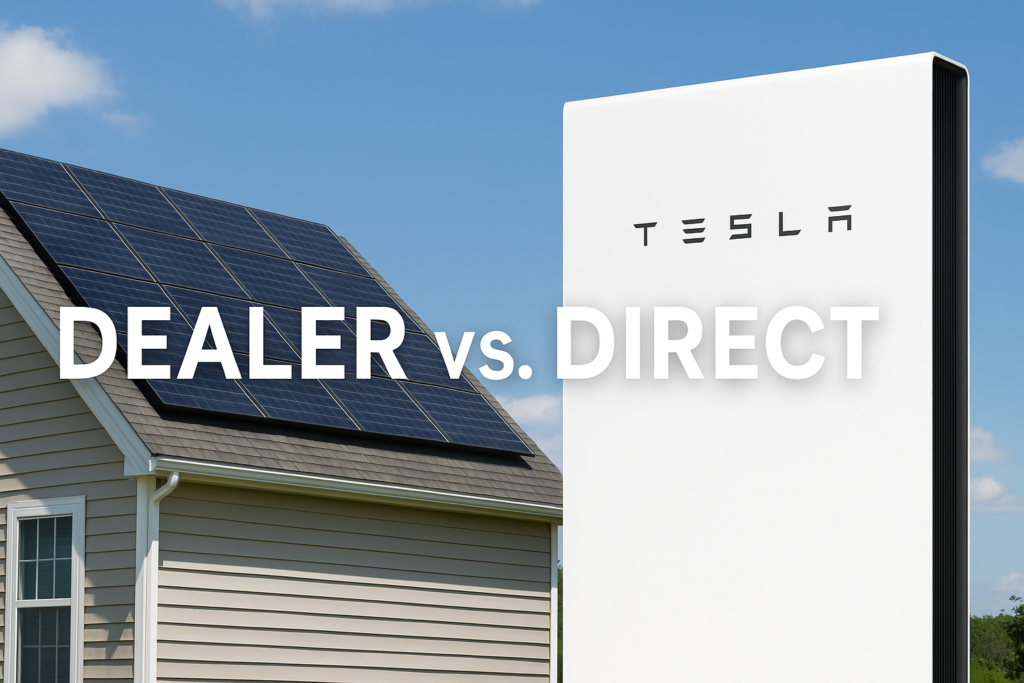
What Tesla’s Online Price Includes (and What It Doesn’t)
Tesla’s website typically shows hardware plus a “standard installation.” That baseline assumes limited electrical work and straightforward conditions. After the site survey, the price can be adjusted for realities like:
- Main panel or service upgrades
- Long feeder runs or challenging conduit paths
- Protected loads subpanel design and labeling
- Swapping backup loads between existing panels
- Structural mounting considerations and clearances
- Permit, utility interconnection, and AHJ-specific requirements
Bottom line: The online number is a starting point, not the final word for every home.
Why Certified Dealers Often Cost More — and Why Many Homeowners Prefer It
Local certified installers carry costs that improve your outcomes: licensed electricians, AHJ permitting expertise, hands-on project management, white-glove commissioning, and faster service if anything goes sideways. You’re not only paying for a battery, you’re paying for risk reduction and accountability.
Dealer vs. Tesla Direct: Side-by-Side Comparison
| Category | Certified Dealer | Tesla Direct |
|---|---|---|
| Installation Quality | Local crew with reputation on the line; meticulous conduit runs; tight labeling; optimized equipment placement for serviceability. | Standardized approach; quality can be excellent but varies by subcontractor and workload. |
| Code Compliance & AHJ Nuance | Deep familiarity with local inspectors and utility interconnect rules; fewer re-inspections. | Meets code, but local nuance can add extra trips and time. |
| Project Management & Communication | Direct line to a named PM; proactive updates; you don’t have to “chase” status. | Centralized portals and emails; responsiveness can vary with volume. |
| Scheduling & Timelines | Typically more predictable; easier to coordinate around your calendar. | High demand can create longer queues; reschedules are more common in peak season. |
| Warranty & Service After Install | Dealer diagnoses and handles manufacturer warranty with you; faster onsite support. | You open tickets directly; service windows depend on regional capacity. No direct local support |
| Pricing Transparency | Turnkey price before you sign; no surprises. | Low base price up front; change orders may occur after a detailed survey. |
| Storm Readiness & Critical Loads | Designs for hurricane season realities and complex backup scenarios. Considers your specific backup needs. | Standardized critical loads approach; no customization without additional cost (if it is even offered). |
Installation Quality You Can See (and Inspectors Love)
Battery storage is an electrical project first, a gadget second. Certified dealers obsess over conductor sizing, terminations, working clearances, equipment height, ventilation, labeling, gateway placement, and serviceability. That discipline minimizes callbacks and maximizes uptime when you actually need backup power.
Translation: when the lights go out, you’ll be glad someone sweated the details.
Real People, Real Accountability
Prefer texting your PM and getting an answer the same day? That’s a dealer advantage. You won’t be stuck “project-managing” your own install or waiting for an email from a no-reply inbox. If a hiccup appears, we handle it. Permit comments, utility notes, or inspector clarifications.
Timelines That Survive Reality
Local teams understand your AHJ’s cadence and utility lead times. We schedule realistically and keep you posted. Fewer surprises. Less waiting. More certainty.
Battery backup installations often require that the utility company shut down power to your house for a few hours to a full day. The coordination of this effort is no joke. A local dealer will understand the utility requirements and often have the contact information for linemen in their phones. Making this process smooth is invaluable.
Warranty & Service: Who Shows Up at Your House?
With a dealer, we do. We troubleshoot, document, and work with Tesla for any RMA. You get a single point of accountability. With direct purchases, you’ll open tickets with a call center in another state and wait your turn in the queue. Both paths honor Tesla’s warranty – the difference is how fast the pain goes away.
Pricing Transparency: No Surprise “Gotchas”
Our proposals provide a no-surprises, turnkey price. If your home needs extra work, you’ll know before signing. That clarity is part of the value.
Local Value Adds for Southwest Florida
- Design for hurricane season and multi-day outages (battery sizing, staggered loads, generator integration).
- Critical loads planning that matches how you live: HVAC, well pumps, medical devices, refrigeration.
- Utility interconnect experience with FPL/LCEC and local inspectors—speeds approvals and avoids do-overs.
When Tesla Direct Might Make Sense
If your home is electrically simple, your schedule is flexible, and you’re comfortable coordinating via a centralized operation in another state, Tesla Direct can be a solid, lower-cost path. Just make sure you budget time for surveys, potential change orders, and scheduling windows.
How to Compare Quotes Fairly (Apples to Apples)
- Match scope: Are both quotes including gateway, critical-loads work, labeling, and any service/panel upgrade?
- Check labor warranty: Hardware is Tesla. Labor isn’t. Ask who fixes what, how fast, and at what cost after year one.
- Confirm timeline: What’s the realistic install window, and who is responsible for inspections and utility paperwork?
- Assess support: If something fails the week before a storm, who physically shows up?
- Inspect workmanship samples: Ask for photos of recent installs—conduit paths, equipment height, labeling, and neatness tell you everything.
FAQ: Tesla Powerwall, Dealers, and Direct Orders
Is the Powerwall hardware different if I buy from a dealer?
No. It’s the same Tesla Powerwall. The difference is the installation quality, project management, and service after the sale.
Why is the dealer price sometimes higher than Tesla’s online number?
Dealers include the full scope—site-specific electrical work, permitting, labeling, commissioning, and post-install service. Tesla’s online price is a baseline that can change after a survey.
Will a dealer installation protect my warranty?
Yes—certified installers follow Tesla’s requirements and local code. You keep manufacturer coverage and gain a local advocate to handle any claims.
Can I add a Powerwall expansion later?
Yes. Good design accounts for future expansion – space, conduit, overcurrent protection, and software. System expansions after the initial installation are not possible with Tesla Direct, or at least, they are a known to be a nightmare to get done.
How fast can I get installed?
It depends on permits, utility schedules, and season. Local certified teams are typically more predictable and easier to coordinate with.
Ready for a Powerwall, Without the Headaches?
Get an all-inclusive, transparent quote. We’ll design, permit, install, commission, and support your system—so when the next outage hits, you’re ready.
Contact Us Today!


