

I did the math so you don’t have to.
FPL quietly bumped the minimum bill from $25 to $30. That does not blow up the economics of solar in Southwest Florida. But it is a convenient reminder of something I have been telling customers for years: bigger is not always better, especially if your goal is a reasonable ROI, not bragging rights.
This post is about one thing: optimum system size under the new $30 minimum bill environment. Not “zeroing out the bill at any cost.” Not “max panels because solar is cool.” Just smart sizing that balances strong ROI with meaningful bill reduction.
There is nothing wrong with wiping out your electric bill. That is an admirable goal. But pretending that is the best ROI for solar panel buyers would be false advertising.
What the $30 Minimum Bill Actually Does
Once your net energy charges get low enough, your bill hits a floor. After that, more solar that month does not reduce your bill further. It can still matter if you bank credits and use them later, but it is important to understand that the floor exists.
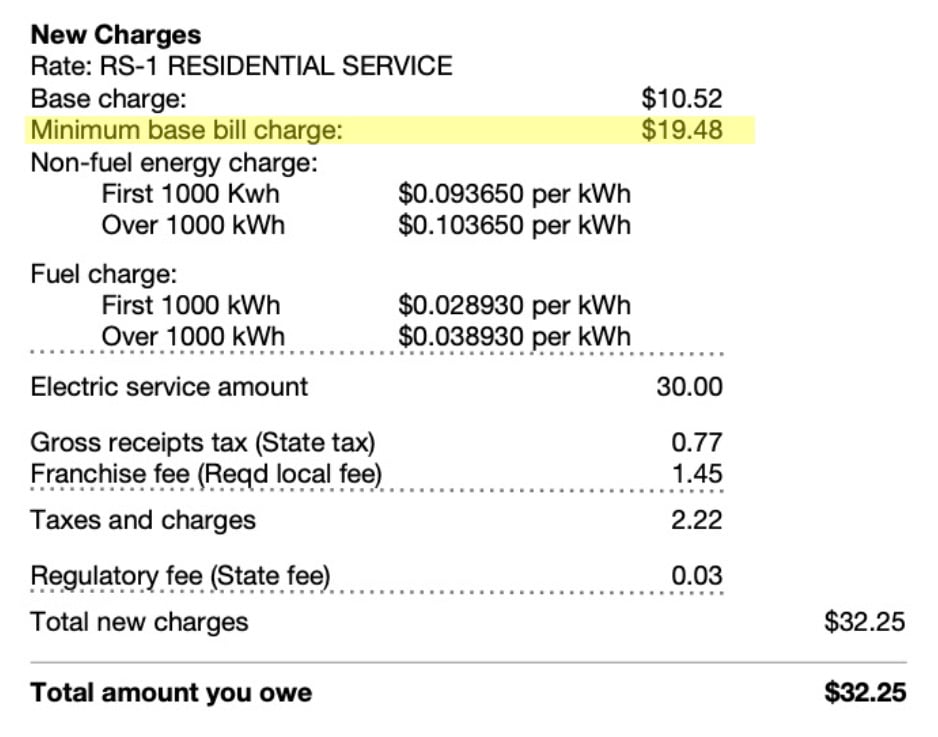
The floor isn’t zero. It’s $30. Technically, that includes a $10.52 customer charge, so $19.48 is the real floor for energy charges. You have to pay for that much energy every month, whether you offset it with solar or not. At today’s rates, that is roughly 159 kilowatt-hours that you are effectively forced to buy every month.
Here is the simplest way to think about it. If you are already at the minimum bill in a good solar month, meaning you offset all of your usage minus 159 kWh that you have to pay for anyway, then additional production in that month does not save you money in that month. The value of those extra kilowatt-hours depends on what happens next.
Two Quick Scenarios (So This Is Not Just Theory)
Scenario 1: A homeowner averages around $250/month. We install a mid-sized system that offsets a big chunk of annual usage. In spring, they may bank some credits. In summer, those credits get burned off to reduce the ugly air conditioning months. In this scenario, most solar production is offsetting retail electricity. That tends to produce a strong ROI.
Scenario 2: Same homeowner, but now we keep adding panels until the bill is pinned at the minimum almost year-round. At that point, the system starts generating a regular surplus that does not get used up. Those unused credits are typically settled at avoided-cost levels. In plain English, some of the added production is no longer replacing expensive retail electricity. It is being valued at a much lower rate. ROI drops as you push deeper into that territory.
The takeaway is not “go small.” The takeaway is “stop when the added solar starts producing low-value surplus more often than it produces high-value savings.” The right answer is somewhere in the middle.
The Graph That Explains the Cliff
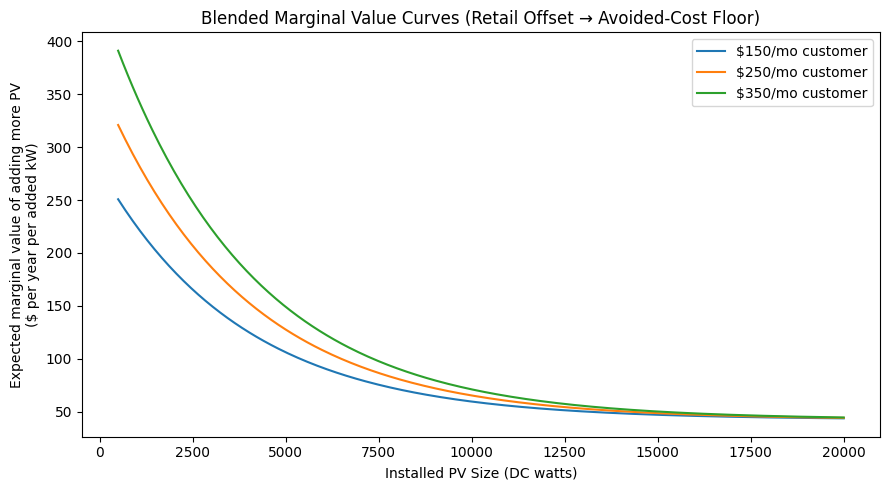
Here is a chart showing the blended marginal value of adding more PV as a system gets larger. Early capacity offsets expensive retail purchases. As the system grows, more months hit the minimum bill floor, and more production drifts toward low-value surplus. Eventually, the curve approaches the avoided-cost floor.
These curves illustrate diminishing returns as PV size increases. Higher-usage homes shift the curve to the right. Lower-usage homes shift it left. The principle is the same.
So Where Is the “Optimum” Size for ROI?
For most typical Southwest Florida homes, the ROI sweet spot is usually a system that offsets a large majority of usage, but not so much that you routinely end the year with a pile of excess credits. In practice, that often lands somewhere in the 60% to 85% annual offset range. Not tiny. Not oversized. Disciplined.
Past that point, you can still reduce the bill further, but you are buying less and less real benefit with each added panel. That is why ROI goes down as you chase the last slice of bill reduction.
What complicates the calculation is that each solar panel doesn’t cost the same. Your first solar panel is the most expensive, since you have to cover the fixed costs of installing the system. Each additional panel costs less (with some exceptions). At a certain point, the cost per panel levels off. Again, there is a middle ground here where you reach the optimum size.
If you are installing a straight grid-interactive system with no storage (no battery backup), we generally recommend aiming to offset 85% of your historical annual usage. That is a safe number where you are not wasting excess solar production and effectively paying for energy that you are sending to the grid anyway due to the minimum energy charge.
“Bigger” Still Makes Sense Sometimes
There are valid reasons to go larger than the ROI sweet spot. If you are planning an EV, pool heating, a new HVAC system for your garage, an addition, or a growing household, sizing ahead can be smart. Predictability has value, even if it is not the highest IRR on paper on day one. And solar production decreases over the life of the system, so starting with an initial production level that is higher can make sense.
Offsetting 100% of annual usage is a goal we often hear. The old “net-zero” verbiage that people have become accustomed to is a strong reason for this. If you are seeking an environmental goal or just want the satisfaction of saying you produce everything you consume, go for it! It truly is a great feeling.
Just do it on purpose. Do not do it because “more is always better.” It isn’t, from a strictly financial standpoint.
Battery Backup Is a Different Conversation
If your priority is backup performance, you should be willing to sacrifice some ROI. Backup is not a spreadsheet sport. It is about staying comfortable and safe when the grid is down, especially in hurricane season.
In a backup-first design, oversizing solar can be justified to improve recharge capability during extended outages, cloudy recovery days, and high critical-load periods. That may not maximize IRR, but it can absolutely maximize resilience. Those are different goals. Both are legitimate.
With battery backup, you need to consider the worst case scenario, and how much solar power you need to keep the lights on when the grid is down. That is not an ROI play – that’s a peace of mind decision.
Bottom Line
The new $30 minimum bill does not erase the value of solar. It does tighten the math around system sizing. It slightly compresses the range where solar offsets full retail electricity, and it makes oversizing easier to justify emotionally than financially.
If you want a strong ROI and a much smaller electric bill, the winning strategy is usually not “as big as possible.” It is “big enough to offset expensive energy, small enough to avoid regular low-value surplus.”
If your goal is simply the lowest electric bill or the best battery backup performance, larger systems are still necessary, despite diminishing returns on investment.


If I have to pay for it, give me the bill credit.
I will use it in July, August and September!
We even have to pay tax on the erroneous charge!
What a bunch of greedy A**holes!
They made $1.462 BILLION the first quarter of 2026!
Spend some on customer service. The 10 minute Phone Jail then 30 minute wait is unacceptable !!