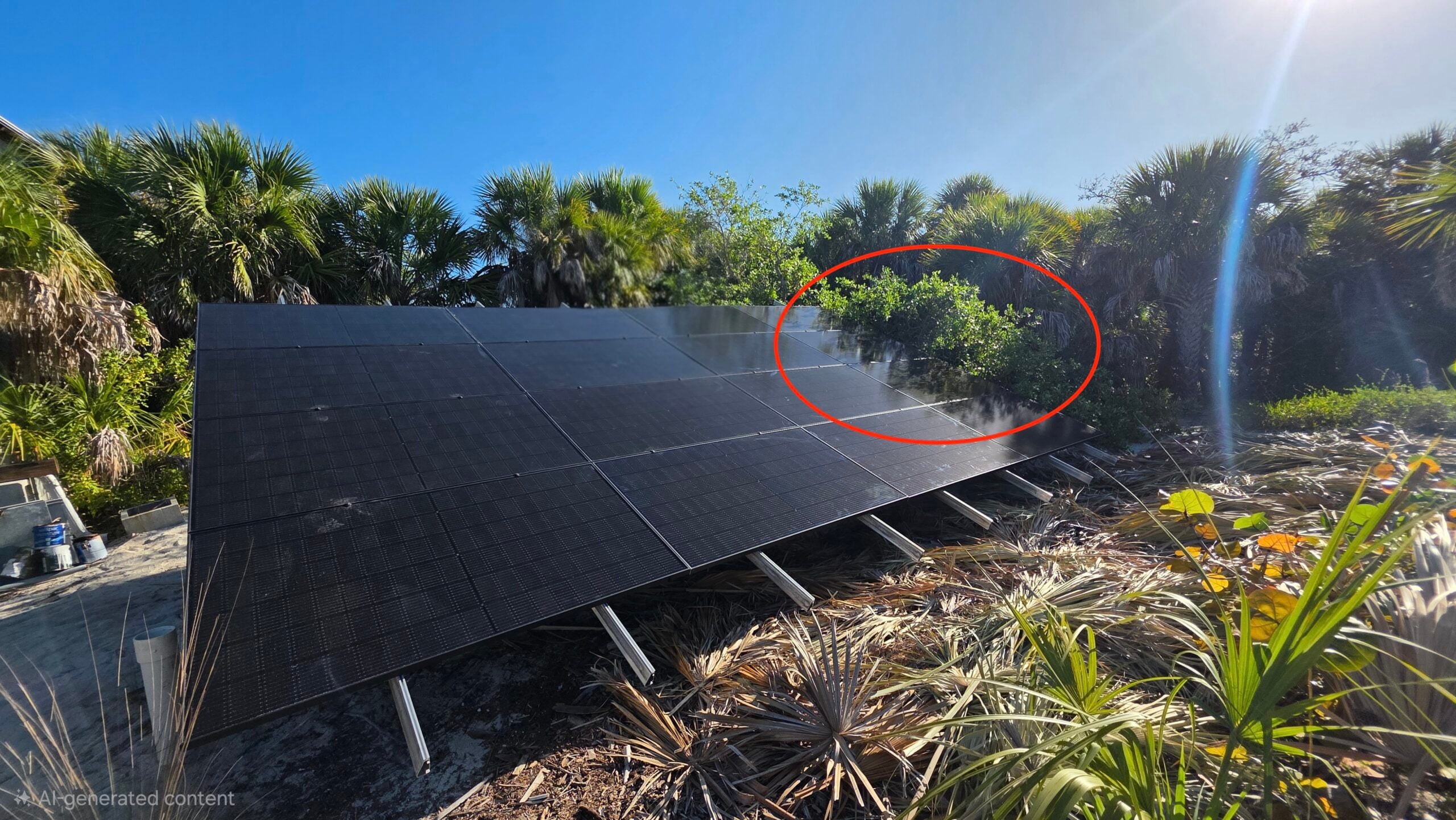
I trimmed a bush on Cayo Costa last week and added roughly 800 watts to a solar array. Not a theoretical 800 watts. Real watts, measured by the inverter, on the same clear day, at the same time, before and after. The bush was a sea grape that had crept up behind the panels and was throwing shade across the upper right corner of the top row. A handful of cells on a few modules. That was enough to knock the system down by about 14% during peak production hours.
This is the kind of thing that sounds small until you see the data.
The Site and the Setup
The array is a ground mount at one of our off-grid installations on Cayo Costa, a barrier island off the Southwest Florida coast. It runs an EG4 string inverter with two MPPT trackers for the array (eight panels each). Ground mount means the panels sit close to the soil, which puts them right in the growing zone of every shrub, palm, and sea grape on the property. On a tropical island where vegetation does whatever it wants year round, that is a maintenance problem that keeps coming back.
I was out there working on a separate issue and noticed the upper right section of the array looking dappled in the late morning sun. A few branches of a sea grape had grown just tall enough to throw shade across the top corner panels. Nothing dramatic. Nothing you would flag in a casual site photo. But solar doesn’t care what something looks like to your eye. It cares about photons hitting cells.
The wet season is the worst time for this kind of creep. Vegetation explodes after summer rains, and what was a tidy site in April can be a shaded mess by September. We try to schedule site visits around that cycle, but off-grid work on a barrier island rarely runs on a schedule. You check it when you can get to it.
I got out the saw and cleared the bush. Then I watched the monitoring portal.
What the Data Showed
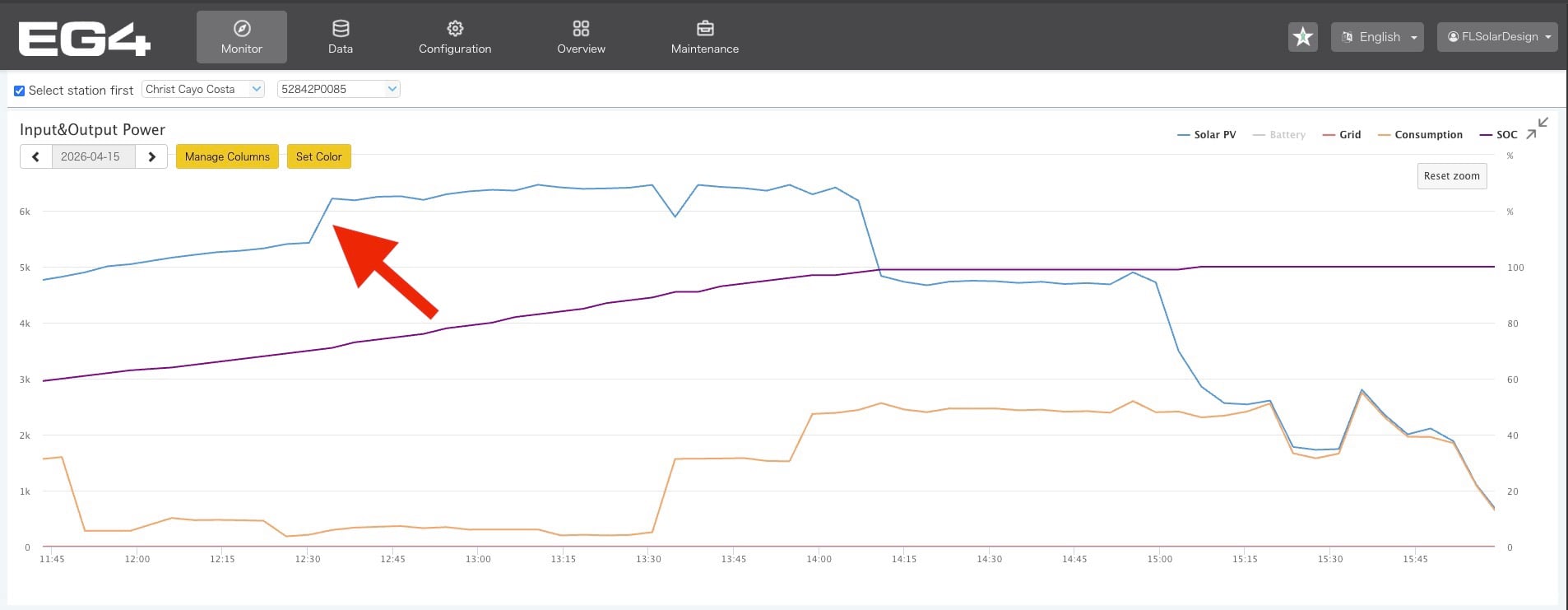
Before trimming, the array was pulling in about 5.4 kilowatts as it climbed toward solar noon. A few minutes after the cuts, the curve jumped to around 6.2 kilowatts and held there through the peak of the day. Same sun. Same panels. Same inverter. The only variable that changed was the shade.
Eight hundred watts of additional production. On an array that size (7.36 kW), that is not a rounding error. Over a full sunny day, it adds up to several extra kilowatt hours. On an off-grid site where every watt-hour either goes into the batteries or gets wasted by a saturated charge controller, that production matters. On a grid-tied home with net metering, it would be money flowing back onto the bill instead of staying at the utility.
The 14% number is important context. That is about what I would expect from a modest partial shading scenario on a string inverter. Some days it will be more, some days less, depending on the sun angle and how much of the string is affected. But the pattern is consistent. Partial shade punishes string inverters out of proportion to the physical area that is actually shaded.
Why String Inverters Take Partial Shading So Hard
Here is the piece most homeowners do not understand about string inverters. The panels in a string are wired in series, like flashlight batteries end to end. Current flows through every module in sequence. When one cell in one module is shaded, the current through that entire string drops to whatever the weakest cell can push.
The inverter runs a maximum power point tracker (MPPT) that finds the best voltage and current combination for the whole string. When part of the string is shaded, the MPPT has to choose a compromise operating point. The shaded section drags the unshaded modules down with it. Bypass diodes inside each panel help some, by letting current route around the worst shaded sub strings, but they do not eliminate the penalty. They just keep a single shaded cell from cooking itself through reverse bias.
This is why a few shaded cells at the corner of one module can cost you power on seven other modules down the line. A string is only as strong as the weakest link in the chain. If you want to see this in action, shade one corner of a panel on a clear day and watch the whole string’s output crater in real time. It is sobering.
Module Level Electronics Help, But Aren’t Magic
The solar industry has known about this problem for decades. The answer for shaded installations has been module level power electronics. That means microinverters like Enphase, or DC optimizers, that let each panel operate at its own maximum power point independent of the others.
We install a lot of Enphase microinverter systems at FSDG for exactly this reason. On a Southwest Florida rooftop with palm shadows sweeping across throughout the day, you want each module working independently. A shaded panel produces less, but it does not drag its neighbors down with it. That is a real advantage in partial shading conditions, and it is one of the biggest reasons we recommend microinverters as the default on most residential grid tied systems in Lee, Charlotte, and Collier Counties.
Module level electronics are not a license to ignore shade, though. A shaded panel still produces less power than an unshaded one. The penalty is smaller with microinverters or optimizers, but it is still a penalty. The best solution is always the simplest one. Don’t let things grow over your panels.
Want to see how microinverters sidestep this problem? This two-minute animated explainer walks through the whole system, from the panels to your outlets.
Why This Matters More on Ground Mounts
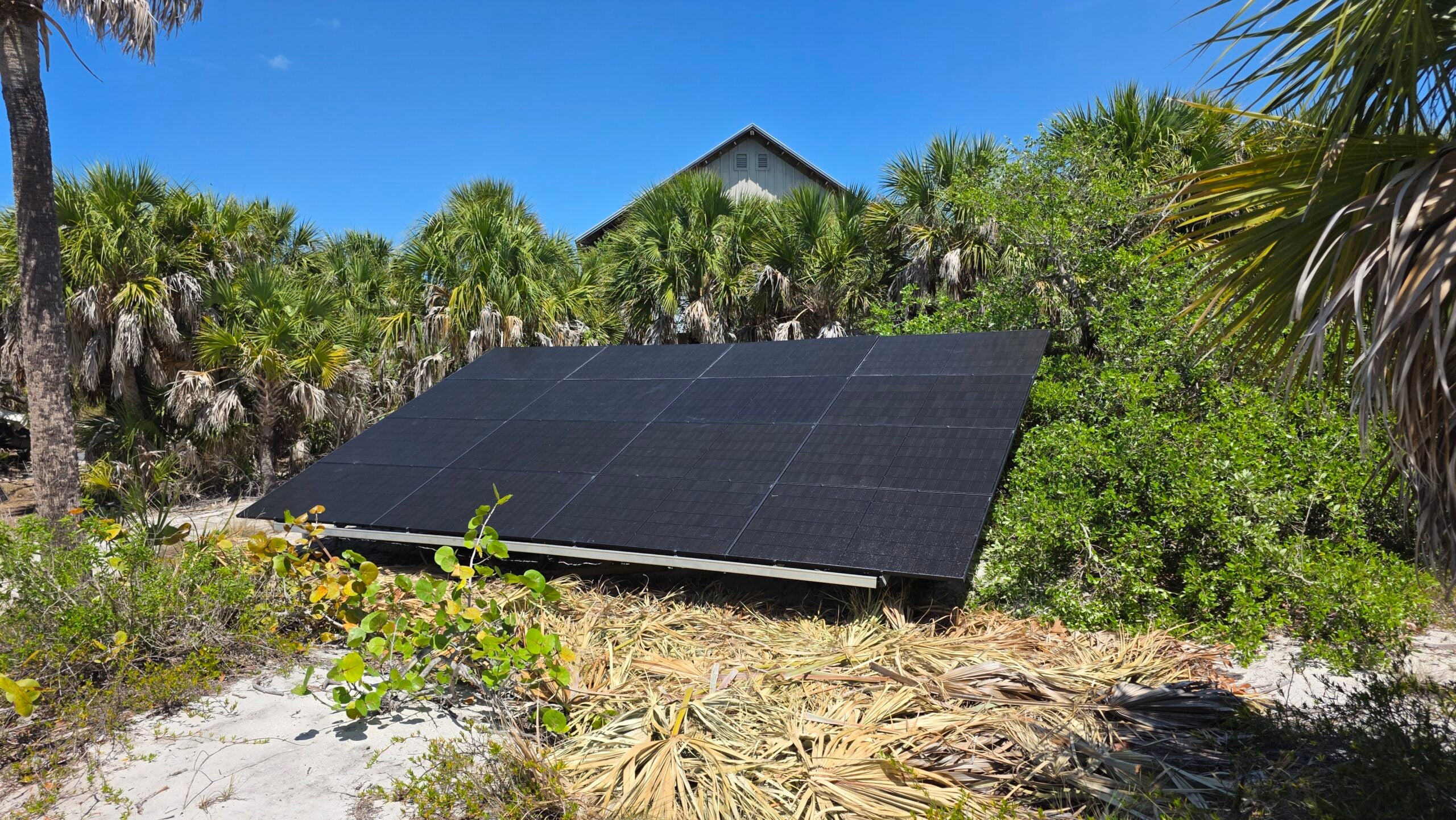
I have written before about why we don’t generally recommend ground mount solar in Southwest Florida. This Cayo Costa site is an exception. It is off-grid. The roof is not suitable for the full array. A ground mount was the right call. But it comes with what I call the ground mount tax, and vegetation management is a big chunk of it.
On a rooftop, you can usually trim back the canopy once and then coast for a few years. On a ground mount surrounded by tropical vegetation, you will be back out there with the saw. Sea grape, saw palmetto, cocoplum, Brazilian pepper (get rid of that one anyway, it is invasive), whatever grows near your array is going to grow up and over it if you let it. Plan for the maintenance or accept the lost production.
Ground mount panels also sit closer to the soil, which means anything that would be below the roofline on a rooftop installation is sitting right in the shadow path. A three foot shrub in the wrong spot can wipe out an entire row of modules during the hours that matter most.
What Homeowners Should Take Away
A few things worth remembering from this field experience.
Clean panels matter, but clear sight lines to the sun matter more. If you are only going to worry about one thing, worry about shade. Dust and pollen come off with a good rain. Trees don’t.
If you have a string inverter and you can see anything shading your array during peak sun hours, that shade is costing you real money. Not a hypothetical few percent. Ten to fifteen percent is easily on the table, and in bad cases, it can be worse.
If you are building a new system on a tree-heavy lot and you know partial shade is going to be an issue, microinverters or DC optimizers are worth the money. The difference shows up on day one and every day after. You can browse our technical blog archive for more examples of how inverter choice plays out in real Florida conditions.
And if your panels are producing less than they used to, look at the vegetation before you assume the system is broken. Trim first. Call the installer second.
The Bottom Line
A small bush at the corner of a ground mounted array cost this system 800 watts of production. Trimming it back gave every one of those watts back. Partial shading on a string inverter punches above its weight because of how the electronics work, and the fix is almost always cheaper than a service call. If you have shade on your array, address it. If you are planning a new installation on a partly shaded lot, we can help you think through the right inverter topology for your site before you commit.