Ten years ago, a battery was a niche add-on. Five years ago, it was an option worth discussing. Today, most solar proposals we present to Southwest Florida homeowners include storage as a core component of the system. That shift didn’t happen by accident.
There are specific reasons why batteries became standard in this market, and they’re different from the reasons driving storage adoption in other parts of the country. If you’re trying to understand why the industry changed, or trying to figure out whether storage belongs in your own project, this is the breakdown.
The Grid Reliability Problem Is Real Here
This is the biggest driver, and it’s local.
Southwest Florida is not a mild weather market. Hurricane Irma in 2017, Irma’s aftermath across Lee and Collier Counties, and then Ian in 2022 reminded everyone in this region that FPL can go down for days. In some areas after Ian, it was weeks. That’s not a hypothetical risk. It’s the documented recent history of the grid we all depend on.
Here’s the thing that a lot of homeowners didn’t know before they went through one of those storms with solar on their roof: a grid-tied solar system without a battery goes completely dark when FPL goes down. The inverter shuts off automatically to protect utility workers on the lines. Your panels are sitting in full sun and producing nothing you can use. That’s how the system is designed to work, and it’s the right call from a safety standpoint. But it’s a rude discovery in the middle of a major outage.
After Ian, we fielded calls from existing system owners who couldn’t understand why their solar wasn’t keeping their lights on. The answer was the same every time. You have solar, not storage. They’re not the same thing. Our clients are aware of this because we focus on education and detailed consultations pre-sale. Many system owners are taken by surprise.
That experience, repeated across thousands of Southwest Florida homeowners, changed how people think about what a solar system is supposed to do. Battery storage stopped being a nice-to-have and started being the point.
Battery Prices Dropped Enough to Change the Conversation
Resilience would have driven storage adoption eventually, regardless of cost. But the financial side of the equation changed substantially over the past several years, and that accelerated everything.
A single-battery backup system that would have added $30,000 to $40,000 to a project in 2018 now comes in around $20,000 to $30,000 for a quality whole-home backup installation. Smaller batteries for partial or short-term backup can be had for under $15,000. That price compression came from scaling in battery manufacturing, improved chemistry, and a more competitive market for residential storage products. The technology got better and cheaper at the same time, which doesn’t always happen.
That price point put storage within reach for a much wider range of homeowners. The conversation shifted from “someday, maybe” to “let’s look at the numbers now.”
Air Conditioning Is Not A Nice-To-Have
Air conditioning is the #1 thing requested to be backed up in a home. Well, it might as well be everything, because during some times of the year, cooling your home could use upwards of 75% of your electricity. While battery cost was a big problem, and still isn’t cheap by most definitions, the real problem was motor startup.
Starting up a large air conditioner while the grid is down requires a large inverter. And a large inverter generally requires a sizable battery. It was previously hard to install an affordable battery with an inverter large enough to start the air conditioner. That has changed in two ways.
First, surge capabilities for most inverter brands have improved dramatically. And second, variable speed air conditioning units are now becoming more common, virtually eliminating the startup problem.
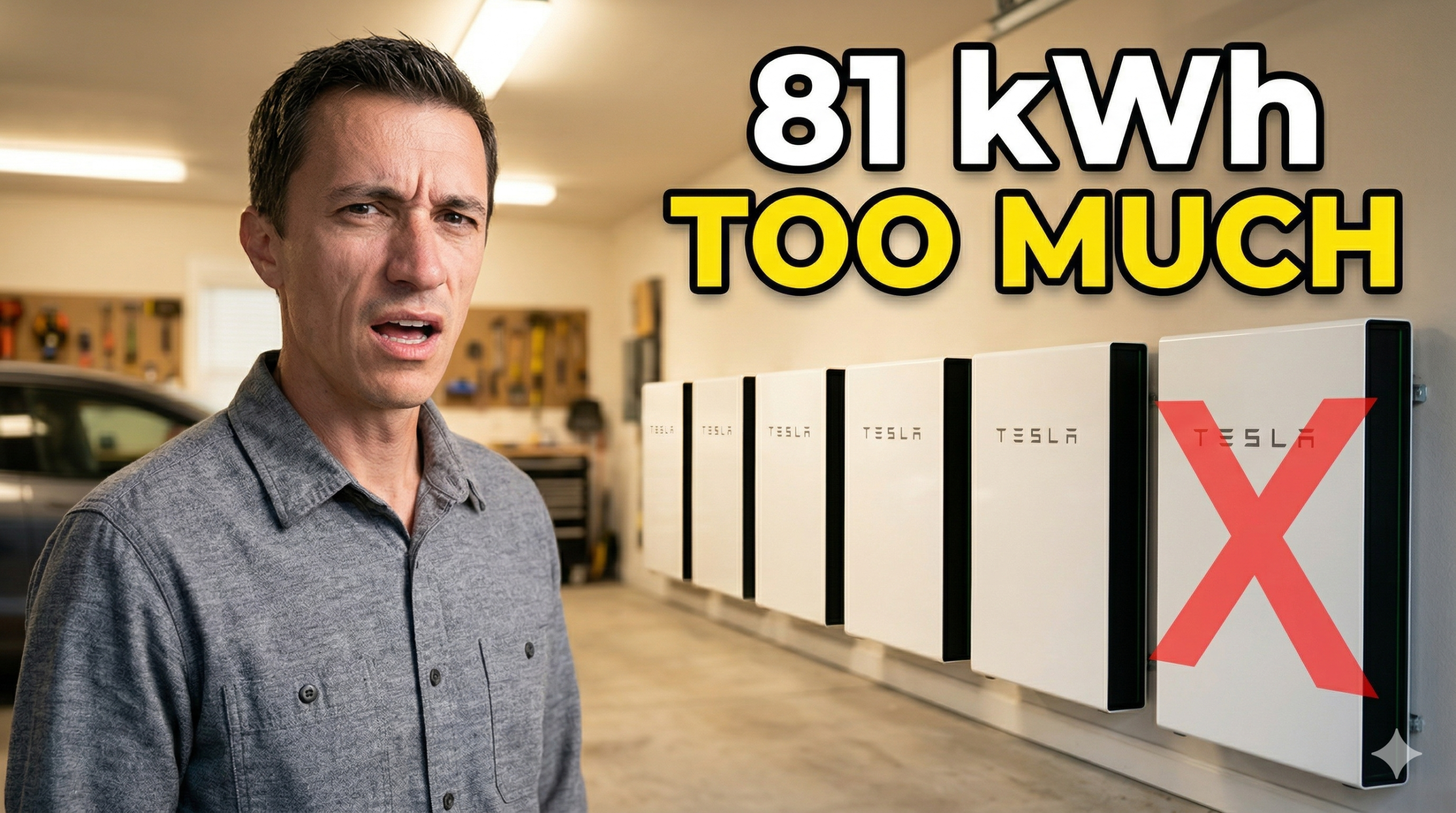
A single Tesla Powerwall 3 can start up a 5-ton central air conditioning unit. Admittedly, the battery capacity of a single Powerwall is unlikely to get you through a night of typical air conditioning usage, but battery expansion packs can address that at a reasonable add-on cost.
What FPL’s Net Metering Structure Actually Looks Like
Let’s clear something up, because there’s a lot of misinformation floating around about Florida net metering.
FPL still offers true 1:1 net metering. Power you export to the grid is credited at the same rate you pay for power you consume. That’s genuinely good compared to what solar customers face in other states, where utilities have moved to avoided-cost compensation that pays a fraction of the retail rate for exported power. Florida homeowners are in a better position on net metering than most people realize.
What FPL does have is a $30 monthly minimum bill. Even if your solar system produces more than you consume in a given month, you’ll still owe FPL $30. That’s not a deal-breaker, and it doesn’t change the fundamental value of a well-sized solar system. But it does mean you can’t zero out your bill entirely on solar alone. A battery doesn’t change that minimum either. It’s just part of the FPL rate structure.
The honest answer is that FPL’s net metering terms are not the reason battery storage has taken off in this market. The reason is storm resilience, full stop. Homeowners in Southwest Florida have lived through what happens when the grid goes down for days, and their solar systems sit idle. That experience, more than any utility policy or financial calculation, is what’s driving the shift.
What the Current Storage Market Looks Like
The residential battery market has matured considerably in a short period of time. There are now several well-engineered products at different price points and capability levels, and the right choice depends on what the homeowner is trying to accomplish.
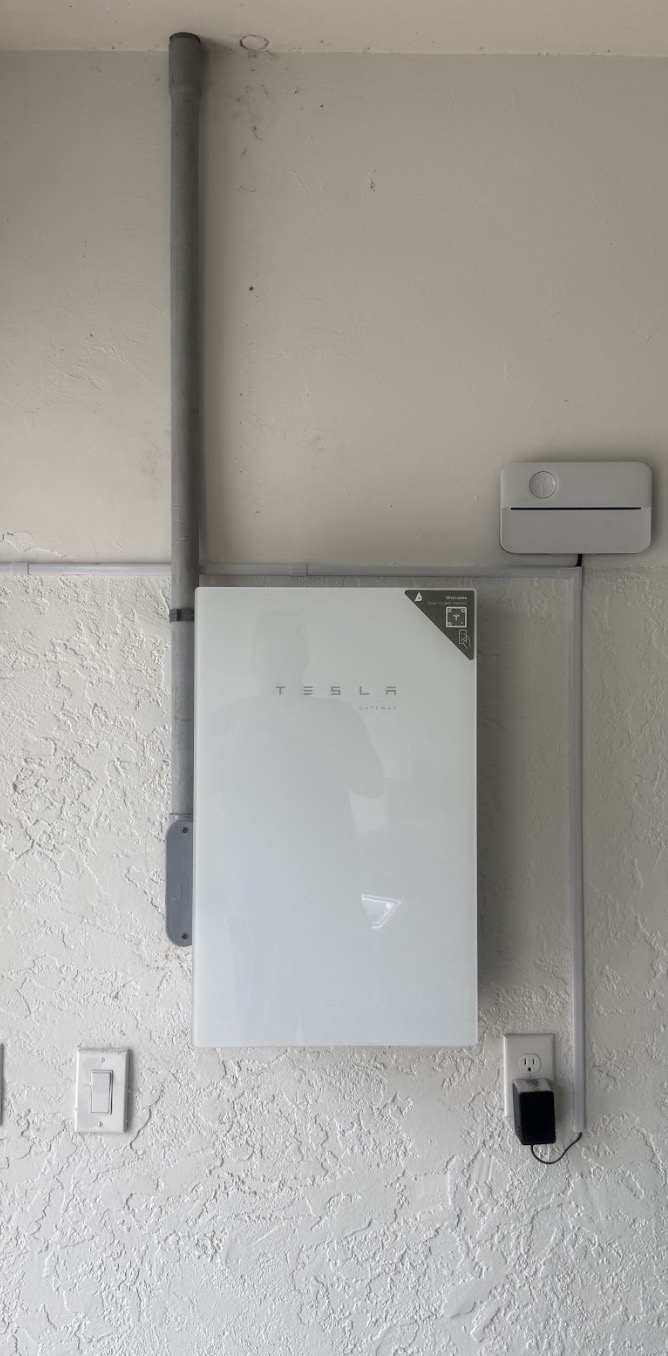
For most homes, systems built around products like the Tesla Powerwall 3 or Enphase battery platforms handle essential loads through the typical FPL outage event. Refrigerator, lighting, phone and device charging, a mini-split if usage is managed carefully. The Powerwall 3 in particular integrates solar and battery into a single inverter platform, which reduces equipment and simplifies installation.
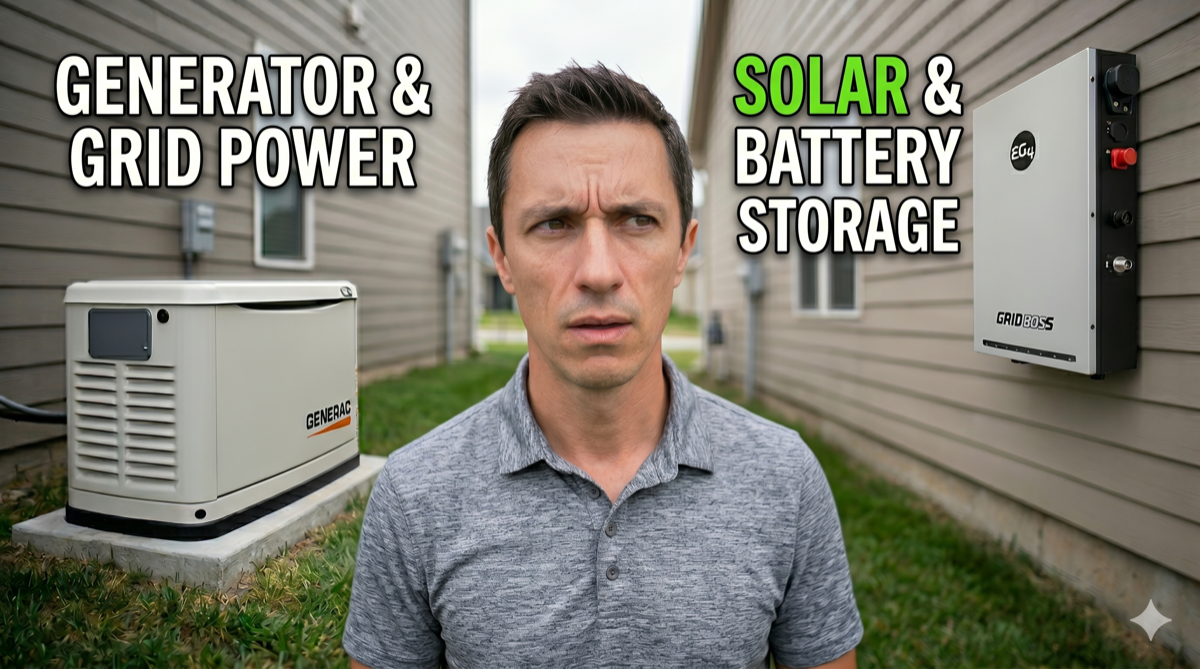
For homeowners who want more capacity, whole-home backup, or the ability to sustain through a multi-day event without generator support, we’ve been deploying EG4 FlexBoss and GridBoss systems, or Tesla Powerwalls with expansion packs. These platforms are built for higher-capacity configurations and support larger battery banks for homeowners who want serious autonomy, not just overnight coverage. They’re particularly well-suited for clients who are done with generators and want a longer-term solution. Enphase’s solution is still very viable, but the premium features come with a premium price.
The right system depends on your loads, your goals, and your budget. There’s no single answer that works for everyone. But the range of good options is wider now than it’s ever been, and the gap in quality between a well-designed system and a poorly configured one is significant. The hardware choice matters. The design and configuration behind it matter more.
We use actual monitoring data from installed systems in this market to calibrate sizing recommendations. Not just manufacturer specs. Real consumption and production data from Southwest Florida homes, in this climate, on FPL’s grid. That context makes a difference when you’re trying to right-size a system for a specific house rather than a generic profile.
When Storage May Not Be the Right Call Right Now
Battery storage makes sense for the majority of Southwest Florida homeowners going solar today. But I’m not going to pretend it’s the right call in every situation.
If your budget is constrained and the choice is between a correctly sized solar-only system and an undersized solar array with a battery, go with properly sized solar first. Production capacity matters more to your long-term financial return than backup capability. You can add storage later. You can undo an undersized array as well, but it is a bit more complicated and costly, especially due to engineering requirements for each new solar permit.
If your outage history is genuinely short and infrequent, the resilience case is weaker, and the financial case needs to be evaluated honestly on its own terms. Some neighborhoods in our market are on newer infrastructure with shorter average outage durations. That doesn’t make storage wrong, but it changes what you’re actually buying.
And if you’re planning to sell the home in the near term, the payback timeline is worth factoring in. Batteries do add value and marketability. Whether you capture enough of that to justify the upfront cost depends on the specific numbers. Some homebuyers are delighted to find a solar with battery backup system, but only if it is suitably sized for what they expect.
Why the Trend Isn’t Reversing
The forces that drove battery storage into the mainstream in Southwest Florida are structural, not temporary.
Storm frequency and intensity in the Gulf Coast region is not trending in the direction that makes grid-tied solar without storage look better. Grid infrastructure in Lee and Collier Counties is improving but remains vulnerable during major events. Battery costs, while not dropping as sharply as they did from 2018 to 2023, are holding at levels that make residential storage financially accessible for a wide range of homeowners. And awareness of the grid-tie shutoff issue, the fact that solar without a battery goes dark during outages, is now widespread in a way it wasn’t before Ian.
There’s also a generational shift happening in how homeowners think about their relationship with the grid. A growing segment of buyers in this market, particularly those who went through Ian with a generator and extension cords, are not interested in repeating that experience. They want a system that runs the house without them managing it. Battery storage, properly configured, does that.
And our retiree clients want peace of mind and minimal to no maintenance and worry, something that can’t be said about generators.
The result is a market where the question has changed. It used to be: “Should I add a battery to my solar?” Now it’s usually: “What size and configuration makes sense for my house?” That’s a different conversation, and it reflects how far the technology and the economics have moved in a short period of time.
The Bottom Line
Battery storage became standard in Southwest Florida because the grid here is vulnerable, battery prices fell to a level that made sense for residential projects, and the technology matured enough to deliver on what homeowners actually need during an outage. Those factors came together in this market in a way that makes storage a practical default rather than a premium upgrade.
That doesn’t mean every homeowner should buy the biggest battery available. Start with your goals: resilience, energy independence, financial return, or some combination. Match the system to those goals with honest numbers. Understand what limitations you are willing to live with during extended grid outages. The options available today, from single-battery essential-load systems to multi-battery whole-home configurations, cover a wide range of situations and budgets.
The industry moved to storage because the situation called for it. In Southwest Florida specifically, that call came in loud and clear.