Part of the NABCEP CE Conference 2026 Series. See the full agenda and series overview here. Read the Day 1 Recap here.
The blizzard cleared overnight and day two opened bright, cold, and clear in Milwaukee. Four technical sessions back to back, covering DC disconnects and code calculations, advanced ground fault troubleshooting tools, the state of PV and energy storage codes and standards, and a deep dive into Midnite Solar’s modular inverter architecture. Long day. Good day.
Here’s what I took away from each one.
DC Disconnects: The Code Details That Actually Matter on a Rooftop
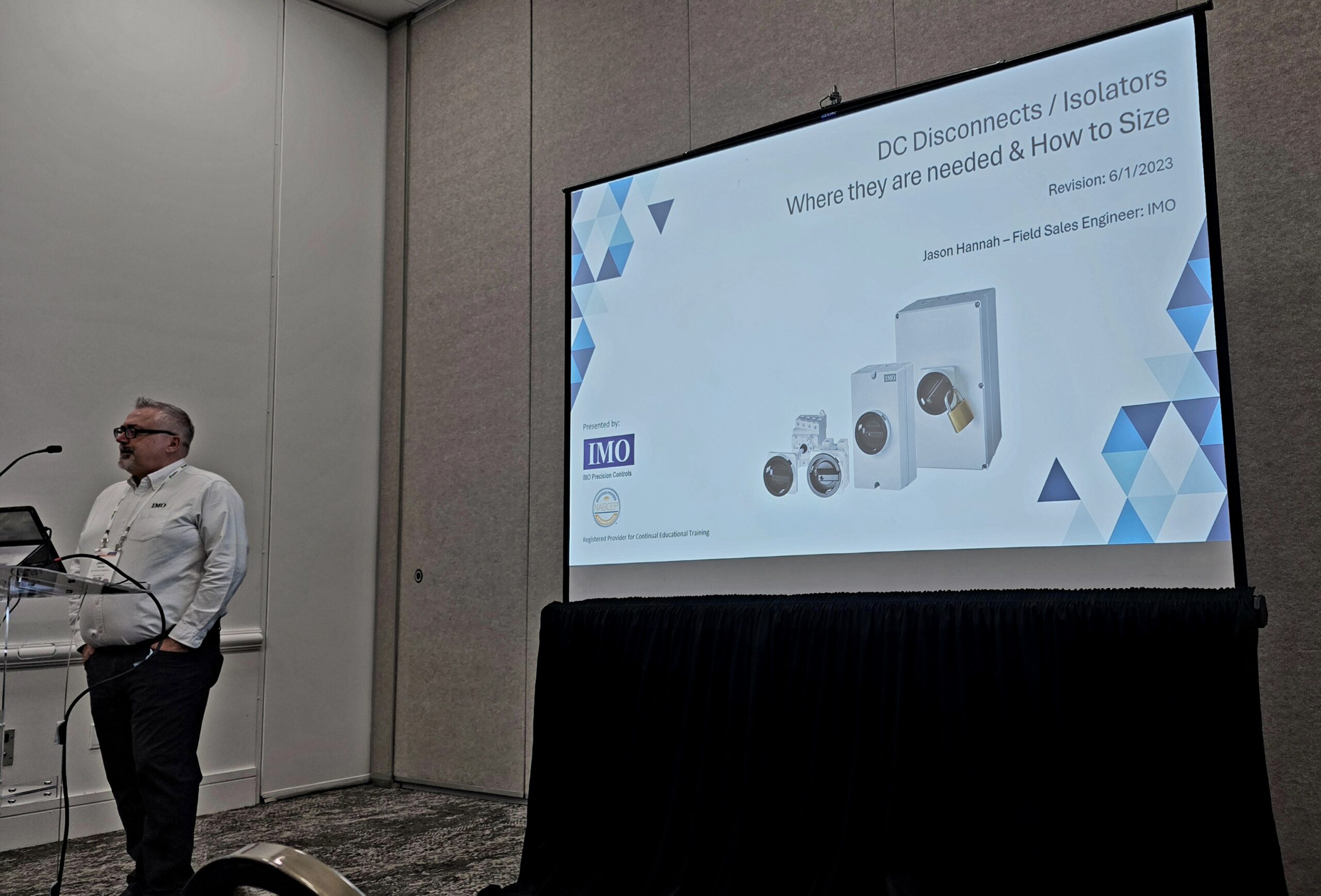
The first session was presented by IMO North America, a disconnect manufacturer based out of Atlanta. The content walked through the NEC code sections that govern DC disconnect selection and placement: Articles 690.7, 690.8, 690.13, 690.15, 690.17, and 706.15 for energy storage systems. There was also a useful note on a 2026 NEC update to 690.4 that allows rounding voltage and current calculations to the nearest whole number, including dropping a 0.5 decimal. Minor change, but it simplifies field calculations and removes some ambiguity.
The arc suppression explanation was the most technically interesting part. DC current doesn’t cycle through zero volts the way AC does, which means opening a DC circuit under load produces an arc that won’t self-extinguish. Old knife-blade style disconnects let the operator control the switching speed, which means a slow pull can sustain a damaging arc indefinitely. IMO’s solution is a spring-loaded rotary mechanism that fires open faster than the operator can modulate, reducing arc time to under three milliseconds. That’s not a marketing claim; it’s an engineering response to a real failure mode.
What actually caught my attention was something more practical: IMO makes a disconnect capable of isolating up to four strings of DC PV in a single compact switch. For residential installations, that matters more than it sounds. When an inverter needs service and the rooftop is difficult to access, having a single accessible disconnect point for multiple strings saves time and reduces the risk of someone on the roof working around live conductors longer than necessary. Serviceability is something I think about on every system I design, and this is a product worth looking at more closely.
There was also a new UL requirement worth knowing: disconnects must now physically prevent being locked in the off position if a terminal is welded. Previously, some disconnects would allow a technician to lock out a circuit that still had an energized pole. That’s a serious field safety issue, and the new requirement addresses it directly.
Ground Fault Troubleshooting: Impressive Tool, Honest Limitations
The second session was presented by a Fluke product manager covering the GFL-1500, a ground fault locator released at RE+ last year. The technology borrows from utility and telecom line fault location: inject a signal into the DC system, then use a receiver and signal-tracing clamp to physically walk the array and trace the fault to its exact location.
The traditional methods most of us use, voltage testing and insulation resistance testing, can identify which circuit has a fault and sometimes estimate which module in a string it’s near. What they can’t do is pinpoint a fault in a large combiner box system with parallel strings without physically unwiring circuits to isolate them. The GFL-1500 changes that workflow significantly, especially for commercial and utility-scale systems where chasing a ground fault through a multi-level combiner box can eat an entire day.
The presenter was honest about the limitations. High-resistance intermittent faults, the ones that only show up in wet conditions or when a tracker moves to a specific position, are still difficult even with this tool. And underground conductor runs require a workaround: check for signal at both ends of the buried run to determine whether the fault is in the underground section or out in the array.
Here’s my honest take: the GFL-1500 runs about $7,000. For a residential solar contractor working on 10 to 20 kilowatt rooftop systems, that’s a hard number to justify. The signal injection and tracing technique is genuinely useful, but the practical application for residential work is limited. Where the session added real value was in the discussion of traditional methods and when they break down. The voltage-to-ground calculation technique for estimating fault location within a string is something any residential installer should have in their toolkit, and the session reinforced when and how to apply it correctly.
The Sausage Gets Made: Codes and Standards from the People Who Write Them
This was the session I’ll be thinking about longest, and not just because of what was covered.
The panel featured three master electricians and code professionals, including a current member of NEC Code-Making Panel 13 and the Director of Codes and Standards for the Solar Energy Industries Association. These are not people who read the code and interpret it. These are people who write it, debate it, and fight over the language in committee rooms. Sitting in that session was a rare chance to pull back the curtain and watch the sausage being made by the heavyweights who actually make it.
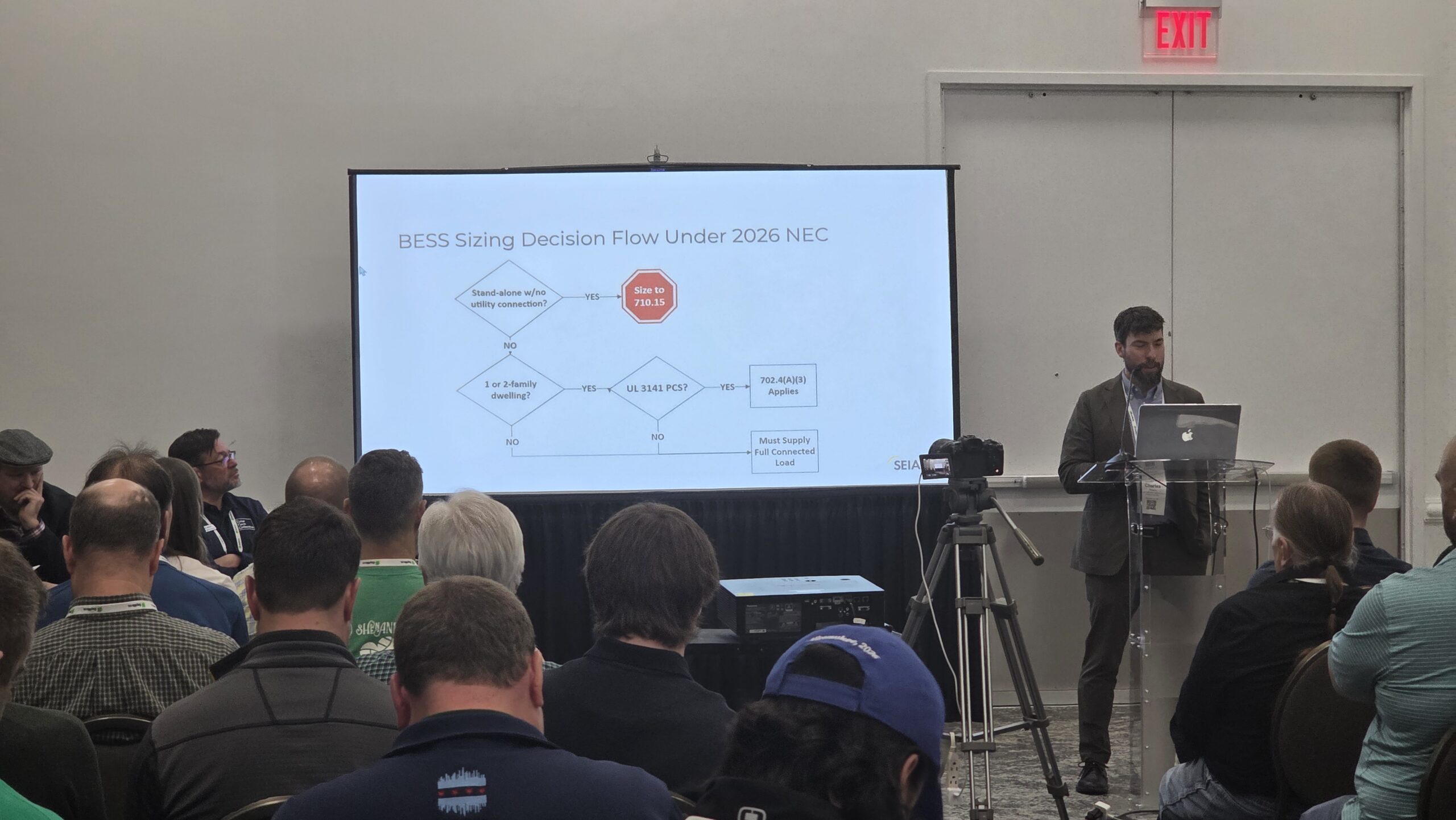
The session covered updates from the 2023 to 2026 NEC cycle. A central theme was the relationship between Article 702, which governs optional standby systems, and Article 710, and how the 2026 code introduces a better sizing pathway for residential battery storage. The 702 sizing requirements were written for fossil fuel generators, not inverter-based storage systems. Applying generator logic to a modern battery inverter creates oversizing requirements that don’t reflect how the equipment actually behaves. The 2026 NEC addresses that with an alternative sizing method, which is a genuine improvement for residential system design.
But the topic I found most valuable was Power Control Systems, or PCS. This is where my interest goes beyond fighting with inspectors and plan reviewers, which this knowledge will also help with. PCS is fundamentally about designing interconnected solar and storage systems that operate safely and maximize functionality for the homeowner. Understanding what the code allows, and why it allows it, is a design tool. It tells me what’s possible, not just what’s compliant.
Watching the panelists debate language interpretation in real time, sometimes disagreeing with each other, was instructive in a way that reading the code never is. The 2026 NEC has barely been adopted anywhere yet, with Florida not currently on the adoption map. But what gets written into the code today shapes what manufacturers build tomorrow, which shapes what I’m installing in Southwest Florida within a few years. Staying ahead of that curve is exactly why I’m here.
Midnite Solar: Modular vs. All-in-One, and a BMS Problem Worth Knowing
The final session of the day was a deep dive into Midnite Solar’s product line and system design approach. Midnite builds modular inverter systems: separate inverters, charge controllers, monitoring devices, and communication components that work together as a configurable platform.
I came into this session specifically to challenge my own conclusion that the market is moving decisively toward all-in-one inverters. Midnite made a fair case for the modular approach. Lower idle power draw, better surge capacity, true component-level repairability without replacing an entire unit, and the ability to expand one piece at a time rather than buying capability you don’t need yet. Those are real advantages, particularly for off-grid applications and for installers who want deep control over system configuration.
But let’s face it – even Midnite Solar tried the All-In-One approach, and eventually spun off the company Sol-Max (formerly Midnite Power) to pursue the AIO approach.
Ultimately, I came out of the session more convinced than ever that all-in-one architecture is the right choice for the residential grid-tied market in Southwest Florida. Here’s my problem with modular systems in that context: it’s not that I don’t understand them. I do. The problem is the next person. When a homeowner needs service two or three years after installation, whoever shows up has to understand how every component is connected, what every setting means, and how the communication bus is configured. Midnite’s manuals are thick. The wiring diagrams are complex. The configuration options are extensive. All of that is a feature for a knowledgeable integrator and a liability for anyone else who ever touches the system. Serviceability matters, and simple wins.
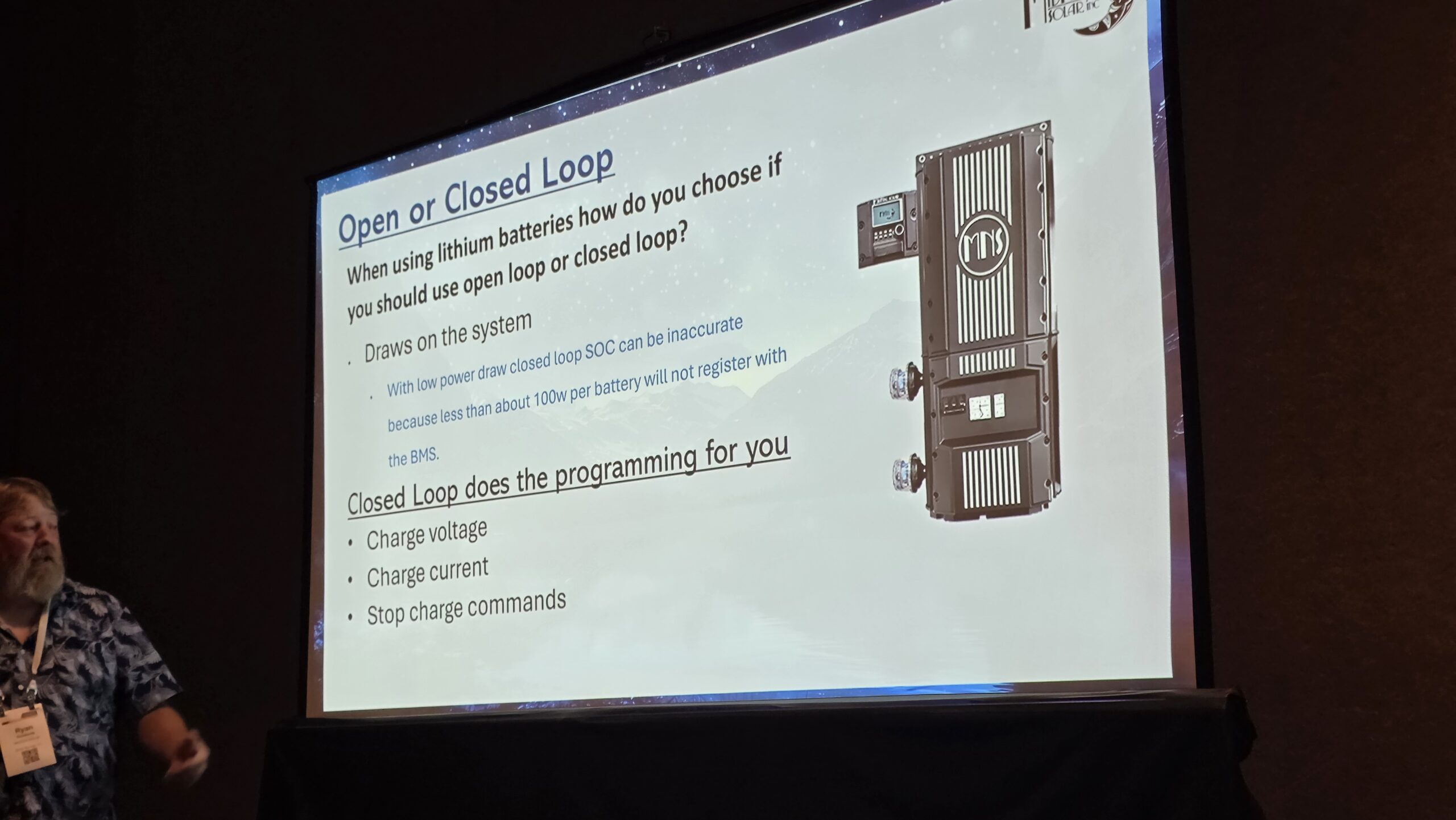
That said, the session gave me one genuinely valuable technical insight that applies regardless of what brand you’re using. Lithium battery BMS systems have a blind spot for very low power draws. The presenter demonstrated this clearly: most lithium BMS units don’t register current below roughly 0.6 amps per battery. In a small off-grid system running a modest continuous load, say a couple hundred watts, the battery can be depleting for hours without the BMS registering any discharge. The state of charge reading stays artificially high, the charger doesn’t respond because it thinks the battery is fine, and eventually the battery voltage drops to a critical level while the display still shows 85 percent charge.
That’s a real failure mode. The presenter described a customer call where exactly this scenario played out. The fix for off-grid applications is to use open loop control with a current sensor that can measure down to hundredths of an amp rather than relying on closed loop BMS communication. For grid-tied systems with heavier loads, BMS drift is less of a concern because the current draw is usually well above the BMS measurement threshold. But for small off-grid systems or any system with significant standby loads, this is worth understanding and accounting for at design time.
The Bottom Line
Day two was dense. Four sessions covering code calculations, fault location tools, NEC committee-level policy debates, and inverter architecture. The codes and standards panel was the most intellectually valuable session of the conference so far. The DC disconnect multi-string capability and the lithium BMS low-draw blind spot are the two technical details I’ll be carrying back to my design work in Fort Myers.
Tomorrow covers off-grid system design in the era of cheap panels and lithium batteries, the Sol-Ark 18K NEC line diagram review, NFPA 855 and advanced safety standards, and the session I’ve been looking forward to all week: AI, drones, and photogrammetry. Full recap tomorrow evening.
Read the full series: